


A landing in Leh
In 1948, when Pakistani raiders infiltrated Ladakh, the Dakota rose to the occasion
Share

 "Veenu Sandhu")
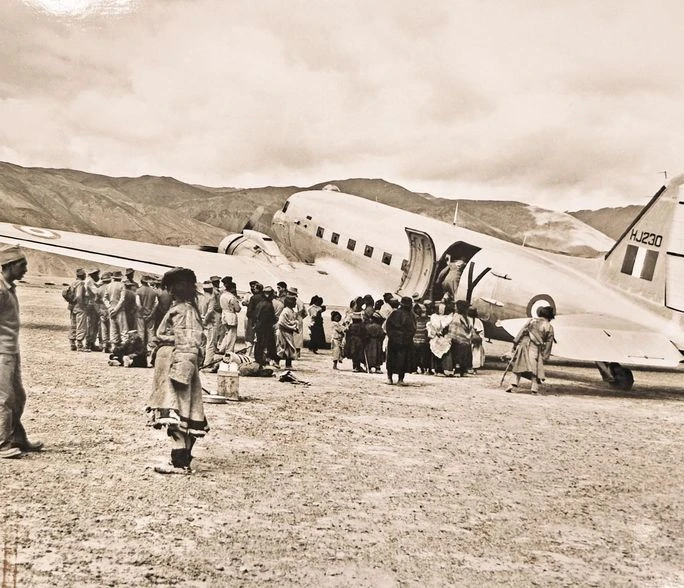 "The Indian Air Force's Dakota DC-3 aircraft successfully lands in Leh on a 2.1-kilometre-long makeshift runway, built in under a month (PHOTO: Ministry of Defence)")
The Indian Air Force’s Dakota DC-3 aircraft successfully lands in Leh on a 2.1-kilometre-long makeshift runway, built in under a month (PHOTO: Ministry of Defence)
In the second week of March 1948, Sonam Norbu, a British-trained civil engineer, got down to building an airstrip in the cold, barren desert of Leh, on a war footing. The 38-year-old Ladakhi knew he had little time.
Pakistan had launched an offensive, Operation Sledge, aiming to capture key towns of Ladakh, including Leh. This was months after Hari Singh, the maharaja of Jammu and Kashmir, had signed the Instrument of Accession, on October 26, 1947, agreeing to integrate his state into the Dominion of India. Tribal raiders, supported by the Pakistani army, had marched well into the Skardu region of Gilgit-Baltistan (now in Pakistan-occupied Kashmir).
Norbu was part of a column of 40 men who had arrived in Leh after crossing the treacherous Zoji La. They had walked for nine days, braving snow blizzards on the 11,516-feet-high mountain pass. Leh, until then, had only 33 troops defending it. Major Prithi Chand, who had led the men, all volunteers, quickly realised they would be outnumbered, and urgently needed reinforcements.
Located over 400 kilometres each from Srinagar on one side and Manali on the other, Leh was practically cut off from the world, especially in winter. It had no motorable road, and was accessible only via passes that cut through the world’s highest mountain range.
There was only one quick way in: the aerial route. But never had an aircraft landed in Leh. The land of the lamas had not even seen a motorised vehicle.

 "Sonam Wangchuk, Sonam, Wangchuk")
Work on the airstrip began on March 12, 1948, and by April 6, a 2.1-kilometre-long makeshift runway was ready next to the Indus River.
By May 20, the infiltrators started closing in. Chand sent a desperate message to the Srinagar headquarters. Major General K S Thimayya, commanding the 19th Infantry Division in Jammu and Kashmir, informed Air Commodore Mehar Singh of the dire situation. Singh, air officer commanding No 1 Operational Group of the Indian Air Force (IAF), had already shown his mettle in Srinagar and Poonch, but Leh was a different ball game altogether.
The IAF’s Dakota transport aircraft, DC-3, had never flown over peaks that rose over 18,000 ft, or in such unpredictable Himalayan weather conditions. It was designed for low-altitude flying (up to 10,000 feet), so its cabins were not pressurised.
Given the challenge, Singh, an IAF legend, chose to fly the aircraft himself. On May 24, 1948, with Thimayya on board, he successfully landed the first Dakota on Leh’s sandy airstrip. Subsequent landings were briefly delayed because of unfavourable weather, but on June 1, six Dakotas — carrying troops, ammunition, equipment, communication devices and ration — touched down in Leh. Over the next few months, the Dakota made about 700 such sorties, also helping evacuate casualties, and ensuring Leh stayed with India.
Written By
Veenu Sandhu
Veenu Sandhu is the Resident Editor at Business Standard. Based in New Delhi, she has been a journalist since 1996 and has worked in some of India's leading newsrooms across print, digital and television media, including NDTV 24x7, Hindustan Times and The Indian Express. At Business Standard, she writes, commissions, edits, and gives direction to special, in-depth articles for the newspaper and the digital platform across beats and sectors. She also hosts video shows for Business Standard. Before this, she edited BS Weekend. She is a 2017-18 batch Chevening South Asia Journalism fellow.

 "Veenu Sandhu")


First Published: Nov 07 2025 | 4:44 PM IST
In this article :