


A missile to deter enemy air defences
Pralay, a surface-to-surface quasi-ballistic missile with a range of 150 to 500 km
Share

 "Martand Mishra")
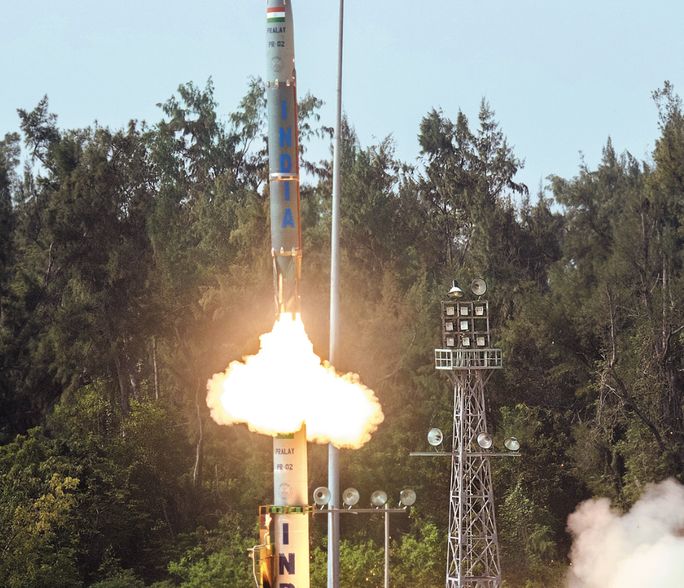 "Pralay follows depressed trajectory to reduce detection time (Photo: PIB)")
Pralay follows depressed trajectory to reduce detection time (Photo: PIB)
The Defence Research and Development Organisation (DRDO) successfully fired two Pralay quasi-ballistic missiles in quick succession from the same launcher off the Odisha coast as part of user evaluation trials for the armed forces in December 2025.
Pralay, named after the Sanskrit word pralaya (meaning “apocalypse”), is a short-range, surface-to-surface missile developed by the DRDO. It has a range of 150 to 500 kilometres (km), and is equipped with an advanced navigation and guidance system to target high-value enemy targets across the border with accuracy. It can carry a payload of 500 to 1,000 kilograms and is powered by a solid-propellant rocket motor.
Unlike other ballistic missiles with suborbital trajectories, Pralay follows a “depressed trajectory”, reducing detection time and making it harder for enemy radars and missile defences to track and intercept it.
It can reach hypersonic speed up to Mach 6 — six times the speed of sound — and execute evasive manoeuvres. It has an inertial navigation system (independent sensors to calculate position, velocity, and orientation), GPS, and Navigation with Indian Constellation, using satellite signals to enhance accuracy and providing guidance in all-weather conditions. It is expected to strike within 10 metres of its intended target.
“Pralay addresses a critical operational gap in India’s missile arsenal by bridging the space between short-range rocket systems like Pinaka and Smerch, the BrahMos cruise missile, and the strategic, nuclear-capable Agni series,” said Major General Rajan Kochhar (retired).
Kochhar said that effective force planning requires matching weapons to specific ranges and missions, noting that expending high-end strategic missiles on limited targets is neither economical nor operationally sound. “In warfare, you cannot fritter away a higher-end missile on a shorter-range target. You need a layered approach, where each system is optimised for a specific range and mission.”
He added that a depressed and non-parabolic trajectory of the missile complicates enemy radar tracking and interception and “compresses the enemy’s decision-making cycle”, as its high speed enables striking of targets within a narrow 90 to 180-second window.
According to Kochhar, Pralay was ideally suited for counterforce strikes against enemy missile launch sites, airbases, radar installations, logistics hubs, ammunition depots, and dumps, since such high-value military targets typically fall within the 150–200 km engagement range. He said that it also offered a precision strike option to suppress enemy air defences, such as Pakistan’s HQ-9 or HQ-7 radar systems.
The missile’s road-mobile design significantly enhances survivability after launch, Kochhar said. “Mobility is critical. Once you fire, your location is detected, so shoot-and-scoot capability becomes essential.” Pralay’s terrain-agnostic nature allows effective deployment across mountains and plains, he added, offering an easy strike option without crossing the nuclear threshold.
Written By
Martand Mishra
Martand Mishra has started his reporting career with defence coverage. He is a graduate of the Indian Institute of Mass Communication. He enjoys reading books on defence, history and biographies.

 "Martand Mishra")


First Published: Feb 10 2026 | 1:00 AM IST
In this article :