


A return to spheres of influence in Venezuela
With Venezuelan President Nicolas Maduro's capture, the United States reasserts its pre-eminence in Latin America
Share

 "Mohammad Asif Khan")
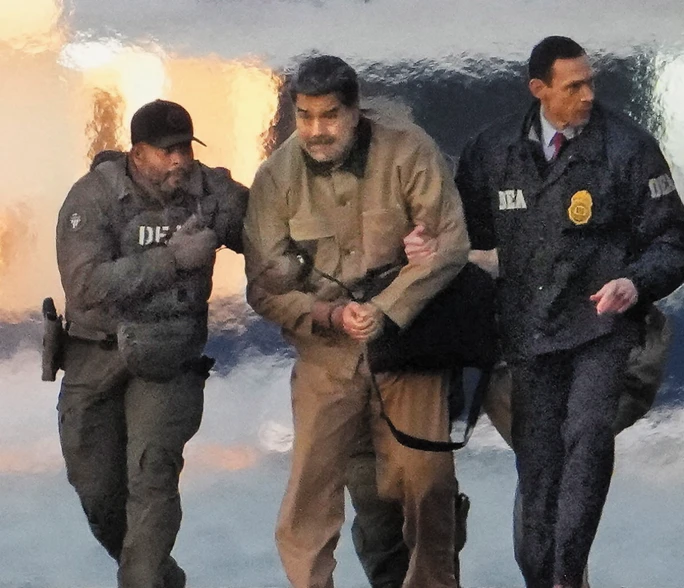 "Captured Venezuelan President Nicolas Maduro is escorted for a courthouse appearance to face multiple charges,including narco-terrorism, in New York City on January 5, 2026 (Photo: Reuters)")
Captured Venezuelan President Nicolas Maduro is escorted for a courthouse appearance to face multiple charges,including narco-terrorism, in New York City on January 5, 2026 (Photo: Reuters)
“I took the Canal Zone and let Congress debate, and while the debate goes on, the canal does also.” When President Theodore Roosevelt made that remark, he was explaining how the United States (US) secured control over the Panama Canal by acting first and legitimising its action later. For much of the 20th century, treating nearby countries as one's own backyard was not unusual among great powers.
In the Western hemisphere, it shaped how the US dealt with the rise of socialism in Latin American countries through coups, military interventions, and assassinations.
But as the Iron Curtain fell in Europe, the rules of multilateralism and sovereignty defined the Western way of shaping the rules-based global world order. That belief held for a generation, until Donald Trump came back to power.
On January 3, 2026, the US launched Operation Absolute Resolve, which resulted in the capture of Venezuela’s President Nicolas Maduro and his wife, Cilia Flores, in Caracas. The operation was condemned by local and international bodies as illegal. Like Roosevelt, Trump did not seek a congressional vote. Neither did he obtain authorisation from the United Nations Security Council for his military actions. US intervention in Venezuela has also increased fears that other Latin American countries like Cuba, Mexico, and Colombia will follow next.
“Clearly, the rules-based international order is under major stress, and Trump is a big factor in that. He is threatening traditional allies and defending the use of American force wherever he chooses,” Michael Albertus, professor of political science at the University of Chicago, told the Blueprint.

 "Maria Corina Machado")
“I believe we are witnessing the end of the prior global era and the beginning of a new one that will be characterised more by force and the projection of military power than in recent decades,” he added.
That logic is laid out in Trump's “2026 National Defense Strategy”, which argued that US interests are under threat “throughout the Western Hemisphere”, and traced this danger back to what it describes as a loss of US dominance in its own neighbourhood. Invoking the Monroe Doctrine and Roosevelt corollary, the document contended that the US erred by taking its supremacy for granted even as it began to erode. This erosion not only jeopardised US access to strategic geography but has made the Americas “less stable and secure”, undermining both US interests and those of its regional partners.
Reports indicate that the Trump administration is considering a naval blockade for oil imports to force the collapse of Cuba's communist government. Colombia, too, is under constant threat of US military action.
“In the near term, especially while Republicans control Congress, we are likely to see more unilateral action,” Evan Ellis, research professor of Latin American studies at the US Army War College, told the Blueprint.
“In the broader context of President Trump’s focus on the Western hemisphere and threats that directly affect the US, Venezuela emerged as a priority,” he added.
The operation in Venezuela aligned closely with the priorities laid out by Trump’s National Security Strategy document in 2025, which seeks to reassert US primacy in the Western hemisphere and pledges to keep the region “free of hostile foreign incursion”. It also aims to assert and enforce a “Trump corollary” to the Monroe Doctrine, which Trump rebranded as the “Donroe Doctrine”.
A history of intervention
Venezuela is not an exception — it is a policy pattern. Since its inception, the US has treated Latin America as a strategic zone that needs to be under its influence.
This approach was formalised under the Monroe Doctrine in 1823 by US President James Monroe and his Secretary of State John Quincy Adams: it warned European powers against interference in the Western hemisphere.
While it was framed as a defensive principle, it has shaped decades of direct interventionist military approaches to secure US interests in Latin America, often driven by corporate interests.
In the case of Guatemala, the United Fruit Company, a US-based multinational corporation, was the single largest landowner and employer in Central America and controlled vast tracts of land, railroads, and ports, which allowed it to maintain a near monopoly in exporting tropical fruits.
Even when the democratically elected government of President Jacobo Árbenz attempted minor land reforms and sought to curb the company's influence in the early 1950s, the US government saw it as a “Communist menace”. The US’ Central Intelligence Agency orchestrated a coup d’état in 1954, ending the Árbenz government. The military then installed a dictatorship to govern Guatemala. Out of the coup came decades of repression and civil war.
During the Cuban wars of independence against Spain, the US effectively controlled the island’s affairs through the Platt Amendment, as well as through embargoes and its display of force.
In the 1950s, American business became intertwined with Fulgencio Batista’s military regime, especially in the capital city, Havana, as portrayed in the 1974 film The Godfather Part II. As Fidel Castro rose to power in 1959, there was an effort to overthrow him through the Bay of Pigs invasion. All this culminated in the 1962 Cuban Missile Crisis.
The Americas became the US’ chessboard during the Cold War. The US invaded Panama in 1989 when Manuel Noriega, the country’s de facto ruler and a former US asset, had fallen out of favour.
The US has used the war on drugs as an excuse to attack countries in Latin America. One such example is Colombia, where the US, through Plan Colombia (2000-2015), poured billions of dollars into military aid to Colombian forces against left-wing militias, which resulted in mass civilian casualties and human rights abuses. It has also occupied Haiti, the Dominican Republic, Nicaragua, and Honduras at various points, often to protect US security and commercial interests.
In each case, the Monroe Doctrine was more than its legal expression. What the doctrine truly achieved was to introduce the principle that events in Latin America could not be treated solely as matters for national security concerns but involved the US’ commercial interests.
The oil rush
In Venezuela’s case, commercial interests go along with the security rationale. It has the largest proven oil reserves in the world, but years of sanctions, mismanagement, and isolation have locked US companies out of the fray.
For context, Venezuela has an estimated 300 billion barrels of oil reserves, which is one-fifth of the world’s total oil reserves and 13 per cent more than Saudi Arabia, yet it ranks 21st in global oil production.
“Due to tremendous mismanagement, Venezuela’s energy infrastructure has been allowed to rot,” Smita Purushottam, former Indian ambassador to Venezuela, told the Blueprint. She added that in 2015, Venezuela was producing between two and three million barrels per day.
The US has already seized Venezuelan oil tankers and has authorised the sale of Venezuelan oil in the global market. At the same time, Venezuela’s national assembly under acting President Delcy Rodriguez is advancing legislation to open the oil sector to private and foreign companies.
But the core problem is that Venezuelan oil is extra-heavy crude from the Orinoco Belt reserves, which is too viscous to export or flow. This necessitates significant blending with imported lighter diluting agents like naphtha and requires steam injection for extraction, which is a technically demanding process.
“A huge amount of work is required to restore those oil fields. Given the current oil glut, it may not make sense for US companies to invest heavily to increase production,” Purushottam said.
For this reason, many companies are sceptical about investing in Venezuela. The US multinational oil company Exxon’s chief executive officer Darren Woods called the country “uninvestable”. He was later rebuked for his frankness by Trump, who said he might keep Exxon out of Venezuela.
The most immediate contender to lead the effort is the US multinational company Chevron: it had been operating in the country under special licences, including joint ventures with the Venezuelan state oil company, Petroleos de Venezuela.
Chevron already has infrastructure and personnel on the ground. US oilfield service firms such as SLB (formerly Schlumberger) are also in discussions with the White House about scaling up operations, which could help rehabilitate ageing wells and boost output.
Indian oil companies like Reliance are already in talks with the US for securing a permit to buy Venezuelan oil in order to diversify their energy supplies amid rising pressure to reduce Russian oil purchases. Reliance was already pumping 63,000 barrels per day from Venezuela until early 2025, when it had to halt operations due to tightened sanctions.
The way forward
US interests in Venezuela extend beyond oil. Analysts argue that oil, while significant, was not the initial motivation. While US companies have long been interested in Venezuela’s reserves, energy considerations were secondary to concerns about security and geopolitical influence.
There is interest in its rare earth minerals, which include vast reserves of bauxite, tantalum, niobium, and other metals. These reserves are very critical to defence technology, and the US administration has stressed that it needs these minerals for national security.
However, even if US companies try to mine these rare earth minerals from Venezuela, these minerals are usually sent to China for refining as it holds a near monopoly in processing and refining these minerals.
For many Venezuelans who have lived in a crippled economy under the late Hugo Chavez, Maduro’s removal was a moment of relief. But the situation on the ground has not changed much: Venezuela’s economy has contracted by roughly 80 per cent over the last decade.
Under Rodriguez, Maduro’s regime is still in power. While Maduro remains the de jure president in the eyes of his administration, he is currently in US custody facing drug trafficking charges.
The US had previously lauded the opposition figure and Nobel Peace Prize laureate, Maria Corina Machado. But Trump has cast her aside, citing she lacks popular support.
“Venezuela could eventually move towards change, but the repressive apparatus remains intact; the intelligence services, militias, surveillance systems, and Cuban support structures are still in place,” Ellis said.
For ordinary Venezuelans, the consequences can be dire: economic recovery can be slow, as Venezuela owes tens of billions of dollars to countries like China through oil-backed loans. US control over export revenues could disrupt these arrangements and raise the prospect of prolonged disputes over repayment.
“Restoring a democratic government that pursues a more market-based economic path would benefit the country,” Purushottam said.
“One major benefit for the US would be the return of the millions of Venezuelan refugees, nearly seven to eight million people, who fled due to man-made famines, economic mismanagement, and political repression,” she added.
For the US, the intervention was less about Maduro than about restoring unquestioned control over the Western hemisphere. In that sense, it is not a return to the Monroe Doctrine’s warning to outsiders but to Roosevelt’s corollary.
“The Roosevelt corollary reflected a much stronger United States asserting dominance in the hemisphere through military and political power. President Trump’s approach resembles this interpretation,” Ellis said.
Trump’s doctrine is the revival of the principle that even in the so-called “rules-based order”, force — not rules — defines power. A principle that will shape US rivalry with China over Taiwan or with Russia in Ukraine.
Written By
Mohammad Asif Khan
Mohammad Asif Khan is a Senior Correspondent at Business Standard, where he covers defence, security, and strategic affairs.

 "Mohammad Asif Khan")
First Published: Feb 10 2026 | 5:15 AM IST
In this article :