


 "Veenu Sandhu")
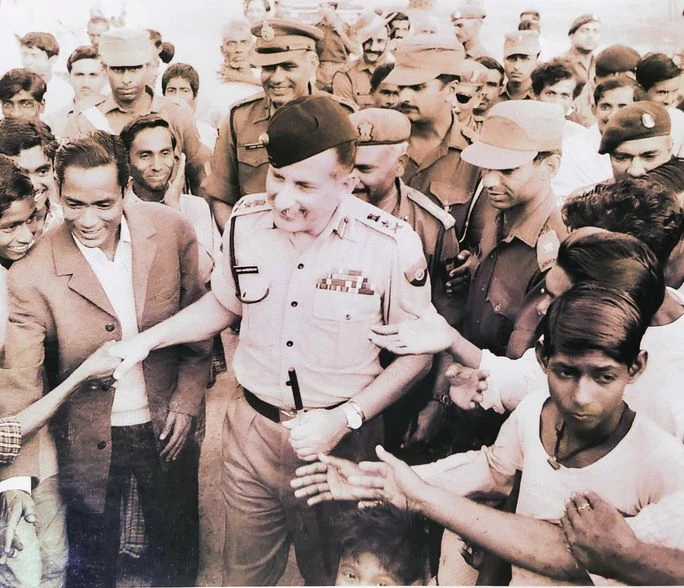 "General Sam Manekshaw (centre) greets people in Dhaka, Bangladesh, on December 29, 1971 (Photo: Ministry of Defence)")
General Sam Manekshaw (centre) greets people in Dhaka, Bangladesh, on December 29, 1971 (Photo: Ministry of Defence)
Thirteen days. That is all it took for a country to be liberated and the map of South Asia to be altered. India officially entered Bangladesh’s bloody battle for independence on December 3, 1971, and on December 16, Pakistani forces laid down their arms in Dhaka.
In terms of its duration, this was one of the shortest full-blown wars in military history. (The shortest one recorded is the Anglo-Zanzibar War of August 27, 1896, which lasted 38 to 40 minutes.) More than 93,000 Pakistani troops surrendered, the most since World War II.
Bangladesh (then East Pakistan) had been burning. To quell the uprising for its independence, Pakistan had launched Operation Searchlight on March 25, 1971, under Major General Khadim Hussain Raja, the general officer commanding of the 14th Division. The brutal crackdown — a genocide — led to the elimination of an estimated three million Bangladeshis, which Raja admitted to in his posthumously published book,
A Stranger in My Own Country: East Pakistan, 1969-1971. He also wrote about the intention of East Pakistan’s commander, General A A K Niazi, to alter the ethnicity of the Bengali people. Niazi, he wrote, had declared, “I will change the race of this b*****d nation.” Rape camps, on the lines of Hitler’s concentration camps, were set up where Bengali women were herded and brutalised by the Pakistani military.
Speaking to this writer before his death in 2016, Lieutenant General J F R Jacob, then chief of staff of the Indian Army’s Eastern Command in Calcutta who is credited with convincing Niazi to surrender, had said: “They raped. They killed. They slaughtered students at Dacca University. Almost 10 million refugees poured into India. We (India) had to intervene.”
The flood of refugees had brought a humanitarian and economic crisis to India’s soil. The country gave them shelter, but it also trained the Bengali resistance fighters (Mukti Bahini) while itself preparing for war. Prime Minister Indira Gandhi wanted early intervention, but Chief of the Army Staff (later Field Marshal) General Sam Manekshaw convinced her otherwise. He wanted it to be a precise, definitive action through a full-scale invasion effected by a coordinated air, sea, and ground attack. It would be a winter offensive, giving Indian forces the time to prepare. Besides, the foggy month would work against Pakistan’s air force.
Manekshaw did another thing: he launched a psychological campaign against Pakistani troops through direct radio broadcast messages, promising them humane and honourable treatment if they surrendered. Together with India’s calibrated military action, the impact of this psychological warfare was huge. When they surrendered, Manekshaw, a soldier’s soldier, defied criticism to keep his word, treating the prisoners of war (PoWs) with the dignity every PoW deserves. After the Simla Agreement, Pakistan recognised Bangladesh’s independence, and India returned all PoWs.
Written By
Veenu Sandhu
Veenu Sandhu is the Resident Editor at Business Standard. Based in New Delhi, she has been a journalist since 1996 and has worked in some of India's leading newsrooms across print, digital and television media, including NDTV 24x7, Hindustan Times and The Indian Express. At Business Standard, she writes, commissions, edits, and gives direction to special, in-depth articles for the newspaper and the digital platform across beats and sectors. She also hosts video shows for Business Standard. Before this, she edited BS Weekend. She is a 2017-18 batch Chevening South Asia Journalism fellow.

 "Veenu Sandhu")


First Published: Dec 10 2025 | 10:30 AM IST
In this article :