


India and Europe are in search of a multipolar future
As the transatlantic order fractures and great-power ties realign, Europe and India confront parallel reckonings
Share

 "Jawed Ashraf")
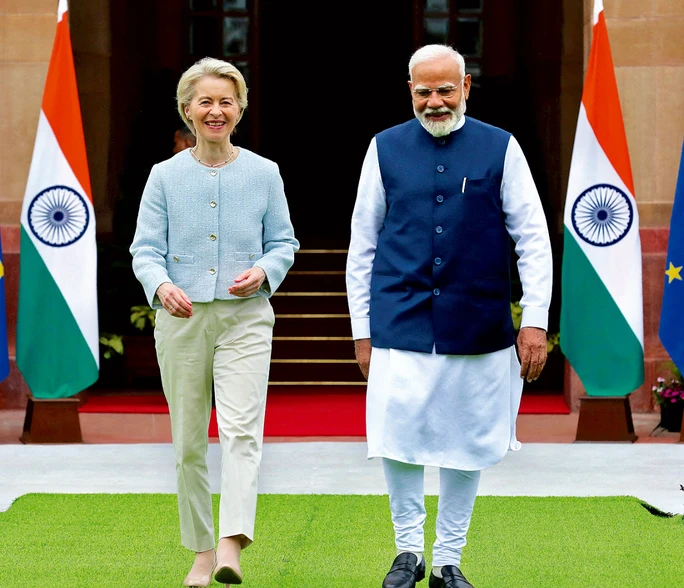 "European Commission President Ursula von der Leyen and Prime Minister Narendra Modi in New Delhi on February 28, 2025 (Photo: Reuters)")
European Commission President Ursula von der Leyen and Prime Minister Narendra Modi in New Delhi on February 28, 2025 (Photo: Reuters)
From the old order to an uncertain future, the world is in transition. The geopolitical upheaval it has unleashed has rocked Europe the most. United States (US) President Donald Trump has untethered the long adrift transatlantic relations from its anchors of security, economics, and values. Europe is forced to resist exclusion from negotiations on ending a war on its own continent that affects it the most. In addition to American hostility, it must contend with a war with Russia and an economic offensive from China. Multilateralism, Europe’s refuge for order and its instrument of international influence, is crumbling. The world’s most open major economy faces an upturned global trade regime. The Ukraine war has once again sharpened the perennially contested lines of what constitute Europe’s political and cultural geography and its security framework.
Europe has its own problems. Its share in the global gross domestic product (GDP) is shrinking. It is falling behind China and the US in innovation and competitiveness. Unemployment and cost of living remain high. Several countries face an unrelenting fiscal strain. Economic woes, immigration, security, and the identity question are polarising national politics and triggering the rise of new populist forces. That is complicating the deepening of the European Union’s (EU’s) vertical integration needed to fully exploit its scale and power.
For all these challenges, Europe has shown cohesion and resolve in responding to the COVID-19 pandemic and the Ukraine war. It is standing up for Ukraine and insisting on its role in the settlement of the conflict. It is waking up to the need for economic, digital, and industrial sovereignty and competitiveness, a resilient supply chain, a strong defence industrial base, and the imperative of forging a cohesive and independent EU foreign and security policy. Although it is hard to imagine Europe coming together to successfully pursue this agenda, Trump’s disruption may be the shock that Europe needed to shake off its complacency and confront the painful reality staring at it for some time now. It has the intellectual, industrial, innovation, and investment capacity for the task. It cannot, however, do it by itself. It needs new patterns of alliances and trusted partnerships of complementarity, not competition.
India would be an obvious partner of choice as it, too, is at a moment of geopolitical reckoning. Trump’s decisions and declarations have applied breaks, if not set into reverse gear, 25 years of transformation of the India-US strategic partnership. The immediate causes are known. Normalcy will be restored and new terms of partnership negotiated afresh. However, deeper structural challenges and limitations of the relationship will prevent the return to its exaggerated optimism and expansive framework.
Meanwhile, India has revitalised its long-standing partnership with Russia, but it will need investment to raise it above a narrow base and external constraints. India is also moving to ease tensions and normalise relations with China. However, strategic coexistence and economic cooperation will not easily build trust or erase the geopolitical, security, and economic challenge from an increasingly powerful China. In this fluid phase, India must also be prepared for unexpected trajectories of relationships between the major powers.
Also Read

 "Vice Admiral Tarun Sobti (right), Deputy Chief of the Naval Staff, Indian Navy, with Major General Ibrahim Hilmy, Chief of Defence Force, Maldives National Defence Force on an official visit to the Maldives in December 2025 (Photo: Indian Navy)")
The three powers are not the sole vectors of India’s external engagement. India’s response to the tectonic shifts has many other dimensions. Overall, it will reinforce strategic autonomy, the preference for a multipolar world, and investment in a diversified portfolio of partners. India will intensify relationships in the Global South; pursue multilateral reforms and launch international initiatives; participate in a vast web of intersecting and competing mini-laterals and groupings; diversify its economic partnerships, including through high-quality free trade agreements (FTAs); build resilient digital, energy, critical mineral, technology, defence, and electronics supply chains; and, above all, stimulate rapid economic growth with macroeconomic stability and self-reliance.
A new level of attention to Europe will form a key pillar of India’s new approach and one that touches each of its other dimensions. Collectively as EU and individually as member countries, Europe’s impressive capabilities and significant influence matter. But the value of any relationship lies not just in the strength of a chosen partner, but in the need it fulfils, the benefit it creates, and the stability it carries. For this reason, whether it is building capacity or a coalition, India and Europe can build a partnership of great value. The European Commission President Ursula von der Leyen’s first visit outside Europe to India in her new term — and with the entire Cabinet or College of Commissioners — in February 2025 and the EU’s new Strategic Agenda for India unveiled in September 2025 signal a new EU priority for India.
Engagement with Europe involves two levels: with the European Commission in its areas of exclusive and shared competence, and independently with member states. The two reinforce each other. With the EU, there is a long tradition of summits, and now, expansion of strategic dialogues, including in trade, technology, security, and foreign policy. With key member states, there is a long history of close ties.
France has been a reliable and strong strategic partner for decades, with a shared principle of strategic autonomy. It stood with India in the most testing moments; provided constant support in the UN Security Council; advocated India’s accommodation in the global architecture of governance and security; and has been a major partner in the development of India’s defence, nuclear, and space capabilities. The willingness to share advanced technologies in these areas makes France a key option in India’s quest for self-reliance in strategic domains.
Germany, a major economic partner, is shedding its traditional hesitation and appears willing to come out of the US’ shadow in developing defence cooperation with India. Spain and Italy are also prioritising strategic cooperation with India. The Nordic countries are technological powerhouses that are the new frontiers of India’s engagement. Attention is now turning to the strategically important and dynamic East. Over the past few years, Prime Minister Narendra Modi has deepened engagement across Europe — from the Nordic to the Mediterranean, from the Atlantic coast to the eastern frontier.
Some of the major defence acquisitions in recent times and in the pipeline have come from Europe. The defence partnership must be elevated. Europe, seeking to rearm itself, and India, pursuing atmanirbharta (self-reliance), must shift from a buyer-seller relationship to prioritise collaboration and full transfer of technology in joint design, development, and manufacturing of defence equipment and establishment of a mutually beneficial supply chain. New domains of conflict such as maritime, underwater, space, and cybersecurity call for cooperation in operations, capacity building, and global regulation. An essential element of the security partnership must be a deeper engagement on countering terrorism and radicalism. Beyond technical and intelligence cooperation, Europe — hit by Islamist terrorism, and sometimes with the provenance of Pakistan — needs to do more to penalise Pakistan for terrorism.
Economic partnership will be the cornerstone and also fulfil a strategic necessity. The EU ranks second behind China in global goods trade, and first in services trade. The EU is already India’s top and growing trade and investment partner. According to an Institut Montaigne study on the EU’s ties in the Indo-Pacific, Eurostat data shows that between 2015 and 2022, EU27 Foreign Direct Investment (FDI) stock registered the strongest growth in India at 96.3 per cent, exceeding Taiwan’s 93.2 per cent and
China’s 52.7 per cent in the Indo Pacific region. From France alone, the FDI stock grew a whopping 372.3 per cent.
In trade, too, between 2015 and 2023, EU27 exports to India grew 47.3 per cent, behind 81 per cent to Taiwan and 53.6 per cent to China. EU imports from India grew by over 100 per cent (105.6), second behind Taiwan (122.8) from the Indo Pacific. Surveys indicate a trend toward diversification away from China, though less than that of US companies.
Trade diversification is an urgent need for both the EU and India. The EU-India trade and investment agreements under negotiations now have an unprecedented ambition in terms of quality and coverage. Intense and frequent negotiations have led to progress and the closure of at least half of the chapters, but the deadline of end of 2025 will slip. It must be concluded quickly. Even after negotiations are concluded, a long road lies ahead in the EU, which must build consensus among members at a time of trade pessimism and find a way to address the issue of the Carbon Border Adjustment Mechanism (EU tariff on imported carbon-intensive products).
However, the high-profile FTA negotiations must not stop Europe and India from developing a well-funded industrial and technology partnership policy and road map in specific sectors based on resource and skill complementarities that support growth, economic security, resilience sustainability, and energy independence and transition. India can benefit from Europe’s leadership in deep tech, digital manufacturing, and enterprise technologies. The India-EU Trade and Technology Council can establish a facilitating regulatory framework. Stronger economic partnership will also enhance the viability of the India-Middle East-Europe Economic Corridor, the great new strategic initiative that reprises an old India-Europe corridor, and will survive the current instability in West Asia.
Technology determines power and leadership, but its use also shapes the character of our society and the world. In the competition of the digital age, India and Europe have enormous potential to gain self-sufficiency in the building blocks of artificial intelligence (AI) and semiconductors. That can help prevent a global duopoly. But India and Europe also converge on the public character and purpose of digital technology. As Modi said at the AI Action Summit in Paris in February 2025, we can collaborate in innovation, application, regulation, governance, standards, and serving public good globally. That also applies to digital public infrastructure.
Indeed, science, technology, and innovation should drive our partnership — to lead industries of the future, address global priorities, and support development in the Global South. This also requires a comprehensive mobility programme of higher ambition for students, scholars, and scientists. Both the European Commission and EU member states are creating ambitious legal frameworks to increase mobility and enhance collaboration with India, even as they seek to stem illegal migration globally.
For both India and Europe, multilateralism and coalitions are the instruments of international engagement, not unilateral initiatives or the use of asymmetric bilateral power. As their partnership grows in strength, India and Europe can together play a bigger role and exercise greater influence in addressing the challenges of our times: the perilous course of our planet, the arrested future of the Global South, the growing global fragmentation, the emasculation of multilateralism, the fragile security in the Indo-Pacific, and the seemingly intractable Eurasian security architecture. At a time of disorder when the big powers seek to bend the world to their will, the greatest task before India and Europe would be to influence the evolution of the new global order that will arise from the broken present. That will also entail a shared recognition: that the multipolar future will not be homogenous but will involve multiple powers, polity, systems, and cultures. But for India and Europe, it must still be anchored in international law and underpinned by the discipline of multilateralism.
There are challenges. For Europe, India’s relationship with Russia is a concern, even though India consistently urges an end to the war, and neither wishes to undermine Europe nor seek a geopolitical advantage from the Ukraine war. India, in turn, worries about Europe’s relations with China and Pakistan. India and Europe have clashed in multilateral forums and differed on political and human rights questions, though changing circumstances should lead to convergence and understanding. Negative public perceptions and narratives on both sides impose constraints. There is always the risk of distraction from the compulsions of the immediate periphery or of simply sliding back to the old pattern of inadequate attention and low priority. The EU must also remain cohesive and united, with a sense of autonomy and independent capabilities. Overcoming our challenges and working for a multipolar future call for continuous engagement and greater mutual sensitivity and respect, collaboration over censure, and dialogue over prescription.
The reality is that we will never return to the familiar world that shaped our choices, even if the change of political actors on the global stage raises hopes in the future. So, with attention and time, imagination and ambition, and sensitivity to each other’s concerns, India and Europe need to turn the current turbulence in the world into a tide of opportunities that steers their nearly two billion people, living in democracy and diversity, to a future of resilience, prosperity, and a world that bears their imprint.
Written By
Jawed Ashraf
The author, a former diplomat, last served as India’s ambassador to France and Monaco. Views expressed are personal

 "Jawed Ashraf")
First Published: Jan 10 2026 | 2:30 AM IST
In this article :