


DPSU revamp: Proceed with care
Public sector arms manufacturers accounted for 77 per cent of India's record ₹1.5 trillion defence production in FY25. Moves to reform them must get the diagnosis right first
Share

 "Bhaswar Kumar")
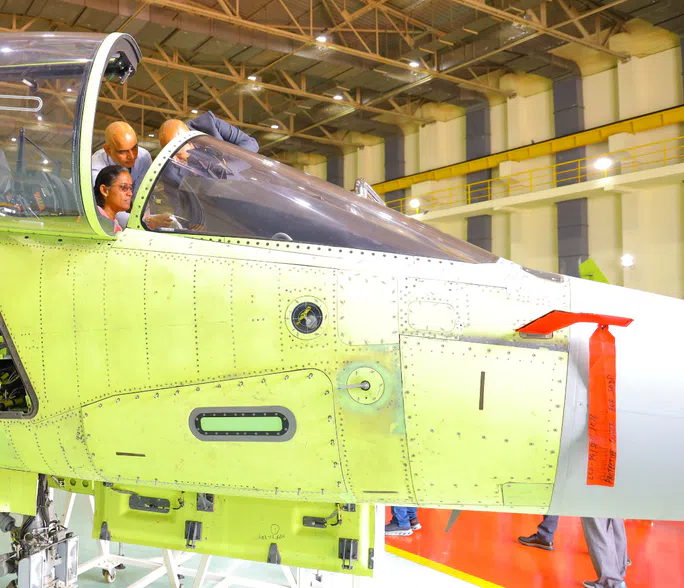 "Parliamentary Standing Committee on Defence's visit to HAL on August 22, 2025 (Photo: HAL)")
Parliamentary Standing Committee on Defence's visit to HAL on August 22, 2025 (Photo: HAL)
Come March, a Boston Consulting Group study on the reorganisation of Hindustan Aeronautics Ltd (HAL) is expected to be ready. Commissioned by the defence ministry’s Department of Defence Production — which oversees all 16 state-run defence firms, including HAL — the review comes at a moment when the company’s order book has swollen to about ₹2.52 trillion, a scale that would be the envy of almost any Indian business.
These 16 companies are what are called defence public sector undertakings, or DPSUs. Despite the creation of seven new units in October 2021 through the corporatisation of the Ordnance Factory Board, any prospective reorganisation of India’s public sector defence players is a politically fraught undertaking.
The move comes amid a broad convergence of views that the post-Operation Sindoor thrust on greater self-reliance, unfolding against an increasingly turbulent global backdrop, demands that the DPSUs be made more efficient and better suited to the roles they are expected to play. However, views differ on whether reorganisation — either by splitting the firms or merging them for scale — is in fact the best way to achieve this goal.
How big is ‘too big’?
HAL is India’s largest defence firm by revenue, order book and market capitalisation, and remains the country’s only combat aircraft manufacturer. It is also responsible for producing the Tejas family of indigenous fighter jets. Any reorganisation, defence sources say, would therefore be aimed squarely at improving platform delivery, sharpening the product focus, and enhancing responsiveness to end-users.

 "semiconductor, chip")
“There is perhaps a sense that too many orders have been concentrated in one place,” said a private defence industry insider. The underlying assumption is that HAL may have too much on its hands — ranging from combat aircraft and helicopters to avionics — even as the Tejas Mark-1A (Mk-1A) programme to deliver upgraded variants of the indigenous fighter continues to face delays, with not a single aircraft delivered to the Indian Air Force so far.
That this line of thinking may carry force was reflected in the expression of interest issued in June 2025 to shortlist entities for developing prototypes of India’s first stealth fighter, the advanced medium combat aircraft. One clause stipulated that participating companies would attract a penalty in evaluation if their order book exceeded three times their annual revenue.
HAL’s order book is more than eight times its FY25 revenue of ₹30,105 crore. It has firm orders for 180 Tejas Mk-1A fighter jets, valued at over ₹98,000 crore, and is executing a ₹62,700 crore contract for 156 Prachand light combat helicopters. Given the scale of these orders, delays in delivery have tangible implications for national security.
A senior defence ministry official with direct knowledge of the matter said, on the condition of anonymity, that, in their view, HAL does require restructuring. “One option is a holding company with vertical subsidiaries — for fixed-wing aircraft, helicopters, unmanned systems and engines, among others,” the official said. These verticals would operate as profit centres, while the holding company would ensure that complementarities across the enterprise are preserved and optimised.
Former HAL chairman and managing director C B Ananthakrishnan believed that any move to restructure HAL into business verticals should be pursued only if it is a strategic necessity, rather than just an administrative change in view of its large order book. He also noted that improving efficiency and productivity, as well as ensuring that delivery timeliness are met, is necessary, and that any restructuring should be designed expressly to achieve these objectives.
HAL, he explained, is already structured into independent divisions focusing on production and design. Each division operates as an independent profit centre, with its own production and financial targets, including revenue and profit. Groups of these divisions are organised into complexes, with completely decentralised decision-making at the division or complex level, while corporate headquarters restricts itself to policy decisions and future growth strategies. He noted that it remains to be seen how a potential restructuring would improve this further.
Ananthakrishnan also emphasised that, most importantly, since the various business verticals of HAL are interdependent, any restructuring should not result in resource fragmentation. For instance, critical talent may become “trapped” in one vertical, making it difficult to share expertise across the company. Similarly, without careful management, each vertical might end up building its own human resources, finance, and procurement teams, potentially increasing administrative costs and reducing the benefits of being a large public sector unit, which would result in an increase in the ultimate cost to defence customers. Presently, inter-division transfers are made on a notional profit basis. Any restructuring, he cautioned, must account for this architecture as well, as a move towards verticals could otherwise drive up costs for end-users once again. “Any reorganisation must ensure that synergies are not broken and efficiency is strengthened.”
Ananthakrishnan said a study conducted on HAL around two years ago had expressed certain views, including the possibility of reorganising the company into at least four verticals, but these were not pursued.
Laxman Kumar Behera, associate professor at Jawaharlal Nehru University’s Special Centre for National Security Studies, is unconvinced by the claim that HAL is simply “too big”. While accepting that efficiency needs to be sharpened, delivery timelines met, and that reorganisation could be useful, he rejects the notion that size is a problem. “Global defence aerospace majors such as the American Lockheed Martin and Boeing, and France’s Dassault Aviation, are far larger than HAL,” he argued. “Their scale — whether measured by revenues, order books or the number of programmes they run — has not been an impediment. I therefore do not see HAL’s size, in and of itself, as a constraint.”
With Lockheed Martin recording nearly 17 times HAL’s arms-sales revenue in 2024, Behera argued that there is no clear or workable benchmark for determining what constitutes “too big”. Still, he sees potential value in consolidating HAL’s engine division at Koraput — currently under its MiG complex — with other public sector units engaged in aero-engine work, and hiving it off as a separate entity.
Ananthakrishnan, however, cautioned that, in addition to any potential broader restructuring, it is imperative to clearly articulate how HAL’s design complex and engines vertical will be positioned, governed, and integrated within the new organisational framework. Arguing that design and engine capabilities form the foundation of HAL’s indigenous aerospace competitiveness, he stressed that any restructuring must ensure these functions continue to work closely with production and delivery units, stay tightly technically connected, and have the authority and systems needed to take decisions and collaborate across verticals. “This is essential to avoid the fragmentation of critical engineering talent and to preserve the long-term sustenance of HAL’s strategic design and propulsion capabilities,” he said.
A former senior defence official involved in the corporatisation of the Ordnance Factory Board said that an internal study of HAL was also conducted in the recent past, examining organisational structures prevalent in the global aerospace industry and mapping synergies in equipment, materials and payloads across different aircraft categories. “The study found that these synergies are substantial. Therefore, they need to be factored in when considering any move to reorganise HAL into verticals that separately handle different aircraft types,” they said.
The former official also cautioned that, as a final systems integrator, many of the delivery delays attributed to HAL in the Tejas Mk-1A programme stem from externalities — linked to foreign suppliers and domestic entities responsible for key subsystems, from radars to communications equipment — and that reorganisation, by itself, would not necessarily resolve this particular problem. “That is not the rope you can hang HAL with,” the official said. “What is needed instead is an urgent broadening of the domestic ecosystem for producing such critical components.”
Other DPSUs have also come under the scanner. For instance, the parliamentary standing committee on defence recently recommended that the remaining portion of the modernisation grant to the seven new DPSUs be utilised prudently and productively. Between FY22 and FY25, the government allocated a modernisation budget of ₹5,757 crore to the new DPSUs, of which ₹3,832.69 crore — 66.6 per cent — had been spent by the end of FY25.
The senior MoD official cited above said that, in their assessment, the seven new DPSUs would benefit from a phase of consolidation tailored to their respective strengths and weaknesses.
Get the ‘why’ right
“If a company is running losses and failing to deliver what it was set up to do, then you reorganise and restructure,” said the former defence official quoted earlier.
From FY20 to FY24, HAL recorded uninterrupted year-on-year profit growth, rising from ₹2,842 crore to ₹7,595 crore. Bharat Electronics Ltd (BEL), the country’s leading avionics and defence electronics firm, followed a similarly steady trajectory, with profits increasing from ₹1,794 crore to ₹4,020 crore. Bharat Dynamics Ltd (BDL), a missile and munition manufacturer, saw profits fall from ₹535 crore in FY20 to ₹258 crore in FY21 before recovering to ₹613 crore by FY24. Mishra Dhatu Nigam Ltd (MIDHANI), which produces advanced materials, remained broadly stable through FY23 before declining to ₹91.26 crore in FY24. BEML, a heavy equipment maker, posted a consistent rise over the period, with profits increasing from a low base of ₹68 crore in FY20 to ₹283 crore in FY24.
The picture among shipyards was more uneven. Mazagon Dock Shipbuilders Ltd (MDL) registered a sharp increase, with profits rising from ₹408.48 crore in FY20 to ₹1,845.43 crore in FY24, particularly after FY22. Garden Reach Shipbuilders and Engineers Ltd (GRSE) recorded incremental growth, moving from ₹163.48 crore to ₹357.27 crore over five years. Goa Shipyard Ltd (GSL) experienced pronounced volatility, with profits falling from ₹197.77 crore in FY20 to ₹1.09 crore in FY22 before recovering to ₹71.32 crore in FY24. Hindustan Shipyard Ltd (HSL) reported profits of ₹13 crore in FY20, a loss of ₹14 crore in FY21 — attributed to the COVID-19 pandemic and nationwide lockdown — and a recovery to ₹119 crore by FY24.
Stating that reorganisation can span a wide spectrum — from restructuring to outright privatisation — the former official argued that none of the old DPSUs are suitable candidates for such measures. In this person’s view, concerns over delivery delays and performance would not be resolved through these routes, and would be better addressed by granting company boards greater autonomy than they currently enjoy. “Allow their leadership to work, and they will work wonders.”
The former official pointed to the case of HSL as instructive. “After it was taken over from the shipping ministry, it was effectively mothballed — we did not give it orders for 15 years and did not allow it to take on commercial work. It was limited to repairs. Once that injustice was corrected around FY24, it began turning a profit.”
Coming to the seven new DPSUs, data shows that most moved into profitability or expanded their profit base within two years of corporatisation. However, their profit and loss trajectories from FY22 to FY24 diverged sharply. Armoured Vehicles Nigam Ltd (AVNL) recorded uninterrupted profit growth, rising from ₹54.19 crore in FY22 to ₹605.06 crore in FY24. India Optel Ltd (IOL) similarly posted steady gains, with profits increasing from ₹60.10 crore to ₹233.03 crore, while Munitions India Ltd (MIL) followed a comparable upward path, climbing from ₹21.69 crore to ₹558.78 crore. Gliders India Ltd (GIL) moved from a loss of ₹20.70 crore in FY22 to profits of ₹6.86 crore in FY23 and ₹10.76 crore in FY24, and Yantra India Ltd (YIL) recovered from a ₹123.12 crore loss in FY22 to profits of ₹51.34 crore in FY23 and ₹425.58 crore in FY24. Advanced Weapons and Equipment India Ltd (AWEIL) showed greater volatility, reporting a modest profit of ₹4.53 crore in FY22, a loss of ₹12.79 crore in FY23, and a return to profit at ₹20.24 crore in FY24. Troop Comforts Ltd (TCL) stood apart from the broader pattern, posting profits of ₹16.38 crore in FY22 and ₹18.95 crore in FY23 before reversing sharply into a ₹303 crore loss in FY24.
The explanation the government offered to the standing committee on defence for TCL’s losses was revealing: “Workload of only ₹340 crore was available during FY24; later orders of above ₹1,200 crore were placed by Army Headquarters in the last quarter of FY24.”
However, the global turmoil appears to have proved a boon, with a senior MoD source pointing out that the new DPSUs — MIL in particular — have benefitted in terms of export orders.
“Apart from TCL, all the other DPSUs have shown consistent profits and are meeting service requirements,” said
the former defence official cited above, adding that only TCL and GIL need a hard look to assess how they can contribute more effectively to India’s security.
Behera argued that government rules and regulations — from hiring practices to procedural manuals — inevitably place DPSUs at a disadvantage when it comes to nimbleness relative to private firms. Even so, the autonomy of DPSU boards and management must be brought as close as possible to that enjoyed by the private sector, he said. “Retaining domain expertise within the state, through DPSUs, remains essential. The challenge today is no longer capacity itself, but how effectively the country deploys what it already has.”
Arguing that privatisation alone amounts to genuine restructuring — on the grounds that merely adjusting a DPSU’s internal structure leaves intact the constraints of a public enterprise — Behera nevertheless cautioned that any such move must be approached with care. Defence production, he stressed, is not simply a business driven by profit. Efficiency must be balanced against the requirement to preserve surge capacity — the ability to rapidly scale up output in wartime. Of the nine older DPSUs, he contended, only BEML and MIDHANI may be plausible candidates for privatisation.
Both Behera and the former defence official also pointed to the robust order books across most of the DPSUs. Taken together, government data suggests expectations of a dramatic expansion in the order books of the old DPSUs over FY26-FY30. The combined order book is projected to rise from ₹3.38 trillion in FY25 to nearly ₹30.8 trillion when the five-year projections up to FY30 are taken together — an increase of almost nine times.
The new DPSUs, too, are expected to see a sharp expansion in their order books. Their combined order book is projected to rise from ₹43,530 crore in FY25 to about ₹1.99 trillion over FY26-FY30 — a more than fourfold increase. Even TCL is projected to see multifold expansion after a period of low workload.
Behera, however, was less sanguine about some of the new DPSUs, arguing that at least AVNL — despite its healthy performance — could emerge as a candidate for privatisation. “With the private sector having achieved scale and capability in land systems, AVNL will find competition increasingly difficult,” he argued.
Behera and the former defence official both argued that the fundamental “why” of any potential reorganisation must first be established, and that this should determine the route chosen.
For example, Behera pointed out that while private sector production of artillery shells has expanded sharply, shuttering or privatising public sector capacities could prove short-sighted. “We need to preserve these capacities and invest in making smart munitions within the country.” He pointed to how, after the end of the Cold War, Europe and the United States scaled down their munitions manufacturing, only to be caught off guard by the war in Ukraine.
Noting that GSL and HSL are the only two of the nine old DPSUs not listed on the stock exchanges, both experts suggested that expanding market listings — including to the new DPSUs — could be one way of injecting efficiency.
What the Boston Consulting Group report will ultimately recommend remains to be seen. But as the former defence official quoted earlier cautioned, the stakes lie not merely in action, but in diagnosis: “We must identify the reasons for delays and inefficiencies correctly. Actions taken on the basis of a misdiagnosis could cost us dearly over the long run.”
HAL, the largest of India’s public defence firms, sits at the centre of a much larger question. Its trajectory will serve as a directional indicator for the future of the wider DPSU ecosystem, which accounted for 77 per cent of the country’s record ₹1.5 trillion in defence production in FY25. Given the centrality of India’s aerospace ambitions to its pursuit of defence self-reliance, the outcome will also have a bearing on how the government’s aim of establishing a dual defence production pipeline — one in which the public and private sectors work together — evolves.
Written By
Bhaswar Kumar
Bhaswar Kumar has over seven years of experience in journalism. He has written on India Inc, corporate governance, government policy, and economic data. Currently, he covers defence, security and geopolitics, focusing on defence procurement policies, defence and aerospace majors, and developments in India’s neighbourhood.

 "Bhaswar Kumar")

First Published: Feb 10 2026 | 1:30 AM IST
In this article :