Friday, February 27, 2026
Digital Edition


The extraordinary awaits: Adventures from fighter jets to glacier caves
From manta ray night dives and glacier caves to fighter jet sorties and volcano boarding, high-adrenaline luxury travel redefines extraordinary escapes

 "Anushka Bhardwaj")
?im=FitAndFill=(600,600)?im=FitAndFill=(600,538) "With the sea’s gentle giants") 1/5
1/5In destinations such as Hawaii’s Big Island, the Maldives, and Indonesia’s Komodo National Park, travellers venture out in search of “gentle giants” — manta rays. Night dives offer the highest probability of sightings. Under floodlights that attract plankton, mantas glide and loop in a mesmerising ritual known as cyclone feeding. Elsewhere, Ecuador’s Galápagos Islands add encounters with humpback whales, sea turtles, sea lions, and reef sharks. Week-long marine expeditions, typically limited to four guests, cost up to ₹6 lakh. For those seeking interaction beyond observation, select marine parks offer dolphin-trainer-for-a-day programmes.
?im=FitAndFill=(600,600)?im=FitAndFill=(600,538) "Icy adventures")
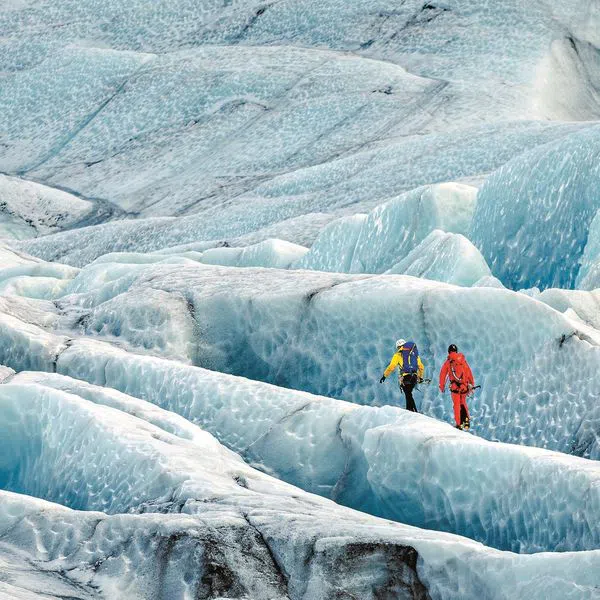
From Argentina’s Perito Moreno to New Zealand’s Franz Joseph, Norway’s Folgefonna and Iceland’s vast Langjökull ice cap, glacier hiking offers a rare walk across millennia. Guided expeditions lead travellers through crevasses and into ice caves streaked with electric blue veins and bands of volcanic ash. In polar regions, the wildlife sightings can be extraordinary. For a more contemplative approach, kayaking among fractured icebergs offers a front-row seat to one of nature’s most dynamic spectacles: Glaciers calving into still waters. Many consider it a safer alternative to traversing the ice itself. Add to the adventure with igloo glamping in Iceland. High-tech glass-domed suites offer uninterrupted views of snowfields and northern skies.
?im=FitAndFill=(600,600)?im=FitAndFill=(600,538) "The jungle calls")
In Rwanda, forest reserves place guests within reach of endangered mountain gorillas. In Kenya’s Maasai Mara National Reserve, dawn drives reveal lions, leopards, elephants, rhinos, and Cape buffalo — the storied Big Five. Elsewhere, Costa Rica’s rainforests teem with biodiversity, from brightly plumed birds to elusive big cats. Accommodation is often limited to fewer than 15 tents or villas, and the comforts rival five-star urban hotels: Private plunge pools, personal butlers, wood-fired hot tubs, open-air cinemas and curated stargazing decks.
?im=FitAndFill=(600,600)?im=FitAndFill=(600,538) "Ride the skies")
It is the closest a civilian may come to a Top Gun moment: Strapping into a former military fighter jet, feeling the roar of afterburners and the pull of G-forces. The experience, offered by private aviation and space adventure companies in the US, UK, and Switzerland, besides elsewhere, begins well before takeoff. Guests go through detailed safety briefings, simulator orientation and cockpit familiarisation with a flight instructor. Only then do they taxi toward the runway, with the instructor, in aircraft such as the MiG-15, T-33, MB-326, and most commonly, the L-29 or L-39, which are favoured for their reliability and safety record. The flight paths? Sweeping over the California desert, tracing Florida’s sun-drenched coastline, or gliding past the Alpine scenery of southern Germany. If the instructor deems it safe, they may hand over partial control mid-air for the added adrenaline rush.
?im=FitAndFill=(600,600)?im=FitAndFill=(600,538) "Fire and Earth")
For adventure layered with scientific insight, there are guided expeditions to active volcanoes. Indonesia’s volcanic archipelago and Iceland’s lava fields remain perennial favourites. Mount Etna in Sicily, Europe’s tallest and most active volcano, combines lava tunnels with sweeping Mediterranean views. On the Greek island of Milos, striking landscapes bear the imprint of ancient eruptions. In Nicaragua, Cerro Negro offers a different thrill: Volcano boarding. Travellers hike to the summit before descending on reinforced plywood boards — a rush set against a backdrop of blackened slopes. Kayaking, jungle ziplining and surf excursions complement such itineraries. With advances in monitoring and forecasting, trips are now planned around safe windows.