'A legacy of public reasoning'

Historians are always befuddled by chronological coincidences
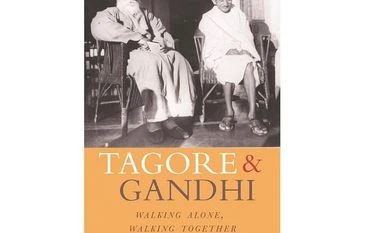
Book cover
Tagore & Gandhi: Walking Alone, Walking Together
Bibek Debroy
5 min read Last Updated : Oct 22 2021 | 1:43 AM IST
Tagore & Gandhi: Walking Alone, Walking Together
Author: Rudrangshu Mukherjee
Publisher: Aleph Book Company
Pages: (xxii) +186 Price: Rs 699

Rudrangshu Mukherjee may have drifted into serious journalism (with The Telegraph) for a bit, but at heart, he has always been a historian and academic. Now Chancellor and Professor of History at Ashoka University, Rudrangshu is mostly known for research and books centred on 1857.  Plus, he has been interested in Jawaharlal Nehru and this book, on Tagore and Gandhi, reminded me a bit of his earlier book (2014) on Jawaharlal Nehru and Subhas Chandra Bose. That book was sub-titled Parallel Lives and this book, also about two parallel lives, is sub-titled Walking Alone, Walking Together. The sub-title is an allusion to Tagore’s song Ekla Chalo Re, written in 1905 against the background of the Swadeshi movement, following the partition of Bengal. This song was a great favourite of Mahatma Gandhi’s, though the younger generation might identify it more with Amitabh Bachchan or A R Rahman (another Tagore song, written at the same time, is the national anthem of Bangladesh.)

Tagore and Gandhi had parallel lives.  From the author’s Prologue, “Rabindranath Tagore and Mohandas Karamchand Gandhi were born in the same decade; the former in May 1861 and the latter in October 1869. Historians are always befuddled by chronological coincidences. There is no explanation why two outstanding individuals were born in the same decade in two different parts of India.  As is well known, Rabindranath and Gandhi became close and respectful friends in spite of differing on many issues…These views which influenced the relationship between Rabindranath and Gandhi grew out of their experiences and their deep reflections on those experiences.  In Gandhi’s case, this affected his thought and political actions; and for Rabindranath this was reflected in much of his literary output and also is his very brief political activity…The encounter between Gandhi, the maker of the Indian national movement, and Rabindranath, the creator of a profound literary and philosophical universe, was perhaps the most creative encounter in the making of modern India.”  This quote sums up what this book explores. 

Understandably, a lot has been written on Tagore and Gandhi. Is there anything more left to say?  For every researcher, there is always more to say.  Indeed, a lot has been written on Tagore, and on Gandhi, individually.  The focus of this book is the relationship between the two, as expressed in their writings and letters to each other.  Sabyasachi Bhattacharya brought out the entire correspondence between Gandhi and Tagore, from 1915 to 1941.  “This compilation serves as the bedrock of my book.”  Based on this dataset, so to speak, Rudrangshu has crafted this relatively thin book in six chapters — Swadeshi and Satyagraha; First Encounters; Out of Tune; Wheel of Friendship; Fasts and an Earthquake; and Last Things.  The titles of these chapters are self-explanatory.  In addition, there is a Prologue and an Epilogue.  Books are often written because of an author’s internal compulsions, because of that urge to write.  Sometimes, they have a target audience in mind.  Is the intended reader someone who is exceedingly familiar with what has been written on Tagore and Gandhi and does their mutual correspondence bring out any new facets in the relationship?  Does the research, based on writings and letters, reveal anything new?  For a reader who has read a lot on Tagore and Gandhi, I suspect the answer is in the negative.  This well-written book simply reinforces what one already knows.

The only exception might be the chapter on fasts and earthquake, the earthquake being a reference to the 1934 disaster in Bihar.  To quote Mahatma Gandhi, “We who have faith in God must cherish the belief that behind even this indescribable calamity there is a divine purpose that works for the good of humanity.  You may call me superstitious if you like; but a man like me cannot but believe that this earthquake is a divine chastisement sent by God for our sins.  Even to avowed scoffers it must be clear that nothing but divine will can explain such a calamity.  It is my unmistakable belief that not a blade of grass moves but by the divine will.”  In passing, I wonder why Rudrangshu chose not to explore a significant difference in “experiences”.  “Gandhi in his bhakti did not allow himself any doubts….  Thus spoke Krishna in the Bhagavad Gita.”  Precisely, the Bhagavad Gita was important for Mahatma Gandhi and he looked at “Dharma” with that lens.  Rather oddly, there is not a single reference to the Brahmo Samaj, and its influence on Tagore, in this book.  That is the lens of “Dharma” Tagore used.

However, there is the target reader who may not know that much about either Tagore or Gandhi, and Tagore essentially wrote in Bengali. For such a reader, this is a masterly rendering of the interaction between the two.  They walked alone and they walked together and the author captures this extremely well.  “Through the expressions of difference and respect for each other, Gandhi and Rabindranath set an example of debating and deliberating on public, social, and political questions. They formed a legacy of public reasoning.  They debated without acrimony.”  Stated differently, that legacy always existed in India.  (Read descriptions of debates in Nalanda, or elsewhere, at the time.)  Prime time television debates are not the legacy of the argumentative Indian.  When Tagore and Gandhi responded to each other’s views, they were following the traditions of Adi Shankaracharya and Ramanuja in setting out “purva paksha”.

One subscription. Two world-class reads.

Already subscribed? Log in

Subscribe to read the full story →
*Subscribe to Business Standard digital and get complimentary access to The New York Times

Smart Quarterly

₹900

3 Months

₹300/Month

SAVE 25%

Smart Essential

₹2,700

1 Year

₹225/Month

SAVE 46%
*Complimentary New York Times access for the 2nd year will be given after 12 months

Super Saver

₹3,900

2 Years

₹162/Month

Subscribe

Renews automatically, cancel anytime

Here’s what’s included in our digital subscription plans

Exclusive premium stories online

  • Over 30 premium stories daily, handpicked by our editors

Complimentary Access to The New York Times

  • News, Games, Cooking, Audio, Wirecutter & The Athletic

Business Standard Epaper

  • Digital replica of our daily newspaper — with options to read, save, and share

Curated Newsletters

  • Insights on markets, finance, politics, tech, and more delivered to your inbox

Market Analysis & Investment Insights

  • In-depth market analysis & insights with access to The Smart Investor

Archives

  • Repository of articles and publications dating back to 1997

Ad-free Reading

  • Uninterrupted reading experience with no advertisements

Seamless Access Across All Devices

  • Access Business Standard across devices — mobile, tablet, or PC, via web or app

Topics :LiteratureBOOK REVIEWRabindranath TagoreMahatma Gandhi

Next Story



