Celebrating a Swiss master

Giacometti's work deserves attention for more than just its value
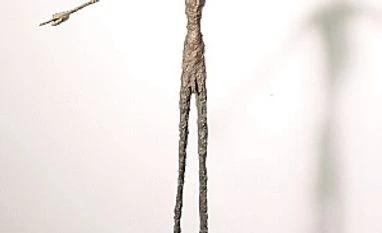
Alberto Giacometti’s Pointing Man, which sold for $143.3 million in 2015. Photo: Wikimedia Commons
Kishore Singh
Last Updated : Jun 30 2017 | 11:13 PM IST
If you’ve heard of Alberto Giacometti, chances are it’s because of the record price established in 2015 for both the artist as well as for a sculpture — Pointing Man — an astounding $143.3 million (approximately Rs 900 crore), making him one of the most expensive artists in world history. And yet, Giacometti’s work deserves attention for more than just its value — and the Tate Modern retrospective in London (till September 10) promises to do just that. 

To see a work by Giacometti, to come face to face with one of his angular sculptures, can be a life-changing experience. Having viewed his works in museums and at auction previews, when a work or a couple of works are like a treat, to see a collection of his paintings and sculptures in a cluster of eight rooms arranged sequentially by the curators at the Tate, is like a feast for the fasting. The powerful exhibition is one of the best on any artist in recent times. 

Born and educated in Switzerland, Giacometti came to work in France, where his practice — influenced by the relics of Egypt — took on an elongated linearity that still marks it out. The incredibly lean, long figures are exquisitely balanced, but even more unique is his ability to turn the silhouette-like faces of the figures into detailed studies, their flatness imbued with a personality the more astonishing for it. An uncompromising sculptor, he was never satisfied till his figures expressed the sentiment Giacometti demanded of his art, and he returned again and again to work on pieces he remained unhappy with. 

In an interview, he expressed his penchant for focussing on the eyes of a sculpted head, believing it was the expression that was its most important feature. “When you look at the human face, you always look at the eyes,” he said. “An eye has something special about it, it’s made of different matter than the rest of the face.” Yet, he came to be known as much for expressing what came to be described as “capturing movement as well as stillness”, inferring both a quality of motion as well as of calm in his sculpted figures. “I have made sculptures that can move!” he exulted. Working across several mediums, his personal choice tended to be more limited to clay and plaster, though many of his works went on to be cast in bronze.

Alberto Giacometti’s Pointing Man, which sold for $143.3 million in 2015. Photo: Wikimedia Commons
His subjects were often the people he was closest to — his parents, his brother, Diego, wife Annette, the writer Simone de Beauvoir, and his mistress, Caroline. But he was never enamoured of likeness, committing instead to the conceptual, drawn for a while to surrealism, experimenting with sizes that ranged from the exceptionally tiny to the life-sized. Yet, he would be astounded that after hours and days of sitting for him, he had failed at arriving at a likeness and, indeed, would claim that he found his family of sitters unrecognisable. But the result was a startling new way of seeing that transformed the language of 20th century sculpture. 

Giacometti struggled for most of his career, knowing success only in the last decade of his 56-year-old life — he died of chronic bronchitis in 1966. His prices have hardened particularly in the last decade as an acknowledgement of his contribution in creating a unique language in the world of sculpture. Even though himself inspired by Egyptian funerary art, and the sculptures and masks of Africa and Oceania, Giacometti’s distinctiveness has added an entire lexicon to the semantic of modern sculpture that the Giacometti Foundation’s contribution has done much to consolidate.
 
Kishore Singh is a Delhi-based writer and art critic. These views are personal and do not reflect those of the organisation with which he is associated


One subscription. Two world-class reads.

Already subscribed? Log in

Subscribe to read the full story →
*Subscribe to Business Standard digital and get complimentary access to The New York Times

Smart Quarterly

₹900

3 Months

₹300/Month

SAVE 25%

Smart Essential

₹2,700

1 Year

₹225/Month

SAVE 46%
*Complimentary New York Times access for the 2nd year will be given after 12 months

Super Saver

₹3,900

2 Years

₹162/Month

Subscribe

Renews automatically, cancel anytime

Here’s what’s included in our digital subscription plans

Exclusive premium stories online

  • Over 30 premium stories daily, handpicked by our editors

Complimentary Access to The New York Times

  • News, Games, Cooking, Audio, Wirecutter & The Athletic

Business Standard Epaper

  • Digital replica of our daily newspaper — with options to read, save, and share

Curated Newsletters

  • Insights on markets, finance, politics, tech, and more delivered to your inbox

Market Analysis & Investment Insights

  • In-depth market analysis & insights with access to The Smart Investor

Archives

  • Repository of articles and publications dating back to 1997

Ad-free Reading

  • Uninterrupted reading experience with no advertisements

Seamless Access Across All Devices

  • Access Business Standard across devices — mobile, tablet, or PC, via web or app

Next Story



