Governance and power

Challenges of Governance is a treat to read with a lot in it for public policy practitioners, policy makers and thinkers.
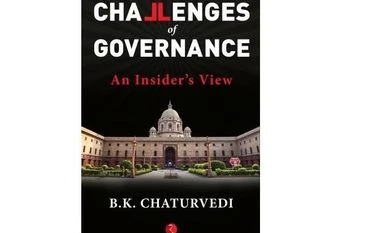
Challenges of Governance
Challenges of Governance | Source: Rupa Publications
C M Vasudev
5 min read Last Updated : Jun 05 2019 | 12:19 AM IST

Don't want to miss the best from Business Standard?

A recently released book Challenges of Governance by B K Chaturvedi, a former cabinet secretary, is a compelling addition to the growing collection of memoirs written by retired civil servants. Since Mr Chaturvedi had worked at the helm of bureaucracy, his memoirs promised to be more revealing by providing insights into governance challenges at the higher echelons of government and interplay of forces between the professional bureaucracy and the political executive. Indeed, the book has achieved this in ample measure. In the preface, Mr Chaturvedi says he felt inhibited to talk about issues where decisions were taken in complete confidence and trust. This is somewhat of a dampener. He would have been privy to many sensitive decisions and revealing their context, barring official secrets, would have enriched this account. He has perhaps been overcautious in this matter. 

The book covers a wide breadth of issues starting from challenges in district administration to state and central government administration and takes in the erstwhile Planning Commission. Mr Chaturvedi occupied pivotal positions in these organisations and he has deftly laced the policy dimensions of subjects with specific issues with which he dealt. His thoughts provide a storehouse of knowledge to budding civil servants and others interested in public policy formulation and public administration. At the same time, a book of 200 pages or so is not enough to do justice to the wide range of subjects that he has sought to cover. It provides a fleeting glimpse of governance challenges, which only whets the appetite of the reader and leaves him wanting more.

The most interesting section is the one concerning coalition conundrums and governance model under the first United Progressive Alliance (UPA I). Mr Chaturvedi was cabinet secretary during that period. His account of governance problems because of the jostling of power between coalition partners and the undermining of the prime minister’s position because of dual centres of power contains many interesting anecdotes. He has abeen critical of the role of the National Advisory Council headed by Sonia Gandhi as a parallel centre of power. These ad hoc institutional arrangements posed many governance challenges. One offshoot was setting up many Groups of Ministers (GoMs) to resolve contentious issues. The GoMs took a lot of time to resolve conflicts and perhaps led to sub-optimal compromises. The process also delayed decision-making and weakened the position of the prime minister. The unique governance model evolved during UPA I is perhaps an example of the pitfalls of coalition governments. In the author’s words, “This position did not give the impression of a government that was fully united. It adversely affected its public image.”

Mr Chaturvedi has been more forthcoming when he writes about overreach by different organs of the state, especially the judiciary and the Comptroller & Auditor General (CAG).  He has reserved his harshest comments for the encroachment by the CAG and judiciary into the domain of policy-making in telecom and coal, and explains how this made civil servants increasingly more risk averse. He has also put up a stout defence of civil servants who have been charged with criminal offences for administrative lapses. His analysis is a grim reminder, especially in an era of judicial activism, of the need for different institutions to confine their respective roles to those envisaged in the Constitution.

The portions in the book concerning the Planning Commission, Finance Commission and centre-state relations makes interesting reading. He has provided an insider views on how the Planning Commission was able to usher in reforms in the states as part of annual plan discussions. His defence of the resource allocation role of the erstwhile Planning Commission and his description of renaming the body Niti Aayog as a knee-jerk reaction seems to be overstated, however. There were perhaps good reasons to rename the Planning Commission so that its name and role reflects the current market-driven growth model that the country has adopted. The Planning Commission was a relic of the period when our growth model was public sector led with centralised planning. Also, the Planning Commission’s resource allocation role was not in tune with our evolving federal structure under which discretionary grants (which central assistance for state plans were) from the centre to the states need to be minimised. Today 46 per cent of central taxes are given to the states in a non-discretionary manner. Niti Aayog with a redefined role of a think tank of government perhaps better reflects the change in our growth paradigm.

The last section contains Mr Chaturvedi’s thoughts on future governance reforms. He has ticked many of the right boxes. He has offered wide-ranging suggestions for strengthening governance institutions and for electoral reforms. Having seen the functioning of coalition governments from close quarters he has argued for banning post-election defections. Our party-based parliamentary democracy has many shortcomings. But it is a moot point if these can be corrected by legislative action such as banning defections. Banning defections can also cut at the root of freedom of speech. Ultimately it is for the voters to punish unscrupulous defectors. 

All in all, however, Challenges of Governance is a treat to read. There is a lot in it for public policy practitioners, policy makers and thinkers.
 
The reviewer is former Finance Secretary

Challenges of Governance: 
An Insider’s View
BK Chaturvedi
Rupa, 220 pages, Rs 595

One subscription. Two world-class reads.

Already subscribed? Log in

Subscribe to read the full story →
*Subscribe to Business Standard digital and get complimentary access to The New York Times

Smart Quarterly

₹900

3 Months

₹300/Month

SAVE 25%

Smart Essential

₹2,700

1 Year

₹225/Month

SAVE 46%
*Complimentary New York Times access for the 2nd year will be given after 12 months

Super Saver

₹3,900

2 Years

₹162/Month

Subscribe

Renews automatically, cancel anytime

Here’s what’s included in our digital subscription plans

Exclusive premium stories online

  • Over 30 premium stories daily, handpicked by our editors

Complimentary Access to The New York Times

  • News, Games, Cooking, Audio, Wirecutter & The Athletic

Business Standard Epaper

  • Digital replica of our daily newspaper — with options to read, save, and share

Curated Newsletters

  • Insights on markets, finance, politics, tech, and more delivered to your inbox

Market Analysis & Investment Insights

  • In-depth market analysis & insights with access to The Smart Investor

Archives

  • Repository of articles and publications dating back to 1997

Ad-free Reading

  • Uninterrupted reading experience with no advertisements

Seamless Access Across All Devices

  • Access Business Standard across devices — mobile, tablet, or PC, via web or app

Next Story



