Pure maths and the natural world

The book adheres closely to the popular science principle Stephen Hawking articulated in avoiding equations and formulae in A Brief History of Time
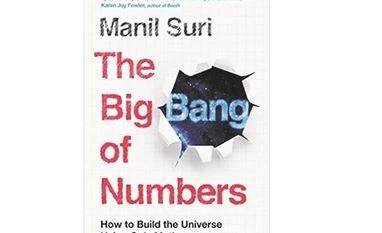
Book cover
The Big Bang of Numbers: How to build the universe using only maths
Devangshu Datta
5 min read Last Updated : Dec 21 2022 | 10:30 PM IST
The Big Bang of Numbers: How to build the universe using only maths
Author: Manil Suri
Publisher: Bloomsbury
Pages: 384
Price: Rs 699

Starting from scratch can you derive an entire, internally consistent, logical edifice of mathematics? Moreover, can you use that mathematics to “design” the universe, with its mind-bogglingly complex combination of physics, chemistry and biology?

Also Read


In practice, of course, mathematics was derived from a combination of empiricism and applied logic. People saw things; counted them; measured them; and discovered deeper patterns and principles as they went along.

But the actual historical underpinnings haven’t stopped sundry mathematicians, logicians and philosophers from performing the ambitious thought experiment of starting from scratch, setting the axioms and working out where that would take them.

This is actually very difficult. Bertrand Russell and Alfred Whitehead famously took over 300 pages in their monumental Principia Mathematica  to prove “1+1=2”. Their attempt to logically codify all of maths was derailed by Kurt Godel’s subsequent proof that every mathematical system would have to contain certain hypotheses that could not be proved true or false within the system.

Manil Suri, who is a professional mathematician as well as a novelist, decided to try his hand at a much lighter, less rigorous variation on this theme. This is the result. He expanded some thoughts which arose when he penned an essay “How To Fall In Love With Math” for The New York Times in September 2013. That essay went to #2 in popularity on the NYT website, being beaten to pole position by Pope Francis’ opinion on gays, abortion and birth control.

This led Dr Suri to structure this book in a certain way. It’s written in seven sections to mirror the Biblical Days of Creation, which is actually fine if you’re looking to go from the axioms of basic arithmetic to the Big Bang and beyond. Dr Suri also references the Pope (a chemist before he turned to religion) multiple times, using him as a counterpoint or mirror, when he makes mathematical assertions. While this conceit is mildly amusing in the early phases, it gets a little tedious in its umpteenth iteration.

That apart, the book is a nice ride through some basic mathematical concepts. It adheres closely to the popular science principle Stephen Hawking articulated in avoiding equations and formulae in A Brief History of Time. Assuming the reader studied mathematics to around the secondary level, he or she will not find unfamiliar concepts popping up in the three early sections where basic operations, unit circles, number systems, etc., are discussed.

The heavy lifting starts with “Day 4 patterns” where concepts like symmetry, fractal geometries, the golden ratio, Fibonacci Series, and so on are introduced. This is the first time the book connects maths to the physical universe in its exposition of how fractals pop up in natural formations, and in the design of leaf formations, in pandemic spreads, and in the alveoli pattern of our lungs.

In “Day 5 Physics”, the discourse moves to creating the “axioms” that run the universe. We must recall that the book is trying to derive the law of gravity, etc., by pure logic without recourse to empirical observation, or experiment.

There’s a nice little speculative section about how “Nature” could have worked out a different mathematics, or created a different universe with different iterations of the same maths. This is an easy introduction to the concept of the multiverse — that is, many universes with different physical laws and different mathematics.

“Day 6 Infinity” will require close attention from readers who don’t have a reasonable grasp of set theory. The concept of different sizes of infinities – countable and non-enumerable – is hard for anyone to get their heads around. Georg Cantor who originally figured this out, arguably drove himself insane pondering the different flavours of infinity, (or perhaps his tendency to mental instability was pushed past the tipping point by the head-spinning concepts).

“Day 7 Emergence” is an entirely philosophical look at “Setting Nature Free”. What occurs when natural processes, which are after all governed by mathematical laws, go through multiple, perhaps nearly infinite iterations? It also raises some questions philosophers have been asking forever.

For example: Is mathematics a human construct? Or is our knowledge of mathematics, a discovery of something that exists eternally, regardless of whether we know anything about it, even something that exists regardless of the existence of the universe?

The latter sections also have a few speculations about the debate between “intelligent design” and random iteration. Could the universe and life itself arise from random iterations of simple processes as agnostics and atheists believe? Or is there a creator designing things? The author chooses not to align himself to either party, and of course, he references the Pope who would be a leading proponent of the intelligent design brigade.

Quite apart from the text, the book is a visual pleasure to read. It has a huge number of well-organised, thoughtful diagrams. The end-notes are also rewarding. The author is a smooth, stylish writer, though he tries a little too hard to avoid nitty-gritty details and the humour can sometimes get ponderous. There is actually an audience, which would have actively enjoyed a little more in the way of actual computational mathematics with formulae and equations. But then I guess Hawking, more than Dr Suri, is to blame for this determined avoidance of detail.

One subscription. Two world-class reads.

Already subscribed? Log in

Subscribe to read the full story →
*Subscribe to Business Standard digital and get complimentary access to The New York Times

Smart Quarterly

₹900

3 Months

₹300/Month

SAVE 25%

Smart Essential

₹2,700

1 Year

₹225/Month

SAVE 46%
*Complimentary New York Times access for the 2nd year will be given after 12 months

Super Saver

₹3,900

2 Years

₹162/Month

Subscribe

Renews automatically, cancel anytime

Here’s what’s included in our digital subscription plans

Exclusive premium stories online

  • Over 30 premium stories daily, handpicked by our editors

Complimentary Access to The New York Times

  • News, Games, Cooking, Audio, Wirecutter & The Athletic

Business Standard Epaper

  • Digital replica of our daily newspaper — with options to read, save, and share

Curated Newsletters

  • Insights on markets, finance, politics, tech, and more delivered to your inbox

Market Analysis & Investment Insights

  • In-depth market analysis & insights with access to The Smart Investor

Archives

  • Repository of articles and publications dating back to 1997

Ad-free Reading

  • Uninterrupted reading experience with no advertisements

Seamless Access Across All Devices

  • Access Business Standard across devices — mobile, tablet, or PC, via web or app

Topics :BOOK REVIEWmathsLiterature

Next Story



