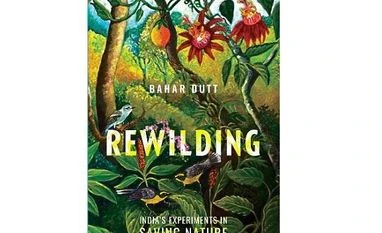
At a time when global leaders are denying climate change even as the world reels under the impact of extreme weather phenomena and gloomy predictions that 30-50 per cent of all species today might be extinct by mid-century, the blurb of Bahar Dutt’s Rewilding: India’s Experiments with Saving Nature , promises that rare commodity — hope for the planet. The award-winning environment journalist has travelled across the country to see dugongs, olive ridley turtles, pygmy hogs and other endangered creatures to assess the efficacy of the efforts to conserve, protect and rewild these species and their habitats. In so doing, she has documented India’s uphill battle to save not just its animals but its wild spaces too.
Rewilding is, simply put, the restoration of environments to their natural state. It has four cornerstones — protecting the core, restoring wildlife corridors, reintroducing carnivores at the top of the food chain and nurturing keystone species. These are species that interact with their habitat in so many ways that their absence would significantly alter it. The first question that Ms Dutt poses is whether rewilding is even possible in India, with its diversity of people, animals and habitats existing together, as she puts it, like a tossed salad. To answer it, she documents cases across India, where rewilding has worked, at least in part. What emerges throughout the book isn’t just that these conservation efforts have worked — but how fragile they are. Their continued success rests in the hands of the government, often clashing with its development imperative to build more dams, mines, roads and waterways.
Of these, the most striking is the story of the turtle hatchery in Varanasi, which was developed in the 1980s under the Ganga Action Plan. Today, this hatchery, which has provided a safe haven for species such as the Indian softshell turtle and Indian flap shelled turtle as well as the critically endangered Gangetic dolphin, faces an uncertain future. A central government proposal to denotify it as a sanctuary was issued in 2018 to make way for developing a waterway on the Ganges. Ironically, merely two days after the state government issued the order, Prime Minister Modi received the UN Environment Champions of the Earth award for his “exemplary action on climate change and sustainable development”. The story of the conservation and rewilding of the mahaseer is also interesting as it is a rare instance of a corporate working towards the conservation of a lesser-known species. She also examines the efforts towards the conservation of pygmy hogs and one-horned rhinos in Manas National Park, Assam, which remains a hotbed of insurgency.
Consequently, these tales don’t evoke the hope that Rewilding’s blurb promises. Instead, being the good journalist that she is, Ms Dutt discloses that while the Tatas were remarkably successful in hatching mahaseer eggs and transporting them in moist cotton wool across the country with a mortality rate of barely 1.5 per cent, they have done little to protect the mahaseer in the wild. Further, by stocking several hundred thousand fingerlings of the blue-finned mahaseer into the Cauvery without establishing a baseline count of the endemic hump-backed mahaseer, their rewilding effort may be one of the reasons for the catastrophic decline in the humpback population. The question arises, if rewilding can upset the delicate balance in which nature hangs, should it be done at all? Ms Dutt does not provide any answers.
She is, however, spot on in criticising wildlife conservation projects in India which often tend to exclude local communities. For example, the government set up residential schools for girls from the Pardhi tribe, traditionally the poachers of Panna National Park in MP. However, they weren’t given any vocational training, and most returned home after years of living away, proverbial fishes out of water. Similarly, some villages bordering Manas National Park were given smokeless stoves to reduce people’s dependence on firewood. The stoves stopped working after a while, the people returned to foraging for wood illegally from the park. Ms Dutt muses that perhaps if they had been encouraged to plant trees along the boundary, locals could have had a continuous source of fuel as well as a relationship with the wild.
Perhaps the most disheartening aspect of India’s rewilding journey is that the newly rewilded spaces are always going to be vulnerable to destruction. The proposed plan to link the rivers Ken and Betwa is an example. First, the government and NGOs worked for over a decade to rewild this jungle, even successfully reintroducing tigers into it. Today, if the plan to link the two rivers is carried out, it would entail submerging this entire tract of forest. Similarly, a successful citizens’ movement to rewild a portion of Delhi/Gurgaon exists under constant threat. The citizens group has already foiled the government’s plan to build a highway through the Aravalli Biodiversity Park once. But even today, the fate of the park depends upon the whims of the government and the resolve of its citizen protectors. These stories, instead of evoking optimism, may prompt the reader to wonder if rewilding is even worth it.
Rewilding: India’s Experiments in Saving Nature

 "Rebalancing nature")












 Connect with us on WhatsApp