Unlike the strong first half of financial year 2021-22 (H1FY22), the consumer durables industry was impacted in the third quarter (Q3) as fewer people stepped out to visit stores due to the third wave of the pandemic.
“The industry witnessed a volume [contraction] of 25-30 per cent in Q3 due to omicron. Price hikes provided some respite in value terms as the fall was capped,” Kamal Nandi, head and executive vice president at Godrej Appliances, told Business Standard. In value terms, the contraction was lower by 15-18 per cent in Q3, Nandi added.
According to Capitaline data, the combined net sales of 12 consumer durable goods companies grew by 11.2 per cent year-on-year (YoY) to Rs 13,620 crore in Q3, slower than the 25-78 per cent YoY growth seen in the previous four quarters. Three companies saw revenues contract, four saw top line grow in single digits, and five posted 16-40 per cent growth.
Their combined profit before interest, depreciation and tax (PBIDT) contracted by 18.7 per cent YoY, the first decline in at least five quarters. In fact, eight firms saw their PBIDT decline in Q3. Consequently, the combined net profit was down 29 per cent YoY in Q3, another first in at least five quarters.
After announcing its results, Voltas had said, “The quarter witnessed mixed results for different business segments. While muted demand post season and early signs of 3rd wave (Omicron) has impacted the trade and consumer sentiments for the cooling products segment.” It also said its unitary cooling products business, despite being impacted by tepid demand after the festive season and uncertainty amongst channel partners due to third wave, reported higher revenue of Rs 1,094 crore, against Rs 1,003 crore in the year-ago period.
Anil Rai Gupta, chairman and managing director of Havells, told investors that the company’s revenue in Q3 grew in mid-teens, but volumes were flat.
Vijay Sales, an offline retail chain, saw its stable revenue but volumes were impacted. “Our sales during the quarter were not impacted in value terms due to price hikes, but we have definitely seen volume degrowth during the quarter and also the year,” said Nilesh Gupta, MD of the firm.
The bad news, however, ends here. After two barren summers, the industry hopes Q4 will be better.
“The last few weeks have seen the return of Covid-led anxiety in the demand market, but it seems that unlike last year, the recovery could be swift. We remain positive on demand resilience,” Gupta of Havells said.
Nandi expects Q4 to be good thanks to pent-up demand, which will lift sales of products like air conditioners and refrigerators in the summer.
Achal Bakeri, chairman and managing director of Symphony, also told investors in a post earnings call that if temperatures rise by February there would be “liquidation” of channel inventory and subsequent replenishment.
There has been some change in consumer behaviour too. According to GfK Market & Consumer Intelligence data, there was a preference for premium products, and smaller cities and online retail thanks to people staying at home were the key drivers in 2021.
“The technical consumer goods industry clocked 22 per cent value growth, led by major domestic appliances (37 per cent) and IT computing (32 per cent) in the January–November 2021 period. We expect 2022 to continue on the recovery path with evolving consumer needs in and beyond metro cities,” said Nikhil Mathur, managing director – India, GfK.
“The consumer electronics market, including television and audio home systems, registered 17 per cent value growth and the smartphone market grew by 18 per cent in terms of value (during Jan-Nov 2021). However, it is essential to understand the technical consumer goods industry sales performance in comparison to pre-pandemic levels since 2020 witnessed several market disruptions owing to lockdowns and two waves of the pandemic,” Mathur said.
Premiumisation as a trend picked up pace in 2020 and has continued in 2021 and GfK expects this to continue in 2022.
Despite price hikes, GfK Market Intelligence’s offline channel data showed that
consumers choose larger, faster and better-equipped devices and, hence, spend more on each purchase.
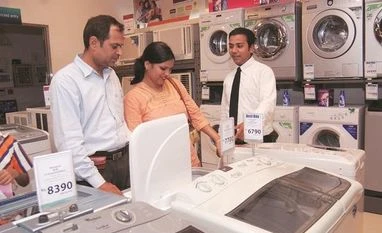
Vijay Sales witnessed the same trend across its stores as its average sales price almost doubled from Rs 36,000 pre-Covid to Rs 59,000-60,000 now. Demand for 8 kgs, 9 kgs and 10 kgs capacity washing machines increased. The same was true even in the refrigerator segment. Gupta explained that people have chosen to make their lives more comfortable at home.

 "Consumer durables market feels Omicron chill in the third quarter")












 Connect with us on WhatsApp