The dream run of declining net debt level for the three state-run oil marketing companies (OMCs) has now hit rock bottom, with analysts expecting the three companies to start a new capital expenditure (capex)-driven cycle.
“Between FY14 and FY16, working capital requirements were low, underrecoveries lower and OMCs managed to repay debt, which was the primary reason for declining debt levels. This will now change, as net debt reduction for the three OMCs has now bottomed out,” said an analyst from a domestic brokerage firm.
At a consolidated level, Hindustan Petroleum Corporation’s (HPCL’s) net debt for 2015-2016 was at Rs 27,062 crore, 17 per cent lower from 2011-2012 net debt.
In the same period, Bharat Petroleum Corporation’s net debt was lower by 21 per cent and for Indian Oil Corporation (IndianOil) net debt declined 29 per cent.
“A major difference between the previous upcycle for net debt seen for these OMCs from what we would see in the coming financial years is the previous one was working capital driven, the one likely to play out in future would be capex-driven, which would be a healthier one,” said a second analyst with a rating agency tracking one of the three OMCs.
Amongst the three OMCs, HPCL is likely to see a significant impact of this change in net debt trend, owing to its ambitious expansion plan and greater presence in the trading business. “HPCL’s lower presence in refining and greater presence in trading means they gain most when we see net debt levels going down and also get impacted significantly when it moves upwards,” said the first analyst quoted above.
A second analyst agreed of the three OMCs, HPCL is expected to see larger interest cost related concerns.
Analysts with JP Morgan expect HPCL’s standalone debt to double by financial year 2019-2020.
“HPCL’s standalone net debt declined 67 per cent over FY14-17. HPCL was a big beneficiary of falling oil prices, strong refining margins and the deregulation of auto fuel pricing that flowed through to earnings, balance sheets and stock prices. From here, we see weaker refining margins, limited inventory gains and the lack of refining volume growth limiting core earnings growth. Net debt should increase as HPCL embarks on a large capital spending programme to upgrade refineries,” the analysts wrote in a March 14 JP Morgan note.
HPCL has planned large capital expenditure of Rs 52,000 crore over FY17-FY21, the majority of which would be focused on refinery capacity addition and upgrades.
For BPCL, analysts point out major part of the capex will also depend on how the company’s exploration interests pan out in the coming years. “The balance sheet deleveraging has likely peaked, though the pace of debt increase from here would be driven by expansion/acquisition projects,” JP Morgan said in a February 10 report.
In addition to planned capex, analysts point out dividend payout may also contribute to rising net debt levels.
In March this year, all three state-owned OMCs —IndianOil, BPCL and HPCL —declared interim dividends for 2016-17 financial year.

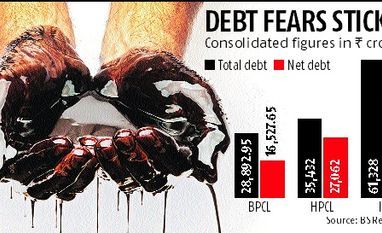 "For state-run OMCs, deleveraging may have peaked")












 Connect with us on WhatsApp