Tyre makers cautious on outlook even as capacity utiliisation improves

Factors helping capacity utilisation include encouraging domestic replacement demand in passenger vehicles, two-wheelers and the farm segment, and a drop in imports
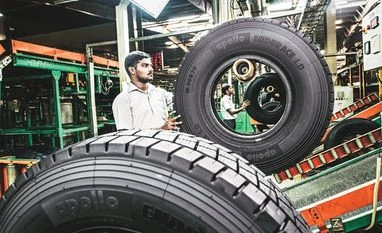
tyre
The share of OEM sales in the overall revenue mix for all tyre companies had declined in 2019-20
T E Narasimhan Chennai
4 min read Last Updated : Oct 02 2020 | 10:59 PM IST

Don't want to miss the best from Business Standard?

In the backdrop of an increase in demand from the aftermarket, farm sector, two-wheeler and cars segments, tyre makers have started seeing their capacity utilisation reaching almost 80-90 per cent. However, companies are cautious on the outlook for the whole fiscal, as many variables may change.

Rajiv Budhraja, director general, Automotive Tyre Manufacturers' Association (ATMA) said that month-on-month demand is going up. Factors helping capacity utilisation include encouraging domestic replacement demand in passenger vehicles, two-wheelers and the farm segment, and a drop in imports.

Satish Sharma, President, Asia Pacific, Middle East & Africa (APMEA), Apollo Tyres added the demand in the after-market has been robust since June till date across categories.  

"We have been improving our utilisation in each successive month since May. Demand in the aftermarket is stronger YoY, OEMs are improving, and now with container availability normalising, we hope to improve our Exports over last year as well," said Sharma.

The company's management in a recent interview mentioned that its capacity utilisation was upwards of 80 per cent.

CEAT's CFO Kumar Subbiah said capacity utilisation at his company is nearly 100 per cent and the demand was slightly higher than pre-Covid levels in the replacement market. OE demand is close to where it was before Covid-19. CEAT is also producing more to bring inventory to normal levels.

The share of OEM sales in the overall revenue mix for all tyre companies had declined in 2019-20, due to the performance of OEs. Replacement market demand, however, helped arrest a steep fall in tyre sales. With further slowdown/degrowth in the auto segment expected this fiscal as well, Karthik Raj K, Associate Director at CARE Rating says OEM demand recovery is likely to be slow, while normalised demand from the replacement market is expected.


Buhdraja added, tyre imports reduced by around 45 per cent during April-July 2020 from April to July 2019 in value terms.  Notwithstanding a tough trade environment with countries erecting barriers in the wake of coronavirus pandemic, tyres worth Rs 3,300 crore were exported from India during the April-July period of 2020-21.

On impact of rubber price, Subbiah said, normally there is a lag of 2-3 months for raw material prices to see impact on margins. Rubber prices have increased 4-5 weeks back. Domestic prices are now at Rs 132-135 a kg, while international price was $1400 per tonne.

Raj added, other key raw materials such as synthetic rubber, carbon black and other chemicals are crude derivatives, material cost for tyre manufacturers have softened over last year.

"Price (for tyre) increases or decreases, owing to movements in raw material prices, follows a lag effect in Indian tyre market. Hence an increase may be needed in Q3. It will also depend on the crude oil price and the strength of Indian Rupee," said Sharma.

Outlook

The forecast of a normal monsoon and its timely onset has boosted the expectations of a bumper crop output and this augurs well for the rural economy. This can strengthen rural income, which will see a spurt in demand for two-wheelers and tractors. Thus, a recovery in the rural economy will be a relief to the tyre industry,” said K M Mammen, CMD, MRF.

The road to recovery will not be smooth, given the impact on disposable incomes, consumer behaviour and credit, he said in a note to shareholders. The bright spot would be the rural and semi-urban areas.

Sharma added, "To give an outlook for the full fiscal we still need to watch the situation as there are too many variables which may change."  Subbiah added, "We need to see how next quarter panning out to give a forecast for the whole year."

Budhraja said, "As we move to the third and fourth quarter, we need to wait and see, If the pandemic settles and festival season is good, then we will end the year with a marginal decline or even manage a flat growth."

One subscription. Two world-class reads.

Already subscribed? Log in

Subscribe to read the full story →
*Subscribe to Business Standard digital and get complimentary access to The New York Times

Smart Quarterly

₹900

3 Months

₹300/Month

SAVE 25%

Smart Essential

₹2,700

1 Year

₹225/Month

SAVE 46%
*Complimentary New York Times access for the 2nd year will be given after 12 months

Super Saver

₹3,900

2 Years

₹162/Month

Subscribe

Renews automatically, cancel anytime

Here’s what’s included in our digital subscription plans

Exclusive premium stories online

  • Over 30 premium stories daily, handpicked by our editors

Complimentary Access to The New York Times

  • News, Games, Cooking, Audio, Wirecutter & The Athletic

Business Standard Epaper

  • Digital replica of our daily newspaper — with options to read, save, and share

Curated Newsletters

  • Insights on markets, finance, politics, tech, and more delivered to your inbox

Market Analysis & Investment Insights

  • In-depth market analysis & insights with access to The Smart Investor

Archives

  • Repository of articles and publications dating back to 1997

Ad-free Reading

  • Uninterrupted reading experience with no advertisements

Seamless Access Across All Devices

  • Access Business Standard across devices — mobile, tablet, or PC, via web or app

Topics :Tyre makersCeatCeat TyresApollo TyresTyre companiestyre importsTyre industry

Next Story



