
Around 400 mn Indians can slip deeper into poverty due to Covid-19: ILO
ILO noted that lockdowns and related business disruptions have had sudden and drastic impacts on workers and enterprises
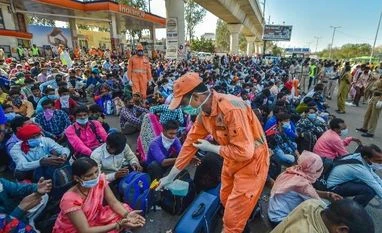 "Around 400 mn Indians can slip deeper into poverty due to Covid-19: ILO")
premium
WebinarsNew
Deep DiveNew
Explore Business Standard
ILO noted that lockdowns and related business disruptions have had sudden and drastic impacts on workers and enterprises
Around 400 million Indians are at a risk of slipping into poverty due to a “stringent” nationwide lockdown implemented to control coronavirus, International Labour Organisation (ILO) said in a recently released report.
“In India, Nigeria and Brazil, the number of workers in the informal economy affected by the lockdown and other containment measures is substantial. In India, with a share of almost 90 per cent of people working in the informal economy, about 400 million workers are at risk of falling deeper into poverty during the crisis,” the ILO said in its report on ‘COVID-19 and the world of work’.
It noted that India’s current lockdown measures were at the high end of an index produced by the University of Oxford, known as COVID-10 Government Response Stringency Index, which has impacted informal sector workers “significantly, forcing many of them to return to rural areas.”
In fact, using the University of Oxford’s index, the ILO plotted a chart to show how India has put more informal workers under lockdown than its neighbour Pakistan and other countries such as Brazil and China.
ILO noted that lockdowns and related business disruptions have had sudden and drastic impacts on workers and enterprises.
“ILO estimates show that workplace closures have increased so rapidly in recent weeks that 81 per cent of the global workforce lives in countries with mandatory or recommended closures,” the ILO said.
The ILO estimates that the pandemic is expected to take away 195 million full-time jobs across the world. It said the employment losses are rising rapidly across the globe and described it as “the most severe crisis since the Second World War.”
The sectors considered at high risk of disruption, according to the ILO, are accommodation and food service activities; manufacturing; real estate, business and administrative activities; and wholesale and retail trade, repair of motor vehicles and motorcycles.
India had announced a 21-day national lockdown beginning March 25 with a complete ban on public transportation and on movement of people outside their homes, except for essential services. The lockdown was announced by Prime Minister Narendra Modi, giving a four-hour notice on March 24.
In India, empirical evidences suggest that the unemployment rate, which was at a 45-year-high of 6.1 per cent in 2017-18, is already soaring. Though the official data is yet to be released, the Centre for Monitoring Indian Economy, a private agency which conducts regular job surveys, said that the unemployment rate touched at 23.4 per cent for the week ended April 5. The sample size was, however, low at 9,429 as conducting physical surveys became a challenge during the lockdown.
The lockdown led a reverse migration with workers leaving cities back to their villages as industries were shut and paying off house rent or taking care of basic needs became a challenge, apart from health concerns. According to official estimates, 500,000-600,000 workers had to walk back home on foot as public transportation was not available to them. They travelled miles on foot to reach their villages. Hundreds of thousands migrant workers are still living in shelter homes set up by various state governments in India, while the rest are under quarantine facility before they are allowed to meet their families.
According to the ILO, around two billion people work informally around the globe, most of them in emerging and developing countries. According to this estimate, India accounts for 20 per cent of all the informal workers around the globe.
Already subscribed? Log in
Subscribe to read the full story →

3 Months
₹300/Month
1 Year
₹225/Month
2 Years
₹162/Month
Renews automatically, cancel anytime

Premium stories handpicked daily by our editors


News, Games, Cooking, Audio, Wirecutter & The Athletic
Digital replica of our daily newspaper — with options to read, save, and share


Insights on markets, finance, politics, tech, and more delivered to your inbox
In-depth market analysis & insights with access to The Smart Investor


Repository of articles and publications dating back to 1997
Uninterrupted reading experience with no advertisements


Access Business Standard across devices — mobile, tablet, or PC, via web or app
First Published: Apr 08 2020 | 4:52 PM IST


 Connect with us on WhatsApp