Coal workers in battle for frontline status amid Covid-19 pandemic

Coal India says it made arrangements for sufficient beds, unions dispute claim
coronavirus, vaccine
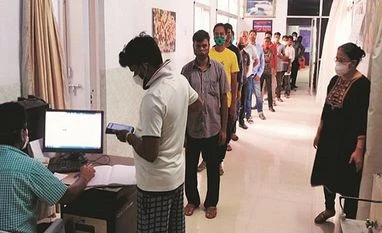
Coal miners work in proximity to each other and the chances of them spreading Covid is high.
Shreya Jai New Delhi
5 min read Last Updated : Jun 07 2021 | 6:10 AM IST
In April, S Srivastava, an office bearer of the Dhanbad Colliery Karamachari Sangh, wrote to Bharat Coking Coal (BCCL) to declare mine workers as frontline staff and start their vaccination immediately.

Coal miners work in proximity to each other and the chances of them spreading Covid is high.

By April-end, BCCL parent Coal India (CIL) started vaccinating its employees but many felt it was already too late. CIL said deaths reported from April 1 to May 27 of 2021 due to Covid was 360. Workers and trade unions in the mining states put the figure at close to 500 employees, including contractual workers and their wards. 

While the numbers vary, mine workers in some of the remotest corners of the country battle Covid-related risks every day. “Coal mining is essential work, but it was not recognised as frontline. Even if one worker falls sick, the other nine who work along with him go to work the next day,” said Ravi Singh, a mechanic with Dhanbad Collieries. These workers cannot self-isolate since work has to go on.

CIL has an extensive medical network but it was stressed during the second wave. Primary healthcare centres near remote mining areas in Chhattisgarh, Madhya Pradesh, West Bengal and Jharkhand have only basic medical infrastructure and staff, several workers told Business Standard. 

Singh works with BCCL, which has one central hospital, 13 regional hospitals and 73 dispensaries for its 43,000 workers. District administrations took charge of CIL hospitals from March 2021 as cases surged but this meant coal workers facing bed and oxygen shortage at their own company hospitals. “For every three to four dispensaries, there is one doctor. There is delay in testing, admission and even medicine availability. There was one ambulance for every three collieries and they did not have an oxygen facility during the peak” said Srivastava. BCCL’s mining area includes Jharia and Raniganj coalfields in Jharkhand and West Bengal. 

Singh, who tested positive in May and was admitted to a CIL-run hospital, said while critical services were available, there was a shortage of staff and ICU admission was solely on “reference” basis.

“I was not even admitted to a Covid ward. There was considerable delay in the treatment. There were non-CIL people in the ICU, while we scrambled for some reference. Even for a CT scan, I had to go to another hospital,” said Singh.

After close to 20 days of recovery, Singh was back to work at the mine but two other colleagues admitted along with him died. “We are workers of the company only till the time we are in the mine, not beyond that,” rued Singh.

South Eastern Coalfields (SECL), which is one of the larger subsidiaries of CIL operating 89 mines in Chhattisgarh and Madhya Pradesh, has seen 1,710 employees testing positive and 124 deaths as on June 1, 2021. According to official data by SECL, two contractual workers have lost their lives. Data collated by the workers’ union, however, shows 68 contractual workers succumbing to Covid, taking the total death toll at SECL zones to 160. 

“As testing and treatment is delayed, a lot of workers, who have died due to Covid, are not even getting certificates indicating Covid as the cause. Most of these contract workers are dying at home, either because of lack of treatment or ignorance because of which they avoid hospitalisation,” said V M Manohar, Centre of Indian Trade Unions (CITU) leader in Chhattisgarh.

Korba, which has three big coal mines – Kusmunda, Dipka and Gevra – has seen the highest number of cases, said Manohar. “The lack of certification is impacting families of deceased workers. It will be difficult for these families to get the Covid compensation announced by the government,” he said.

CIL has declared a compensatory ex gratia of Rs 15 lakh in case of death due to Covid for its own employees and contractual workers. A CIL spokesperson, however, said, “Instances where the compensation is pending could be due to non-submission of documents from the deceased families for various reasons.”

Compensation for families of the 233 deceased, amounting to about Rs 3.5 crore has been disbursed and approval for Rs 6.45 crore for 43 families is under process.

“What the whole country faced, CIL also battled – lack of medical infrastructure. CIL prepared a plan to have super speciality hospitals in every subsidiary but it didn’t take off. We have urged the company to start it. We should be prepared for a pandemic such as Covid,” said DD Ramanandan, general secretary, CITU.  

The CIL spokesperson, however, said the company was “the highest mobiliser of Covid care beds in corporate India.”

CIL said 3,831 Covid beds were created during the current financial year, so far, compared to 2,160 last year. The availability of oxygen cylinders doubled to 2,673 compared to 1,077 as of March 31, 2021. Ready-for-use ventilators were 247 from just 94 earlier. CIL has also recently announced that it would set up two oxygen plants at an investment of Rs 35 crore.

Executives posted in mining areas claimed there is a shortage of vaccines and the drive pauses for days when vaccines run out.

Also, vaccination has its own challenges. In Medhua, one of the remotest villages beyond Korba district, five died post vaccination after the first drive for 50 people was over. The whole village erupted in a riot against the local health worker, who later committed suicide. The villagers have now boycotted the vaccine drive.

One subscription. Two world-class reads.

Already subscribed? Log in

Subscribe to read the full story →
*Subscribe to Business Standard digital and get complimentary access to The New York Times

Smart Quarterly

₹900

3 Months

₹300/Month

SAVE 25%

Smart Essential

₹2,700

1 Year

₹225/Month

SAVE 46%
*Complimentary New York Times access for the 2nd year will be given after 12 months

Super Saver

₹3,900

2 Years

₹162/Month

Subscribe

Renews automatically, cancel anytime

Here’s what’s included in our digital subscription plans

Exclusive premium stories online

  • Over 30 premium stories daily, handpicked by our editors

Complimentary Access to The New York Times

  • News, Games, Cooking, Audio, Wirecutter & The Athletic

Business Standard Epaper

  • Digital replica of our daily newspaper — with options to read, save, and share

Curated Newsletters

  • Insights on markets, finance, politics, tech, and more delivered to your inbox

Market Analysis & Investment Insights

  • In-depth market analysis & insights with access to The Smart Investor

Archives

  • Repository of articles and publications dating back to 1997

Ad-free Reading

  • Uninterrupted reading experience with no advertisements

Seamless Access Across All Devices

  • Access Business Standard across devices — mobile, tablet, or PC, via web or app

Topics :CoronavirusCoal IndiaCoal minesCoronavirus Vaccinehospitals

Next Story



