
Kashmir sees 31% rise in terror-related deaths a year after surgical strike
This indicates that terrorist attacks and infiltration in J&K continue unabated a year after the surgical strikes
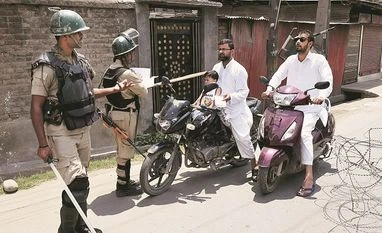 "Kashmir sees 31% rise in terror-related deaths a year after surgical strike")
premium
WebinarsNew
Deep DiveNew
Explore Business Standard
This indicates that terrorist attacks and infiltration in J&K continue unabated a year after the surgical strikes
There has been a 31% increase in deaths due to terrorist-related incidents in Jammu & Kashmir (J&K) in one year since the Indian Army conducted what are called “surgical strikes” in Pakistan-Occupied Kashmir (PoK), according to an IndiaSpend analysis of data from the South Asian Terrorism Portal (SATP) run by the New Delhi-based Institute for Conflict Management, a non-profit.
The increase in terrorist-related deaths from 246 in 2015-16 to 323 in 2016-17 (till September 24, 2017) indicate that terrorist attacks and infiltration in J&K continue unabated a year after the surgical strikes.
This comes even as Indian Army chief General Bipin Rawat hinted that more surgical strikes could be mounted “if necessary”.
“The strike was a message we wanted to communicate to them, and they have understood what we mean,” Rawat was quoted as saying in Mint on September 25, 2017.
He said terrorists keep infiltrating into India because their camps remain operational in PoK.
“Even we are ready. We will keep receiving them (infiltrators) to dispatch them two-and-a-half feet below the ground,” Rawat said.
Source: South Asia Terrorism Portal
Note: * Data for 2016-17 until September 24, 2017
SATP compiles data on deaths due to terrorism from media reports. The data are provisional, and current as on September 24, 2017.
The number of terrorists killed by security personnel increased 24% from 157 in 2015-16 to 194 in 2016-17.
The number of security personnel killed in terrorist violence has declined 2.5% from 79 in 2015-16 to 77 the following year, according to an analysis of data compiled by SATP.
The number of civilian casualties from terrorist-related violence increased almost five times to 52 in 2016-17 from 10 in 2015-16.
The increase in terrorist casualties compared to the marginal increase in deaths of security personnel can be seen as an indicator of the growing effectiveness of counter-terrorism operations of the Indian armed forces in J&K.
The surgical strikes, or forays into Pakistan by special forces, last year were touted as a revenge for the Uri attack.
On September 29, 2016, the Indian Army crossed the Line of Control (LoC) into PoK to carry out “surgical strikes” on terror “launch pads,” Director General of Military Operations Lt. General Ranbir Singh had announced.
“The operations were focused to ensure that these terrorists do not succeed in endangering lives of citizens in our country. During the counter-terrorist operations, significant casualties have been caused to the terrorists,” Singh had said.
Bharatiya Janata Party president Amit Shah had lauded Modi and the Army over the surgical strikes, calling it a “frontal fight against terrorism” which would make India feel “secure”.
(Sethi is a Mumbai-based freelance writer and defence analyst.)
Already subscribed? Log in
Subscribe to read the full story →

3 Months
₹300/Month
1 Year
₹225/Month
2 Years
₹162/Month
Renews automatically, cancel anytime

Premium stories handpicked daily by our editors


News, Games, Cooking, Audio, Wirecutter & The Athletic
Digital replica of our daily newspaper — with options to read, save, and share


Insights on markets, finance, politics, tech, and more delivered to your inbox
In-depth market analysis & insights with access to The Smart Investor


Repository of articles and publications dating back to 1997
Uninterrupted reading experience with no advertisements


Access Business Standard across devices — mobile, tablet, or PC, via web or app
First Published: Sep 29 2017 | 9:14 AM IST


 Connect with us on WhatsApp