Katowice climate talks: US, EU refuse disclosure on climate finance

The developed countries instead demanded that developing countries provide information on how they would also contribute to climate finance
Climate change
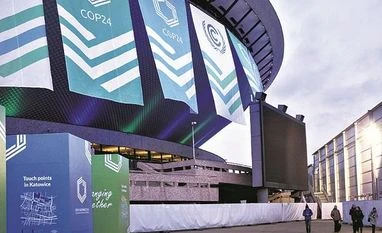
The two-week conference in the Polish city is discussing how to enforce global action to limit further warming of the planet. Photo: Bloomberg
Nitin Sethi Katowice
5 min read Last Updated : Sep 27 2019 | 12:58 PM IST
The United States, European Union, and other developed countries demanded that the climate finance rules to the Paris Agreement not ask them to divulge how much money they would provide in future for loss and damage caused to poor countries by climate change. 

They instead demanded that developing countries provide information on how they would also contribute to climate finance - something the Paris Agreement does not have provisions for. 

Developed countries also refused to set a baseline year to which their future financial contributions under the Paris Agreement could be compared to see if they are contributing more to the funds than what they do pre-2020. The Paris Agreement, which is to be implemented from 2021, requires the developed countries to enhance their contributions. 

“We do not understand what a baseline is,” the US said.

All rich countries and their country groups also said they would not set a date by which they would start providing this whittled down information on climate finance. 

Drawing deeply contentious red-lines, developed countries additionally vetoed any proposal that countries systematically assess and review their upfront information on future climate finance flows under the Paris Agreement.

The developed countries took these positions in a closed-door meeting held on December 5. This led to heated debates with developing countries, including India, the Africa Group, China and others who accused developed countries of walking away from the commitments they had made under Paris Agreement in 2015. 

Business Standard reviewed records of the meeting maintained by negotiators internally. 

On December 6, when the first formal draft of the climate finance rules was released, the hard red-lines developed countries had drawn showed up as bracketed text. Any text in the draft documents that is presented within brackets indicates that consensus does not exist on those issues.

“This is plain ridiculous. They said they shall start negotiating on climate finance but all they want is to have a carte blanche. They want the freedom to provide whatever information they want to. They do not want anyone to review it. They do not want to even indicate how much money they might provide for loss and damage caused to poor vulnerable countries. Instead, they say we should tell how much developing countries will provide,” said a developing country negotiator present in the meeting. 
Developing countries did not mince their words even within the meeting, show records. 

South Africa, speaking for all African countries said, “We are operationalising obligations of developed country partners under the Paris agreement. This (the provisions under Paris Agreement for providing upfront information on climate finance) does not apply to developing countries. This deadline is not for us. This deadline is you. There is no going back on Paris agreement. This is a red line for us - we will not be party to any decision that lumps us together again. We are not going to renegotiate Paris Agreement.” 

Along with India, China and other like-Minded Developing Countries, the Africa Group insisted that the developed countries start providing indicative upfront information from 2020. 

Even as Africa Group, India and China insisted that the rules adhere to the Paris Agreement, developed countries listed out more red-lines and deletions they wanted from the rules on climate finance.

They insisted there should not be a post-facto review of how developed countries actually deliver against the finance they promise to provide - what is referred to as the ex-ante information on climate finance under Article 9.5 of the Paris Agreement.

Brazil countered this by stating, “This is not information not just for the sake of information but it is linked to the issue of ambition from developing countries. More ambition on finance means more ambition on climate action,”

Ecuador, speaking for the Like-minded Developing Countries asked how would the world be assured that there was progression on climate finance fund flows over time, as the Paris Agreement requires, if a post-factor assessment was not provided for in the rule-book.
India also pointed out that the developed countries should be required to clearly say how much of the future financial flows would be new and additional and not double accounting of their existing financial obligations such as overseas development assistance. 

By the afternoon of December 6, the deep divide between developed and developing countries had spread to other elements of climate finance rule-book as well. 

"After a year of stonewalling, on December 4 they (developed countries) said they will finally start talking of climate finance. This might sound harsh, but they are negotiating in bad faith. It is not just the US, all developed countries have come together on it while in public some of them claim to be leaders on climate change," said another developing country lead negotiator present at the closed-door meeting.

One subscription. Two world-class reads.

Already subscribed? Log in

Subscribe to read the full story →
*Subscribe to Business Standard digital and get complimentary access to The New York Times

Smart Quarterly

₹900

3 Months

₹300/Month

SAVE 25%

Smart Essential

₹2,700

1 Year

₹225/Month

SAVE 46%
*Complimentary New York Times access for the 2nd year will be given after 12 months

Super Saver

₹3,900

2 Years

₹162/Month

Subscribe

Renews automatically, cancel anytime

Here’s what’s included in our digital subscription plans

Exclusive premium stories online

  • Over 30 premium stories daily, handpicked by our editors

Complimentary Access to The New York Times

  • News, Games, Cooking, Audio, Wirecutter & The Athletic

Business Standard Epaper

  • Digital replica of our daily newspaper — with options to read, save, and share

Curated Newsletters

  • Insights on markets, finance, politics, tech, and more delivered to your inbox

Market Analysis & Investment Insights

  • In-depth market analysis & insights with access to The Smart Investor

Archives

  • Repository of articles and publications dating back to 1997

Ad-free Reading

  • Uninterrupted reading experience with no advertisements

Seamless Access Across All Devices

  • Access Business Standard across devices — mobile, tablet, or PC, via web or app

Topics :Climate ChangeUN climate summit

Next Story



