Things change. In 2015, this very government, led by Narendra Modi, argued before the Supreme Court that K K Venugopal was caught in the throes of a conflict of interest and must be removed as the lawyer for the Enforcement Directorate (ED) and the Central Bureau of Investigation (CBI). And today, Venugopal has been appointed the Attorney General of India, the senior-most law officer of the government.
The issue in 2015 was the permanent absorption in ED of Rajeshwar Singh, a UP state police services officer. The context was the ongoing 2G spectrum investigation. Singh, described, among other things, as UP’s ‘encounter specialist’, did not want to return to his parent cadre and wanted to be placed permanently with the ED. He was investigating many high profile cases and had imposed a fine of Rs 7,100 crore on Swan-Etisalat for FEMA violations in the 2G case. Then Finance Minister P Chidambaram felt there were legal infirmities in the matter. He ordered that Singh is repatriated to his parent cadre. This order was challenged by Singh on a variety of fora, including the Central Administrative Tribunal. Later, Chidambaram was to charge that Singh was acting against him and his family for the action he had taken as finance minister.
In the meantime, the Supreme Court ordered that no officer associated with the case should be transferred until final orders had been passed. As the tussle over Singh was going on, the government changed. The Bharatiya Janata Party (BJP) came to power, but the argument of the finance ministry did not change. Revenue Secretary Shaktikanta Das told the Supreme Court that the Ministry of Finance had decided to replace the CBI and ED lawyer – KK Venugopal - on grounds of conflict of interest and cited the Rajeshwar Singh matter as evidence.
The court was furious. Venugopal had been the CBI and ED advocate since the beginning of the 2G case. Instead of accepting this, the court named Venugopal amicus curiae(friend of the court) and told the CBI and ED to share all documents with him.
As the 2G case enters its last lap (a judgment is likely to be pronounced in September) KK Venugopal has become AG. A noted constitutional expert, Venugopal is the recipient of Padma Vibhushan and Padma Bhushan. He has become a law officer for the second time after being an Additional Solicitor General during the Morarji Desai government during the 1970s.
According to reports, the law was not his first choice. He was forced to opt for it after falling ill just before graduating from college. His father, M K Nambiar, was also a renowned lawyer who fought the A K Gopalan versus the State of Madras case. Venugopal graduated with a law degree from Raja Lakhamgouda Law College, Belgaum. Enrolled as an advocate in 1954, he was designated senior advocate by the Supreme Court of India in 1972. He has appeared for various cases involving infringement of the Constitution of India and has argued important cases like the Puducherry Assembly speaker election case, the case relating to M Karunanidhi’s government in 1976 and the Babri Masjid case. He was instrumental in urging the Supreme Court to stay the implementation of the Mandal Commission to stop the escalation of student violence.
At a time when liberalisation is yet to touch the legal profession, Venugopal told an interviewer: “I believe that it would be to the advantage of local lawyers because there is no doubt whatsoever that the standard of legal practice in foreign countries is far more advanced. Legal education abroad is of a much higher standard than what we have here in India. Their technology is superb”. This is bound to cause controversy because several lawyers oppose the entry of foreign law firms in India because there is no reciprocity.
It is his expertise in constitutional law which prompted Nepal and Bhutan to seek his help in drafting their respective constitutions.
In an interview to Bar and Bench, the well-known legal web publication, Venugopal revealed a side that was previously not so well known – his weakness for travel and his hobby of collecting antiquarian books. “I have many interests. I collect antiquarian books. I have collected books published in 1634, 1670 and so on. I also collect paintings, pictures and lithograph,” he told the portal in an interview in 2012.
“I have been travelling year after year and I have been to very many places, including the Antarctica, the Arctic Circle, the Galapagos Islands and so on. I trekked to Mansarovar which took a total of about 30 days. I have also undertaken a vertical climb of 2,200 feet to look down on a volcano crater in the Island of Santorini in Greece.”

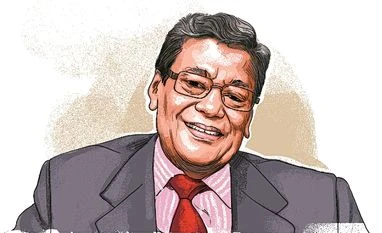 "KK Venugopal: Not allowed to represent ED in 2G case, now Attorney General")












 Connect with us on WhatsApp