Last year was the fourth warmest on record and the outlook is for more sizzling heat approaching levels that most governments view as dangerous for the Earth, a UN report showed on Wednesday.
Weather extremes in 2018 included wildfires in California and Greece, drought in South Africa and floods in Kerala, India. Record levels of man-made greenhouse gas emissions, mainly from burning fossil fuels, trap ever more heat.
Average global surface temperatures were 1.0 degree Celsius (1.8 Fahrenheit) above pre-industrial times in 2018, the UN's World Meteorological Organization (WMO) said, based on data from US, British, Japanese and European weather agencies.
"The long-term temperature trend is far more important than the ranking of individual years, and that trend is an upward one," WMO Secretary-General Petteri Taalas said in a statement.
"The 20 warmest years on record have been in the past 22 years." To combat warming, almost 200 governments adopted the Paris climate agreement in 2015 to phase out the use of fossil fuels and limit the rise in temperatures to 2C (3.6F) above pre-industrial times while "pursuing efforts" for 1.5C (2.7F).
"The impacts of long-term global warming are already being felt - in coastal flooding, heat waves, intense precipitation and ecosystem change," said Gavin Schmidt, director of NASA's Goddard Institute for Space Studies.
Last year, the United States alone suffered 14 weather and climate disasters with losses exceeding $1 billion each, led by hurricanes and wildfires, the US National Oceanic and Atmospheric Administration (NOAA) said.
NOAA and NASA contribute data to the WMO.
This year has also started with scorching temperatures, including Australia's warmest January on record. Against the global trend, parts of the United States suffered bone-chilling cold from a blast of Arctic air last week.
In WMO records dating back to the 19th century, 2016 was the hottest year, boosted by an El Nino weather event in the Pacific Ocean, ahead of 2015 and 2017 with 2018 in fourth.
The British Met Office, which also contributes data to the WMO, said temperatures could rise to 1.5C above pre-industrial times, for instance if a natural El Nino weather event adds a burst of heat.
"Over the next five years, there is a one in 10 chance of one of those years breaking the (1.5C) threshold," Professor Adam Scaife of the Met Office told Reuters of the agency's medium-term forecasts.
"That is not saying the Paris Agreement is done for ... but it's a worrying sign," he said. The United Nations defines the 1.5C Paris temperature target as a 30-year average, not a freak blip in a single year.
Patrick Verkooijen, head of the Global Center on Adaptation in the Netherlands, told Reuters that the WMO report showed "climate change is not a distant phenomenon but is here right now."
He called for more, greener investments, ranging from defences against rising seas to drought-resistant crops.

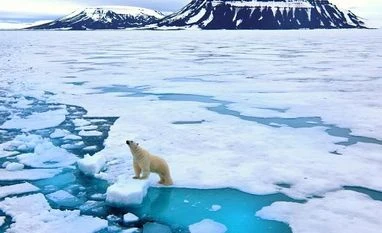 "Last year 4th warmest on record, world may breach 1.5C by 2030: UN report")












 Connect with us on WhatsApp