Finding gems among teachers to fix India's primary education system

Kaivalya Education Foundation's Aditya Natraj wants to fix India's primary education system
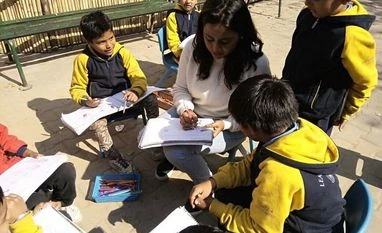
Education Alliance is trying to fix India's failing govt school system
Anjuli Bhargava New Delji
Last Updated : May 06 2018 | 7:00 AM IST
“A leader is someone who demonstrates what’s possible”
— Mark Yarnell

To be a doctor in India, you try and clear the National Eligibility cum Entrance Test or NEET and make it to AIIMS, or other state medical colleges. If you want to be an engineer, it’s the Indian Institute of Technology or IITs you have your eyes set on. And if you want to manage one of India’s MNCs, you must aim for the Indian Institute of Management or IIMs.  But what do you aim at if you want to be a teacher? 

Truth be told, there are no stellar organisations for training teachers in the country. Teaching is not a profession many aspire to pursue and the brightest minds often shun it, since it’s less remunerative than most other career choices. Teaching, like journalism, is something you kind of stumble upon. Failed at most else? Be a teacher or a journalist. It was to bridge this gap that Aditya Natraj, 44, an “anomaly” in the corporate world, after an MBA in France and working in London for a start-up and then with KPMG in consulting and corporate finance, - decided to make a radical change. He decided to marry the MBA and teaching and come up with something that trained people to be great teachers.

The year was 2001, he came back to India, joined ICICI bank and was deputed to work with Pratham for five years — which was relatively unknown back then. He moved out of Mumbai (he could no longer afford the city anyway) and started working in Kutch in Gujarat post the devastating earthquake, lived three months in Rajkot to experience what education in the slums means and worked with child labourers in Surat. In total, he worked for four years with Pratham in Gujarat (2002-07).

Natraj realised a few things. One, scale was important to get anywhere in a country of India’s size. There were many NGOs working in the education sector - working in bits and pieces with a range of children from rag pickers and beggars to slum children -- but very few had achieved any scale. Pratham was the first NGO he had found trying to tackle the problem systemically.

Two, many had given up on the government sector but he didn’t agree. Giving up was not an option. The rise and growth of the private sector in education is a reflection of the failure of the state system, but it cannot fully replace the state system. India as a country cannot afford to leave it “all to the private sector” since we have larger numbers than most. Moreover, since the government infrastructure already exists, it makes more sense to put it to good use. He knew he had found a problem worth tackling.

Aditya Natraj, CEO of KEF during an internal leadership workshop

 
As Natraj studied the education sector more closely he noticed a gap. Many government and public programs have provided training to school teachers, staff and children, but none had really focused on school leaders. The more he thought about it, the more convinced he became. Change starts from a single school. To develop a single school requires developing school leaders and letting them be the real agents of change. Once he is equipped, he can take the ball and run with it. Kaivalya education foundation (KEF) was set up in 2008 with the intention of offering leadership training to school leaders and principals. “It is akin to MBA meets education. We started with a big, hairy audacious goal”, explains Natraj.

The idea was that what IITs did for engineering and what IIMs have done for management, KEF wanted to do for school leaders. He argues that no excitement exists around being a teacher because there are no stellar institutions nurturing teachers. If there were, they would be enough takers.
 
Natraj had done an MBA and could understand the parallels quite clearly. Managing a school, he argues, is like managing a small business. You have eight to ten teachers, support staff, 250-odd students, parents, budgets to manage — a whole gamut of stuff to do, and typically, what the school principal is not trained to do. He may be trained to teach math or physics but not to manage this small enterprise.

It’s akin to asking an engineer in a car manufacturing firm to handle the full company — deal with sales, accounts, marketing, HR and operations. Typically, schools do not equip teachers with any of these skills. Principals are selected based on how many years they have been around and their seniority. “You can be a great physics teacher but are you great at handling subject teachers, politics among staff, administration, creating a positive environment, fees and balancing expenditures and revenues?”, Natraj says. KEF’s three-year Principal Leadership Development Programme trains teachers through 20 classroom sessions in four modules. In addition, eight one-day workshops are conducted in a month for those enrolled. A carefully worked out curriculum that ensures what the principals learn is relevant, imbibed and put into practice.

The KEF board comprises of Ajay Piramal, Madhav Chavan and Aditya Natraj who is also the CEO. The work started in 100 government schools in Rajasthan in 2008, followed by 100 in Gujarat over the next few years. Like with any new idea, the initial work took time, but once various stakeholders began to experience the change, they started to buy into it. Currently, KEF works with over 4,000 schools across 14 states with close to 1,000 people working for it. The primary donors include Ajay Piramal foundation, Michael and Susan Dell foundation, USAID and UNICEF.

Working with these schools across states has convinced Natraj that there is plenty of “hope”. Out of the roughly 12 million teachers in the government school system, he argues, at least 1 per cent are gems. His job is to find and polish them.

One subscription. Two world-class reads.

Already subscribed? Log in

Subscribe to read the full story →
*Subscribe to Business Standard digital and get complimentary access to The New York Times

Smart Quarterly

₹900

3 Months

₹300/Month

SAVE 25%

Smart Essential

₹2,700

1 Year

₹225/Month

SAVE 46%
*Complimentary New York Times access for the 2nd year will be given after 12 months

Super Saver

₹3,900

2 Years

₹162/Month

Subscribe

Renews automatically, cancel anytime

Here’s what’s included in our digital subscription plans

Exclusive premium stories online

  • Over 30 premium stories daily, handpicked by our editors

Complimentary Access to The New York Times

  • News, Games, Cooking, Audio, Wirecutter & The Athletic

Business Standard Epaper

  • Digital replica of our daily newspaper — with options to read, save, and share

Curated Newsletters

  • Insights on markets, finance, politics, tech, and more delivered to your inbox

Market Analysis & Investment Insights

  • In-depth market analysis & insights with access to The Smart Investor

Archives

  • Repository of articles and publications dating back to 1997

Ad-free Reading

  • Uninterrupted reading experience with no advertisements

Seamless Access Across All Devices

  • Access Business Standard across devices — mobile, tablet, or PC, via web or app

Next Story



