MGNREGS work demand slows but still higher than pre-pandemic months

Experts say unless non-farm activities grow in rural areas or demand rises in the urban, the informal sector might continue to struggle
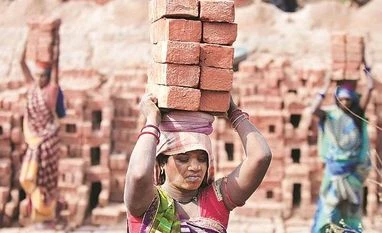
construction, realty, real estate, workers, labourer, labour, women, woman, jobs, migrant workers, mgnrega
Sanjeeb Mukherjee New Delhi
4 min read Last Updated : Nov 11 2022 | 11:03 PM IST
Mahatma Gandhi National Rural Employment Guarantee Act (MGNREGS) work demand has shown some signs of slackening in the last few months. However, in October 2022 around 15.5 million households sought work under the scheme, which is higher than the corresponding pre-Covid month of October 2019 but is much less than the demand in October 2020 and October 2021.

But the fact that still, an unusually huge number of people are seeking work under this flagship scheme means that for the third year running experts said that over 70 million households are expected to seek work under the scheme.

Before, the Covid pandemic around 50-55 million households regularly used to seek work under the scheme in a year, which has jumped to over 70 million per annum since the pandemic.

If this year too (FY23) over 70 million households demand work under the scheme, then it will mean that fundamentally the scheme characteristics have undergone a change and the overall economic growth is still not percolating down to the rural and unorganised segments of the society.

Also, job creation in urban areas for unskilled labour remains patchy, which is not causing labourers to shift from their existence to menial work in rural hinterlands.

This is also somewhat borne by the latest data from the Centre for Monitoring Indian Economy (CMIE).

According to CMIE, the unemployment rate in the country in October rose to 7.77 per cent compared to 6.43 per cent in September.

In this, the rural unemployment rate rose to 8.04 per cent in October from 5.84 per cent in September.

At the same time, the urban unemployment rate slid to 7.21 per cent in October compared to 7.7 per cent in September.

The CMIE data also showed that six out of the 25 states showed an unemployment rate in double figures.

These included Haryana at 31.8 per cent, Rajasthan at 30.7 per cent, Jammu and Kashmir at 22.4 per cent, Jharkhand at 16.5 per cent, Bihar at 14.5 per cent and Tripura at 10.5 per cent.

Madhya Pradesh recorded the lowest unemployment rate at 0.9 per cent, followed by Chhattisgarh at 0.9 per cent, Odisha at 1.1 per cent and Gujrat at 1.7 per cent.

Continuing higher demand for MGNREGS also means that the Budget allocated for FY23, which is around Rs 73,000 crore could woefully fall short and for the third year running, the Centre might have to top it up big time to meet the growing demand.

So far, according to the MGNREGS website, almost 83 per cent of the allocated budget for the scheme has been spent with another five months to go before the next infusion will come.

Not surprisingly, according to a PTI report, the rural development ministry sought additional funds of about Rs 25,000 crore for the rural job scheme for Fy-23.
 
It has sought Rs 25,000 crore from the finance ministry and the funds are expected to be allocated by the second week of November, sources told PTI.

The government will take Parliament's approval for the additional fund allocation under the MGNREGA through the first batch of the supplementary demands for grants to be tabled in the upcoming winter session, the report further added.

If approved, the total expenditure on the scheme will be around Rs 98,000 crore, the same as FY22.

 “The robust demand for work under MGNREGS seen in this financial year despite an overall economic recovery clearly shows that informal sector jobs are still a problem and it is still not coming back to normal. Although, the labour participation rate has improved it is more kind of subsistence work,” Dr S Mahendra Dev, Distinguished Professor at ICFAI Business School, Hyderabad told Business Standard.

He said that by all indications if in FY23 also over 70 million households demand work under the scheme and it will become the new normal in the years unless non-farm jobs in rural areas are created at a brisk pace. Also, urban demand for casual labour needs to grow at a fast clip.

“The urban employment guarantee scheme could be an option to boost that demand for casual labour in the urban areas but it needs to be a combination of both skilled and unskilled workers which will then lead to a pullback at higher wages,” Dev said.


One subscription. Two world-class reads.

Already subscribed? Log in

Subscribe to read the full story →
*Subscribe to Business Standard digital and get complimentary access to The New York Times

Smart Quarterly

₹900

3 Months

₹300/Month

SAVE 25%

Smart Essential

₹2,700

1 Year

₹225/Month

SAVE 46%
*Complimentary New York Times access for the 2nd year will be given after 12 months

Super Saver

₹3,900

2 Years

₹162/Month

Subscribe

Renews automatically, cancel anytime

Here’s what’s included in our digital subscription plans

Exclusive premium stories online

  • Over 30 premium stories daily, handpicked by our editors

Complimentary Access to The New York Times

  • News, Games, Cooking, Audio, Wirecutter & The Athletic

Business Standard Epaper

  • Digital replica of our daily newspaper — with options to read, save, and share

Curated Newsletters

  • Insights on markets, finance, politics, tech, and more delivered to your inbox

Market Analysis & Investment Insights

  • In-depth market analysis & insights with access to The Smart Investor

Archives

  • Repository of articles and publications dating back to 1997

Ad-free Reading

  • Uninterrupted reading experience with no advertisements

Seamless Access Across All Devices

  • Access Business Standard across devices — mobile, tablet, or PC, via web or app

Topics :CoronavirusMGNREGSMGNREGAeconomyTop 10 headlines

Next Story



