Modi's million dollar challenge: How to fix Yogi Adityanath's UP?

Anyone who wants India to live up to its potential has to figure out how to fix UP
Modi
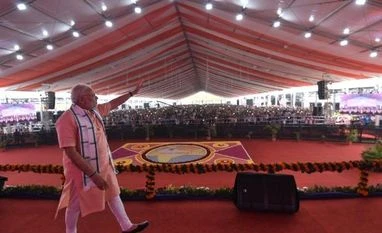
PM Narendra Modi in Daman | Photo twitter: @narendramodi
Mihir Sharma | Bllomberg
Last Updated : Feb 27 2018 | 4:21 PM IST
Uttar Pradesh, India's largest state, is also its greatest challenge. It has about as many people as Brazil but, according to Prime Minister Narendra Modi himself, suffers from development indicators more similar to sub-Saharan Africa than anywhere else in Asia. Anyone who wants India to live up to its potential has to figure out how to fix UP. And that isn't going to be easy. You'd need somehow to turn investors positive on a state burdened by overstretched infrastructure, an unqualified workforce, endemic corruption, hours-long power cuts and widespread lawlessness.

Last week, the state’s chief minister, a controversial monk-turned-politician who calls himself “Yogi” Adityanath, held a giant “investor summit” in UP’s capital, Lucknow. Modi’s choice of Adityanath to lead the state last year shocked many; the pugnacious Hindu nationalist is better known for his history of startling anti-Muslim rhetoric than for his pronouncements on policy or governance. The investor summit was part of Adityanath’s ongoing attempt to demonstrate that he is, in fact, as much a development-focused leader as Modi himself -- and, perhaps, the front-runner to succeed Modi as prime minister.

So how did this coming-out party go? Well, it was certainly well-attended. The prime minister himself opened the summit and 20 of his ministers turned up to turn on the spigot of federal spending. They promised billions of dollars of investment in roads, waterways, airports and even something called a “defense corridor,” a plan apparently worked out in about 18 days.

The private sector was also in attendance and only mildly less enthusiastic. The UP government announced that, by the end of the summit, investor agreements worth Rs 4.2 trillion ($64 billion) had been signed. Such 'memorandums of understanding' have a peculiar ritual significance in Indian politics: They’re designed for both sides to bask in the glow of warm newspaper headlines, without any expectation that the pledges will actually be fulfilled.

The ritual was invented, like the state-level investor summit itself, by Modi when he was chief minister of Gujarat. Both are now widely imitated. Such announcements are, of course, costless for the private sector and, if UP’s summit is anything like Gujarat’s, we shouldn’t expect that a commensurate amount of investment will materialize. This is pretty obvious when you look more closely at who is promising what: Consider, for example, a hitherto-unknown Korean company modestly called Worldbestech, which has claimed it will invest Rs 900 billion ($14 billion) in various projects in UP.

Jamborees such as this, meant to burnish a politician’s credentials, are unlikely to change UP’s fortunes for the better. The state’s deeper problems -- infrastructure, the electricity deficit and crime -- are what need attention.

Adityanath deserves credit for clearly identifying and accepting what the biggest problems are. His priority appears to be fixing electricity supply. Factories in UP are massively uncompetitive because they have to invest in their own power generation capabilities; they can’t rely on the state utilities.

UP is stuck in the worst possible equilibrium. Nobody believes they will receive a reliable power supply, so they aren’t willing to pay for it. Instead, they steal it, tapping illegally into power lines, and because so much electricity is lost to such theft, the power utilities don’t make enough money to upgrade their infrastructure and capacity. And without that investment, they can't provide a reliable, 24-hour power supply.

Thanks to this vicious circle, UP has the biggest power deficit in the country. Adityanath’s government has tried to address this by pushing rural consumers, who currently pay a flat fee to access electricity, toward metered consumption. But the fact remains that UP’s power utilities lost a higher proportion of electricity in 2017 than they did in 2016; whatever Adityanath is doing doesn’t seem to be working.

Any investor is also going to be worried about law and order. UP is famously ruled by local toughs, criminal-politicians who extort and intimidate businesses with impunity. Lawlessness under Adityanath’s predecessor in power was such an issue that a big part of the new chief minister’s appeal was his own tough-guy image; he runs what’s been called a “private army” in his constituency in north-west UP.

Adityanath’s methods are exactly those you’d expect from a guy with a private army. He’s allowed the state police to set up hundreds of “encounters,” the pleasant Indian euphemism for shootouts involving the police that are often little more than extra-judicial executions. “Those who believe in guns,” Adityanath told the state assembly, “should be answered with guns.” Express concern about the police misusing their power, as India’s National Human Rights Commission did recently, and Adityanath will accuse you of “sympathy for criminals.” Law-and-order in UP, he told the investor conference, was now “excellent.”

I find it difficult to imagine investors being reassured by the prospect of gun battles on the street or a state police avoiding all that tedious trial stuff through a well-timed shot or two. Lawlessness is infectious; if the cops break the law, so will everyone else. India’s largest state, the world’s fourth-largest democratic unit, will remain the darkest part of Asia till its leaders figure that out.

One subscription. Two world-class reads.

Already subscribed? Log in

Subscribe to read the full story →
*Subscribe to Business Standard digital and get complimentary access to The New York Times

Smart Quarterly

₹900

3 Months

₹300/Month

SAVE 25%

Smart Essential

₹2,700

1 Year

₹225/Month

SAVE 46%
*Complimentary New York Times access for the 2nd year will be given after 12 months

Super Saver

₹3,900

2 Years

₹162/Month

Subscribe

Renews automatically, cancel anytime

Here’s what’s included in our digital subscription plans

Exclusive premium stories online

  • Over 30 premium stories daily, handpicked by our editors

Complimentary Access to The New York Times

  • News, Games, Cooking, Audio, Wirecutter & The Athletic

Business Standard Epaper

  • Digital replica of our daily newspaper — with options to read, save, and share

Curated Newsletters

  • Insights on markets, finance, politics, tech, and more delivered to your inbox

Market Analysis & Investment Insights

  • In-depth market analysis & insights with access to The Smart Investor

Archives

  • Repository of articles and publications dating back to 1997

Ad-free Reading

  • Uninterrupted reading experience with no advertisements

Seamless Access Across All Devices

  • Access Business Standard across devices — mobile, tablet, or PC, via web or app

Next Story



