Panchayat staffing rules may improve service delivery

Some age-old practices that guide selection to posts in panchayats will be eliminated
graph
Subhomoy Bhattacharjee
Last Updated : Sep 23 2017 | 11:59 PM IST

Don't want to miss the best from Business Standard?

To make 239,000 panchayats more inclusive and in order to seek uniform results from the massive funds being devolved to them, the Centre will soon release a report to decide on who should be recruited as non-elected panchayat staff. 

The release of the report is expected to dismantle entrenched nepotism that provided panchayat members enormous clout in rural India and has made many government programmes non-starters.

Instead of only insisting on education levels to decide who should be recruited as staff in panchayats and related bodies, the report is expected to offer practical solutions. 

In 2015, the Rajasthan government enacted a law mandating minimum educational qualifications for candidates who contest elections for panchayati raj institutions. But no state has clear rules on how the non-elected staff at panchayats should be appointed. 

“The reforms we suggest are meant to improve the core staffing in panchayats. There should be rules to select employees for these posts across the country,” said a source working on the report. 

While literacy is important for panchayat staff to maintain records, the bodies suffer more because people are usually appointed to these posts based on their proximity to panchayat members. This affects outcomes. 

For instance, in the National Rural Livelihood Mission that now embraces most rural development programmes, the community resource persons to be chosen will be “healthy adult women below 45 years of age, preferably with some education”. Such a woman should be a “proven member of a self-help group with demonstrated leadership qualities and articulation skills”. 

The ministry of rural development had appointed an expert committee on performance-based payments for better outcomes in rural development programmes under former finance secretary Sumit Bose. Secretary in the ministry of rural development, Amarjeet Sinha, said he expected the committee to submit its report by the end of September. 

The report will cover the administrative structure of the Mahatma Gandhi National Rural Employment Guarantee Act, the Pradhan Mantri Awas Yojana, the National Rural Livelihood Mission and that of the district rural development agencies (DRDAs).  Some age-old practices that guide selection to posts in panchayats will be eliminated. One of these debars patients with a history of leprosy or other communicable diseases. “These are ridiculous in today’s world, but they survive,” said a committee member. Because of these and other restrictions, the same secretary sometimes works for up to three panchayats. 

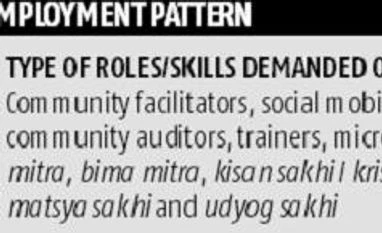
The other problem is the profusion of ill-organised cadres and temporary workers to manage programmes. For instance, in the DRDAs there are four types of employees recruited in each state (see table). Also, just as the number of schemes for rural development has expanded so have the types of employees, which makes it impossible to either monitor their role or make them obey disciplinary steps.

As a result, delivery of services is a mess. The ministry of rural development has found that in Rajasthan, anganwadi workers monitor the government’s ambitious Housing For All scheme. Anganwadi workers are supposed to be only deployed for health activities. 

In most states, there are no dedicated workers for ensuring complex work like house building, which the ministry estimates involves nine steps at the block level, most of which is unsupervised.

It will cost money to bring order into the chaos. A committee set up during the United Progressive Alliance government in 2012 and chaired by 

V Ramachandran estimated it would cost Rs 12,671 crore in 10 years to transition the 15,000 DRDA staff to an integrated set-up. The plan was scrapped. 

In addition, there are 119,000 community cadres engaged to work on most rural development programmes. While the DRDA staff draw salaries, the community workers are paid Rs 250-750 a day with an upper limit of Rs 5,000 per month. 

The committee has found that there is no connection between their performance and the salaries they draw. The linkage with outcomes is expected to be resisted as it undercuts the system of patronage. 

“The committee has examined the ways panchayats spend money and has come to the conclusion that variation in their performance is mostly due to lack of trained human resource,” said one of the sources. 

Sinha said under the Fourteenth Finance Commission award, grants of Rs 2 lakh crore had been allocated over a period of five years (2015-2020) to 26 states where these institutions were directly responsible for delivery of basic services in villages. He said states had ignored repeated requests to furnish audited reports, statements of account and utilisation certificates in respect of financial assistance provided to them for strengthening panchayats.


One subscription. Two world-class reads.

Already subscribed? Log in

Subscribe to read the full story →
*Subscribe to Business Standard digital and get complimentary access to The New York Times

Smart Quarterly

₹900

3 Months

₹300/Month

SAVE 25%

Smart Essential

₹2,700

1 Year

₹225/Month

SAVE 46%
*Complimentary New York Times access for the 2nd year will be given after 12 months

Super Saver

₹3,900

2 Years

₹162/Month

Subscribe

Renews automatically, cancel anytime

Here’s what’s included in our digital subscription plans

Exclusive premium stories online

  • Over 30 premium stories daily, handpicked by our editors

Complimentary Access to The New York Times

  • News, Games, Cooking, Audio, Wirecutter & The Athletic

Business Standard Epaper

  • Digital replica of our daily newspaper — with options to read, save, and share

Curated Newsletters

  • Insights on markets, finance, politics, tech, and more delivered to your inbox

Market Analysis & Investment Insights

  • In-depth market analysis & insights with access to The Smart Investor

Archives

  • Repository of articles and publications dating back to 1997

Ad-free Reading

  • Uninterrupted reading experience with no advertisements

Seamless Access Across All Devices

  • Access Business Standard across devices — mobile, tablet, or PC, via web or app

Next Story



