Rural wages in West Bengal set to take a hit as migrant workers return home

Many fear they will run out of money soon, as they are seen as a burden on the rural economy; most are ostracised due to social distancing
coronavirus
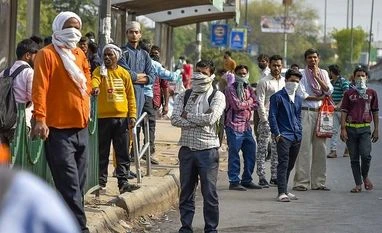
The business of migration is itself an industry in parts of rural Bengal | Photo: PTI
Namrata Acharya Kolkata
5 min read Last Updated : Mar 30 2020 | 1:15 AM IST
At Gobardhanpur, one of the last of West Bengal's villages falling in the deltaic Sundarban region, there is a deep fear of Coronavirus outbreak among locals. In just two days, March 19 and 20 , and before interstate train services were suspended on March 21, hundreds of migrant workers arrived in the area mostly from southern states, say locals.

“Two days prior to lockdown, close to 100 people came to two villages here. The villagers immediately informed the local administration, which instructed these migrant workers to stay at home. Now villagers are keeping a strict vigil on their movements,” says Biswadip Sahu, a fisherman at Gobardhanpur.

Hiron Raut, along with nine others arrived at his native Buraburir Tat, a village adjacent to Gobardhapur, some 10 days back from Kerala, where he was earning Rs 600-900 a day as a construction worker. His savings will soon be exhausted and he stares at an uncertain future. The West Bengal government has announced an aid of Rs 1,000 a month to daily wage earners in the state.

“Whatever money we had will be exhausted in the next 15-20 days. I don’t know how I will survive after that. I am not sure how long the government will support us,” says Raut.  

The thousands of workers returning home to West Bengal amid the pandemic are being seen as a liability and unwelcome guests in their own homes. Meanwhile, the distress in rural economy is already visible.

“Many small grocery shops in rural areas have permanently shut down as they are unable to buy essential food items at high price from big traders. This rural distress might assume mammoth proportions. As far as these migrant workers are concerned, they are quite prone to exploitation as there will be an oversupply for labour in rural areas,” said Dilip Benerjee, an Ashoka fellow who has studied migration pattern in West Bengal.

“The migrant workers who are now back home are seen as huge burden on the local economy. They don’t have requisite skills to be employed in agriculture,” says Aniruddha Dey, Executive Director, Professional Institute for Development & Socio Environmental Management (PRISM), an environment consultancy firm.

Indrajit Das, a textile worker in Tamil Nadu, fears he will be forced to take up farming, the only source of livelihood at Chimta in the Sundarbans, a village that is yet to get a power connection.

“It will be a big challenge for me to take up farming, as I have never done it before. But I will be forced to now, if things remain like this for long,” says Das.

However, Das considers himself lucky to have come back home. His fellow workers informed him from Chennai a day ago that they were having tough time getting meals twice a day.

ALSO READ: Mamata warns of action against those posting fake news on coronavirus

“Many of my friends could not come back and said they were having a difficult time getting full meals. Workers from Bengal will not be helped in Tamil Nadu," he says.

“This pandemic is mostly an urban phenomenon and people rushed to rural areas as they saw safe havens in them. But due to the sudden increase in labour supply, the market wages, including those in agriculture, will come down. These people would now depend upon MNREGA (Mahatma Gandhi National Rural Employment Guarantee Act) for work, but the worrying fact is that on an average in the past four years, employment under MNREGA was provided for just 40-45 days in a year. Besides daily wages are much lower than agriculture wages,” says K R Shyam Sundar, professor of human resource management at Xavier Institute of Management, Jamshedpur.

According to Census data 2011, West Bengal ranked fourth among states on outward migration. The numbers have only risen since.

In the last two decades, West Bengal has had a massive wave of outward migration, especially to Kerala, Tamil Nadu, Delhi and Maharashtra. With factories and tea gardens closing down, farm income falling and storm Aila ravaging a large part of deltaic West Bengal in 2010, migration gradually became a norm

“In 2001, West Bengal was net positive in terms of migration, but by 2011, it turned net negative. Long-term policy failure, demographic transition that added a large young population and agrarian stagnation led to this wave of outward migration, and it has been growing,” says Rabiul Ansary, assistant professor, department of geography, Utkal University.

The business of migration is itself an industry in parts of rural Bengal.  

“Wherever people got easily absorbed, they went. There are agents who act as mediators for providing jobs to young people, especially school dropouts in their early teens. Those who go as migrant workers, themselves become agents after a few years,” says Dey.

While a construction worker in the southern states can earn as much as Rs 500-900 a day, in West Bengal, agriculture yields not more than Rs 200-300 per day.

“These people came in a jiffy and many didn’t even get time to collect dues from their employers. They can barely survive for 20-25 days,” says Pranabesh, a social worker with Sundarban Green Environment Association.

In North Bengal, another emigration hotspot, many women left home to work as domestics in north Indian states. Unlike the men, not many have been able to return home amid the pandemic.

“Many workers wanted to come back, but couldn’t. Several people came in trucks, and Police took them to local hospitals for check-up. Now, tea workers also apprehend that once the gardens open, they will not be paid for days. There is also a fear that many migrant workers will not get jobs for long, as they might be ostracized due to social distancing,” said Nita Dhar, senior programme coordinator, PRISM.  

As the world awaits the end of the global pandemic, rural Bengal sees a recession unfolding bit by bit.


One subscription. Two world-class reads.

Already subscribed? Log in

Subscribe to read the full story →
*Subscribe to Business Standard digital and get complimentary access to The New York Times

Smart Quarterly

₹900

3 Months

₹300/Month

SAVE 25%

Smart Essential

₹2,700

1 Year

₹225/Month

SAVE 46%
*Complimentary New York Times access for the 2nd year will be given after 12 months

Super Saver

₹3,900

2 Years

₹162/Month

Subscribe

Renews automatically, cancel anytime

Here’s what’s included in our digital subscription plans

Exclusive premium stories online

  • Over 30 premium stories daily, handpicked by our editors

Complimentary Access to The New York Times

  • News, Games, Cooking, Audio, Wirecutter & The Athletic

Business Standard Epaper

  • Digital replica of our daily newspaper — with options to read, save, and share

Curated Newsletters

  • Insights on markets, finance, politics, tech, and more delivered to your inbox

Market Analysis & Investment Insights

  • In-depth market analysis & insights with access to The Smart Investor

Archives

  • Repository of articles and publications dating back to 1997

Ad-free Reading

  • Uninterrupted reading experience with no advertisements

Seamless Access Across All Devices

  • Access Business Standard across devices — mobile, tablet, or PC, via web or app

Topics :CoronavirusRural wage crisismigrant workersWest Bengal

Next Story



