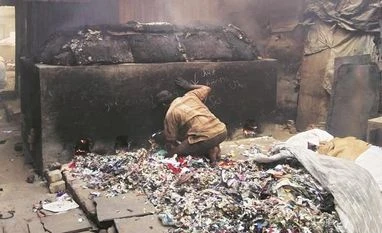
But what if the spanner in the wheel is the wheel itself? Dharavi, for long, has resisted its own redevelopment for various reasons, and is choosing status quo even today. Despite initiatives of successive governments to transform the slum cluster into tall residential towers, it is the residents themselves who are silently resisting change.
In other slums alike, redevelopment has ceased to be a poll issue in the ongoing parliamentary elections in Mumbai, the city where property prices are out of bounds for many.
As Shiv Sena workers and the city police scan the crossroad that runs through the slum for an upcoming election rally, Dharavi’s residents, most of them who did not wish to be named, said many of their peers who own leather factories have constructed up to three illegal floors above the ground floor, and brought in tenant workers who live without formal contracts.
“Many don’t have metered water connections, most use electricity for commercial purpose from a household meter, and do not register their business,” says Salim, a youngster who works as an assistant in a leather products shop off the famous 90-feet road.
Most businesses run informally, paying no goods and services tax (GST) or income tax, and have thus developed a rent market, where everyone in the system benefits at the cost of overall development.
Congress workers are also gearing up for a road show that is going to traverse the entire slum. Veteran Congress leader and two-time MP from Mumbai South Central, the constituency that houses Dharavi, Eknath Gaikwad, is contesting against a young incumbent Rahul Shewale from the Shiv Sena.
“The battle is of ideology,” says a worker participating in the Congress rally. “Redevelopment” is the word conspicuously missing from his version of the campaign discourse as well. Officials are clearly aware of this.
“When it comes to when and who will start implementing the redevelopment project, all depends on the will of the government,” says an official. He says that the process to be undertaken is so tedious, that no one wants to disturb the balance. Experts corroborate this. The titles of lands, houses and shanties developed atop are all grossly unavailable.
“Most of the properties in Dharavi have title disputes. In most cases, there are tenants who have informal contracts with the owners, who do not necessarily have documents of ownership,” says Prashant Thakur, head of research at Anarock property consultants.
Experts who have followed the Dharavi project also say that the registration deeds of most property transactions are not available, or are informal in nature.
People from all communities belonging to various states own the several hundred in-house leather factories in Dharavi. A bags manufacturer who has seen Dharavi change from a single storied flat-to-the-ground mass of shanties to a multi-storied multi-ethnic informal business district, says that business is not as it used to be. “Many like us used to export leather products. Today, exports have virtually stopped from Dharavi, and have gone to Kolkata,” he says.
The GST was followed by the mandatory E-way bill clause. He says even for a procurement of leather from a shop just 100 metres away, he needs an E-way bill.
Most small businessmen in Dharavi say that while people in general would be happy living in proper houses in a building, they rather have an incentive to maintain a status quo, which keeps the business running without much need to declare the size of the business, or pay taxes on business and incomes.
“Tens of elections have passed by. The status quo is hard as ever,” one of them says. Mumbai votes on April 29.
One subscription. Two world-class reads.
Already subscribed? Log in
Subscribe to read the full story →
Smart Quarterly
₹900
3 Months
₹300/Month
Smart Essential
₹2,700
1 Year
₹225/Month
Super Saver
₹3,900
2 Years
₹162/Month
Renews automatically, cancel anytime
Here’s what’s included in our digital subscription plans
Exclusive premium stories online
Over 30 premium stories daily, handpicked by our editors


Complimentary Access to The New York Times
News, Games, Cooking, Audio, Wirecutter & The Athletic
Business Standard Epaper
Digital replica of our daily newspaper — with options to read, save, and share


Curated Newsletters
Insights on markets, finance, politics, tech, and more delivered to your inbox
Market Analysis & Investment Insights
In-depth market analysis & insights with access to The Smart Investor


Archives
Repository of articles and publications dating back to 1997
Ad-free Reading
Uninterrupted reading experience with no advertisements


Seamless Access Across All Devices
Access Business Standard across devices — mobile, tablet, or PC, via web or app
)