NASA contracts Uber to build flying taxi air control software

Holden is set to reveal the company's latest air taxi plans at Web Summit, an annual internet conference taking place in Lisbon
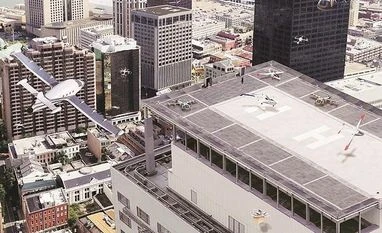
Flying Cars
Earlier this month NASA said it was working with a variety of companies, large and small, to develop the emerging market for what it terms Urban Air Mobility, or UAM. Photo: Nasa
Eric Auchard | Reuters
4 min read Last Updated : Oct 16 2019 | 8:35 PM IST
Uber has struck a deal with NASA to develop software for managing "flying taxi" routes in the air along the lines of ride-hailing services it has pioneered on the ground, the company said on Wednesday.

And in this case, it’s working hard to stay on regulators' good side. Uber said it was the first formal services contract by the US National Aeronautical and Space Administration (NASA) covering low-altitude airspace rather than outer space. NASA has used such contracts to develop rockets since the late 1950s.
Chief Product Officer Jeff Holden also said Uber would begin testing four-passenger, 200-miles-per-hour (322-km-per-hour) flying taxi services across Los Angeles in 2020, its second test market after Dallas/Fort Worth.

Holden is set to reveal the company's latest air taxi plans at Web Summit, an annual internet conference taking place in Lisbon this week.
"There is a reality that Uber has grown up a lot as a company," Holden said in an interview ahead of his speech. "We are now a major company on the world stage and you can't do things the same way where you are a large-scale, global company that you can do when you are a small, scrappy startup." Uber has faced endless regulatory and legal battles around the world since it launched its ride-hailing services earlier this decade, including a recent showdown in London, where it is battling to retain its licence after having been stripped of it by city regulators over safety concerns.

The company is looking to speed development of a new industry of electric, on-demand, urban air taxis, Holden said, which customers could order up via smartphone in ways that parallel the ground-based taxi alternatives it has popularised while expanding into more than 600 cites since 2011.
The company plans to introduce paid, intra-city flying taxi services from 2023 and is working closely with aviation regulators in the United States and Europe to win regulatory approvals toward that end, a senior Uber executive told Reuters. "We are very much embracing the regulatory bodies and starting very early in discussions about this and getting everyone aligned with the vision," he said of Uber's plans to introduce what he called "ride-sharing in the sky".

Earlier this year, Uber hired NASA veterans Mark Moore and Tom Prevot to run, respectively, its aircraft vehicle design team and its air traffic management software programme.

During a 32-year career at NASA, Moore pioneered its electric jet propulsion project which Uber considers to be the core technology for making urban air transportation possible.

Making Taxis Fly

The contract with NASA is to solve the problem of operating hundreds or thousands of aircraft over urban areas with the goal of enabling uberAIR services to operate alongside existing air traffic control systems and in and around busy airports.
NASA was not immediately available to comment on the deal.

Earlier this month it said it was working with a variety of companies, large and small, to develop the emerging market for what it terms Urban Air Mobility, or UAM.
Uber envisions a fleet of electric jet-powered vehicles - part helicopter, part drone and part fixed-wing aircraft - running multiple small rotors capable of both vertical take off and landing and rapid horizontal flight.

Two larger rotors used to lift the plane transition during flight into forward-thrusting propellers in newly released designs.
It plans to build no aircraft itself.

Instead, Uber is building the software to manage networks in the sky of flying taxis, while relying on a stable of manufacturers, including Aurora Flight Sciences, which was acquired by Boeing last month.

Uber has also signed up Embraer, Mooney, Bell Helicopter - a unit of Textron -, and Pipistrel Aircraft to build new vertical takeoff and landing aircraft.
It is also working with real estate developers Sandstone Properties in Los Angeles to build rooftop landing pads on skyscrapers from which it aims to offer its uberAIR services. It plans to start offering services from locations near a downtown sports arena, the international airport, Santa Monica and Sherman Oaks in suburban San Fernando Valley, the company said.

(Reporting by Eric Auchard; Editing by Maria Sheahan and Mark Potter)

One subscription. Two world-class reads.

Already subscribed? Log in

Subscribe to read the full story →
*Subscribe to Business Standard digital and get complimentary access to The New York Times

Smart Quarterly

₹900

3 Months

₹300/Month

SAVE 25%

Smart Essential

₹2,700

1 Year

₹225/Month

SAVE 46%
*Complimentary New York Times access for the 2nd year will be given after 12 months

Super Saver

₹3,900

2 Years

₹162/Month

Subscribe

Renews automatically, cancel anytime

Here’s what’s included in our digital subscription plans

Exclusive premium stories online

  • Over 30 premium stories daily, handpicked by our editors

Complimentary Access to The New York Times

  • News, Games, Cooking, Audio, Wirecutter & The Athletic

Business Standard Epaper

  • Digital replica of our daily newspaper — with options to read, save, and share

Curated Newsletters

  • Insights on markets, finance, politics, tech, and more delivered to your inbox

Market Analysis & Investment Insights

  • In-depth market analysis & insights with access to The Smart Investor

Archives

  • Repository of articles and publications dating back to 1997

Ad-free Reading

  • Uninterrupted reading experience with no advertisements

Seamless Access Across All Devices

  • Access Business Standard across devices — mobile, tablet, or PC, via web or app

Topics :NASA

Next Story



