Pakistan will 'absolutely not' default on debts despite floods: FinMin

No default coming, says Finance Minister Miftah Ismail who expects current account deficit widening to be capped at $2 bn; Ismail says $5-bn investment from UAE, Qatar, Saudi coming this fiscal year

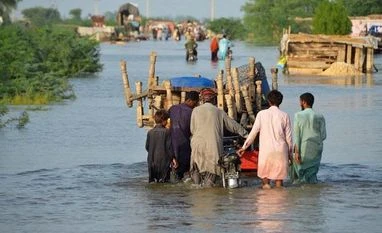
Pakistan floods, Floods
Photo: Reuters
Reuters ISLAMABAD
4 min read Last Updated : Sep 18 2022 | 9:52 PM IST
Pakistan will "absolutely not" default on debt obligations despite catastrophic floods, the finance minister said on Sunday, signalling there would be no major deviation from reforms designed to stabilise a struggling economy.
 
Floods have affected 33 million Pakistanis, inflicted billions of dollars in damage, and killed over 1,500 people - creating concern that Pakistan will not meet debts.
 
"The path to stability was narrow, given the challenging environment, and it has become narrower still," Finance Minister Miftah Ismail told Reuters at his office.
 
"But if we continue to take prudent decisions - and we will - then we're not going to default. Absolutely not." Pakistan was able to bring an International Monetary Fund (IMF) programme back on track after months of delay, thanks to tough policy decisions. But the positive sentiment was short- lived before the catastrophic rainfall hit.
 
Despite the disaster, Ismail said that most stabilisation policies and targets were still on track, including increasing dwindling foreign exchange reserves.
 
Central bank reserves stand at $8.6 billion, despite the influx of $1.12 billion in IMF funding in late August, which are only enough for about a month of imports. The end-year target was to increase the buffer up to 2.2 months.
 
He said Pakistan will still be able to increase reserves by up to $4 billion, even if the floods hurt the current account balance by $4 billion in more imports, such as cotton, and a negative impact on exports.
 
However, he estimated the current account deficit will not increase by more than $2 billion following the floods.
 
"Yes, there has been substantial loss to the very poorest people and their lives will never be made whole again. But in terms of servicing our external and local debt, and being micro- macro-economically stable, those things are under control."
 
December payment to be met
 
He said global markets were "jittery" about Pakistan, given the economy had suffered at least $18 billion in losses after the floods, which could go as high as $30 billion.
 
"Yes, our credit default risk has gone up, our bond prices have fallen. But...I think within 15 to 20 days, the market will normalise, and I think will understand that Pakistan is committed to being prudent."
 
Pakistan's next big payment - $1 billion in international bonds - is due in December, and Ismail said that payment would "absolutely" be met.
 
The IMF said on Sunday that it will work with the international community to support Pakistan’s relief and reconstruction efforts and the endeavour to ensure sustainability and stability.
 
Ismail said external financing sources were secured, including over $4 billion from the Asian Development Bank (ADB), Asian Infrastructure Investment Bank and World Bank.
 
This includes $1.5 billion next month from ADB under the Countercyclical Support Facility - a budget support instrument.
The minister also said about $5 billion in investments from Qatar, the UAE and Saudi Arabia would materialise in the current financial year.
 
The three announced interest in investing in Pakistan earlier this year, but no timelines or exact plans have been reported yet.
 
He said $1 billion in UAE investment will "definitely materialise" in the next couple of months in the form of purchases in the Pakistan stock market.
 
Some $3 billion in Qatari investment pledges will all come within the financial year to June 2023, he added.
 
"They're looking at the three airports in Pakistan, Karachi, Lahore and Islamabad ... long-term leases. They're also looking at buying two plants that run on LNG (liquefied natural gas)...those I think will probably happen this calendar year," he said.
He said if the $3 billion figure was not reached as the financial year closed, the remaining amount would go into the stock market.
 
He also said Saudi Arabia's crown prince had assured Prime Minister Shehbaz Sharif that Riyadh would invest $1 billion before December.
 
Pakistan's central bank announced on Sunday that Saudi Arabia's development authority had also extended a deposit of $3 billion, to mature in December, by one year.
 
He said a legal instrument was going to be signed soon with a "friendly country" to activate a $1 billion deferred payment facility for oil.

One subscription. Two world-class reads.

Already subscribed? Log in

Subscribe to read the full story →
*Subscribe to Business Standard digital and get complimentary access to The New York Times

Smart Quarterly

₹900

3 Months

₹300/Month

SAVE 25%

Smart Essential

₹2,700

1 Year

₹225/Month

SAVE 46%
*Complimentary New York Times access for the 2nd year will be given after 12 months

Super Saver

₹3,900

2 Years

₹162/Month

Subscribe

Renews automatically, cancel anytime

Here’s what’s included in our digital subscription plans

Exclusive premium stories online

  • Over 30 premium stories daily, handpicked by our editors

Complimentary Access to The New York Times

  • News, Games, Cooking, Audio, Wirecutter & The Athletic

Business Standard Epaper

  • Digital replica of our daily newspaper — with options to read, save, and share

Curated Newsletters

  • Insights on markets, finance, politics, tech, and more delivered to your inbox

Market Analysis & Investment Insights

  • In-depth market analysis & insights with access to The Smart Investor

Archives

  • Repository of articles and publications dating back to 1997

Ad-free Reading

  • Uninterrupted reading experience with no advertisements

Seamless Access Across All Devices

  • Access Business Standard across devices — mobile, tablet, or PC, via web or app

Topics :Pakistan QatarUAESaudi Arabia

Next Story