Govt bank stocks on fire after recapitalisation plan

Nifty PSU banks index jumps a record 30%; m-cap of these stocks zooms to Rs 1.2 lakh cr; Sensex crosses 33k-mark
bank stocks
Samie Modak Mumbai
Last Updated : Oct 26 2017 | 3:21 AM IST
An index of state-owned banks rallied an unprecedented 30 per cent — the biggest single-day spurt ever — and the benchmark indices climbed to record highs on Wednesday, reacting to the Cabinet nod a day earlier to Rs 2.11-lakh-crore bank recapitalisation plan and Rs 6.92-lakh-crore highway construction project.

The government announcements to spur the economy is being seen by many as a much-needed stimulus package, which could shore up the sluggish credit growth at public sector undertaking (PSU) banks and help kick-start the economy. 

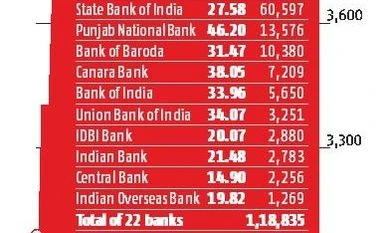
The benchmark Nifty gained 0.9 per cent to close at 10,295, while the Sensex added 1.3 per cent to close at a record 33,042. The Nifty PSU Bank index soared 29.6 per cent, with all state-owned banks (22) cumulatively adding Rs 1.18 lakh crore in market value, taking their total m-cap to Rs 5.48 lakh crore. 

The finance ministry, after market close on Tuesday, said it would inject Rs 2.11-lakh-crore in PSU banks over two years. Analysts said the top-up plan was long-awaited for PSU banks that have been reeling under a pile of non-performing loans (NPLs), which was blocking their growth plans.

State Bank of India (SBI), India’s largest lender, gained 27.6 per cent and added Rs 60,597 crore in market value. Punjab National Bank and Bank of Baroda gained 46.2 per cent and 31.5 per cent, respectively — each adding over Rs 10,000 crore in market value. 

In contrast, private banks such as HDFC Bank, Kotak Mahindra Bank and YES Bank each fell nearly 5 per cent on concerns that recapitalisation plan would help public-sector lenders regain lost market share. Sixteen private banks saw their combined market cap fall by Rs 9,815 crore to Rs 12.39 lakh crore. ICICI Bank and Axis Bank, however, bucked the trend. ICICI Bank was up 14.7 per cent to Rs 305.60, while Axis Bank gained 4.6 per cent to Rs 472.70. 

Non-banking finance companies such as Bajaj Finance, Indiabulls Housing and Edelweiss, which were gaining market share at the expense of capital-starved PSU banks, also fell between five per cent and eight per cent.

The total gain in m-cap for all the 38 banks (private and public) was Rs 1.1 lakh crore, taking the total m-cap to Rs 17.9 lakh crore. Until last week, the Nifty PSU Bank index was languishing at a nine-month low, even as the benchmark Nifty had gained 22 per cent this year with several private sector banks rallying much more.

“PSU banks’ recapitalisation is a fiscal stimulus with a strong multiplier. With about 10 times loans-to-equity multiples, even if one assumes that Rs 90,000 crore of the Rs 2.1 lakh crore is growth capital (rest used for provisions), it enables banks to infuse Rs 9 lakh crore into the economy,” said Neelkanth Mishra, equity strategist at Credit Suisse, in a note. The brokerage made significant changes to its model portfolio of stocks adding PSU banks and moving private banks from “overweight” to “neutral”.

“Our view on the NPL cycle has been that the only way to break it was aggressive recapitalisation. The recapitalisation plan will break the five-year-plus cycle of NPLs,” said a note by another foreign brokerage Morgan Stanley, which “double upgraded” SBI, ICICI Bank and PNB.

The government on Tuesday had also announced the Bharatmala scheme to construct 83,677 km of roads at an investment of Rs 6.92 lakh crore by 2022. The move fueled a rally in infrastructure and cement companies, with Larsen and Tourbo and UltraTech gaining six per cent each.

The government stimulus plan also helped reverse the selling by overseas investors. Foreign portfolio investors, who have been consistently pulling out money from domestic stocks, bought shares worth over $500 million (Rs 3,582 crore) on Wednesday. The buying momentum was so strong that the cash turnover on the National Stock Exchange was highest-ever at Rs 55,909 crore, compared to the previous best of Rs 45,012 crore in September last year.

One subscription. Two world-class reads.

Already subscribed? Log in

Subscribe to read the full story →
*Subscribe to Business Standard digital and get complimentary access to The New York Times

Smart Quarterly

₹900

3 Months

₹300/Month

SAVE 25%

Smart Essential

₹2,700

1 Year

₹225/Month

SAVE 46%
*Complimentary New York Times access for the 2nd year will be given after 12 months

Super Saver

₹3,900

2 Years

₹162/Month

Subscribe

Renews automatically, cancel anytime

Here’s what’s included in our digital subscription plans

Exclusive premium stories online

  • Over 30 premium stories daily, handpicked by our editors

Complimentary Access to The New York Times

  • News, Games, Cooking, Audio, Wirecutter & The Athletic

Business Standard Epaper

  • Digital replica of our daily newspaper — with options to read, save, and share

Curated Newsletters

  • Insights on markets, finance, politics, tech, and more delivered to your inbox

Market Analysis & Investment Insights

  • In-depth market analysis & insights with access to The Smart Investor

Archives

  • Repository of articles and publications dating back to 1997

Ad-free Reading

  • Uninterrupted reading experience with no advertisements

Seamless Access Across All Devices

  • Access Business Standard across devices — mobile, tablet, or PC, via web or app

Next Story



