Lacking firepower

Patrol vessels must have adequate combat capabilities
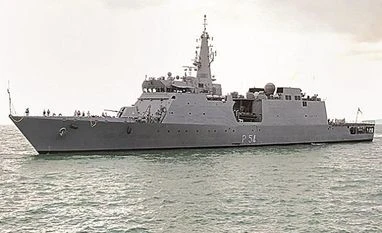
Indian navy, defence, ship, INS, COASTGUARD
For navy planners, the phenomenon of sea-borne terrorism has changed the rationale of OPVs
Business Standard Editorial Comment New Delhi
3 min read Last Updated : Dec 23 2020 | 10:52 PM IST
Two indigenous warship-building programmes are feeding the Indian Coast Guard with Offshore Patrol Vessels (OPVs) that are seriously lacking in combat capability. The navy ensures that each of its OPVs comes fitted with a radar-controlled, 76-millimetre Otomelara gun, but the Coast Guard arms its OPVs with nothing more than a 30-millimetre gun and a couple of smaller-calibre machine guns. While it is true that the Coast Guard operates only within India’s 200-nautical mile maritime zone, there are valid concerns about whether they have the firepower that is essential for dealing with new-age maritime threats from terrorists, pirates, gun-runners, and other armed adversaries. Furthermore, the Coast Guard is expected in wartime to fight alongside the navy, which makes it essential for the Coast Guard’s OPVs to have the armament needed for ship-to-ship combat. These are 100-metre-long, 2,000-tonne vessels with the space for heavier weapons and the crews that operate them. Yet they remain gravely deficient in fighting power.

The navy currently has barely 140 warships against the target of 200 vessels spelt out in the Maritime Capability Perspective Plan. Given this shortfall, it expects the Coast Guard OPVs to contribute real combat capability to the maritime battlefield, rather than relying on the navy to defend them. The Coast Guard, however, tends to regard itself as a policing force, rather than as one with a serious combat role. This mind set goes back to 1982, when the Coast Guard was raised with the primary charter of safeguarding the enormous, 2.3 million square kilometre Exclusive Economic Zone  that the United Nations Convention for the Law of the Sea had allocated to India. The fledgling Coast Guard believed that the primary attribute of its patrol vessels should be an exceptionally long endurance to cover this vast oceanic domain. Since its likely adversaries were lightly armed smugglers and illegal fishermen, the Coast Guard did not feel the need for heavy weaponry. Furthermore, sophisticated guns, radars, and their control systems added significantly to an OPV’s cost. Like any newly raised force, the Coast Guard was keen on expanding its fleet strength and its personnel, rather than bulking up the combat capability of its vessels. The navy would prefer fewer, better-armed OPVs, but it can only influence this up to a point. In earlier years, the Coast Guard was manned primarily by naval sailors on deputation and an admiral headed the force. Today, the Coast Guard has its own large personnel cadre, and its last two directors general were Coast Guard cadre officers.

However, the national interest, rather than parochial considerations, must guide such a decision. Instead of smugglers and poachers, India’s maritime zone and coastline currently face a more malevolent, motivated, and heavily armed threat from sea-borne terrorists and pirates. The suicide boat attack on the USS Cole in 2000 and the sea-borne terrorist attack on Mumbai on 26/11 have redefined the approaches to maritime security worldwide. The Indian Navy has all along adopted a philosophy of arming its OPVs with at least one heavy weapon since, as a senior admiral observed: “Nobody can take seriously a gunboat that has just a 30 mm gun.” The navy’s Next Generation OPVs, of which 11 were cleared for acquisition last week, are to have not just a heavy gun, but containerised capabilities for a range of tasks that involve combat. The Coast Guard, too, must realise its OPVs are warships and arm them as such.


One subscription. Two world-class reads.

Already subscribed? Log in

Subscribe to read the full story →
*Subscribe to Business Standard digital and get complimentary access to The New York Times

Smart Quarterly

₹900

3 Months

₹300/Month

SAVE 25%

Smart Essential

₹2,700

1 Year

₹225/Month

SAVE 46%
*Complimentary New York Times access for the 2nd year will be given after 12 months

Super Saver

₹3,900

2 Years

₹162/Month

Subscribe

Renews automatically, cancel anytime

Here’s what’s included in our digital subscription plans

Exclusive premium stories online

  • Over 30 premium stories daily, handpicked by our editors

Complimentary Access to The New York Times

  • News, Games, Cooking, Audio, Wirecutter & The Athletic

Business Standard Epaper

  • Digital replica of our daily newspaper — with options to read, save, and share

Curated Newsletters

  • Insights on markets, finance, politics, tech, and more delivered to your inbox

Market Analysis & Investment Insights

  • In-depth market analysis & insights with access to The Smart Investor

Archives

  • Repository of articles and publications dating back to 1997

Ad-free Reading

  • Uninterrupted reading experience with no advertisements

Seamless Access Across All Devices

  • Access Business Standard across devices — mobile, tablet, or PC, via web or app

Topics :Indian NavyIndian coast guardIndian OceanOffshore Patrol Vessel

Next Story



