Mirroring the art of resistance

Nilima Sheikh's scrolls are, at once gigantic in their context and scale, but familiar in their connect and urgency
Nilima Sheikh
Nilima Sheikh’s paintings show strength in resistance
Kishore Singh
Last Updated : Jul 27 2018 | 11:22 PM IST
For those of us who grew up listening to stories from the Ramayana and the Mahabharata told around the fires of chilly winter evenings in North India, the experience managed to combine the epic with the intimate. Here were grand stories from times long ago recreated for the pleasure of a small group of spellbound kids, rendering it immediate and personal. Nilima Sheikh’s scrolls are like that too, at once gigantic in their context and scale, but familiar in their connect and urgency. Interestingly, one such large work — Terrain: Carrying Across, Leaving Behind— currently on view at New Delhi’s Bikaner House, represents this dichotomy. Created for Documenta 14 in Kassel, Germany, it is being shown closer home now reprising her interest in mythology as well as modern history. 

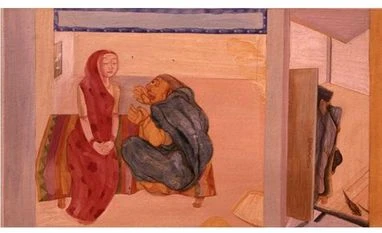
Works by Nilima Sheikh are a rare treat, the Baroda-based artist being a deep and conscientious thinker rather than a market-driven creator. Her subjects connect thematically with legends around the world, at once bridging the gaps between cultures and geographies at a humanitarian level, while, ironically, at the receiving end, they embody separation and the pain of otherness. In recent times, her interest in poet-philosophers, in particular the Kashmiri mystic Lal Ded, has been significant, and poetry marks a part of her work. The paintings themselves appear timeless, a beyondness of periods that she manages to communicate in the manner in which she paints, combining the Chinese scroll, the Japanese screen and the Persian (and Indian) painted manuscript. The background landscapes retain a lyrical quality; it is the narratives that, when closely observed, offer instances of quiet but determined rebellion.

Nilima Sheikh’s paintings show strength in resistance
Whether it is lovers separated by families or current student politics, she looks for strength in their resistance, chronicling these in a complex history of the world that she observes with an avuncular eye. The aesthetics of her work make it appear benign; beyond the pleasant façade, she questions the morality and ethics of society’s and humankind’s sorrow. There is no escaping the grief one senses in these paintings, nor does she offer the viewer a way out from her own involvement with her subject. But in painting within a tradition-inspired matrix, she can divert the casual viewer with a sleight-of-hand the way any good story, well told, does.

A teacher herself, she is drawn to literary sources that address issues close to her heart such as separation and longing, violence and containment, all within a matrix of histories past and present. Drawn towards poetry that concerns itself with pain and healing, these could be a metaphor for her own work. Her scrolls and screens draw from the miniature and pichwai tradition, a nod to local art practices of which she is a vociferous supporter. 

In the wake of the 2002 Gujarat riots, it was Kashmir she found herself drawn to. Not surprisingly, since her childhood memories of Kashmir were evocative, but also because it had a tradition of philosophy that drew her to it. But Kashmir is also a leitmotif for her work, representing within it the weight of history, however strife-torn, but lightly rendered. Kashmir’s ancient soul, so troubled in these bloody times, represents the travails of the world as we know it today. Whether or not we put Kashmir in our dreams every night, as she once beseeched us to do with an exhibition of her works, this much is obvious: Nilima Sheikh is a time-traveller of the world, a guardian spirit who daily traverses the terrains of manmade boundaries and barriers to hold up a mirror that can only sadden us.

Kishore Singh is a Delhi-based writer and art critic. These views are personal and do not reflect those of the organisation with which he is associated

One subscription. Two world-class reads.

Already subscribed? Log in

Subscribe to read the full story →
*Subscribe to Business Standard digital and get complimentary access to The New York Times

Smart Quarterly

₹900

3 Months

₹300/Month

SAVE 25%

Smart Essential

₹2,700

1 Year

₹225/Month

SAVE 46%
*Complimentary New York Times access for the 2nd year will be given after 12 months

Super Saver

₹3,900

2 Years

₹162/Month

Subscribe

Renews automatically, cancel anytime

Here’s what’s included in our digital subscription plans

Exclusive premium stories online

  • Over 30 premium stories daily, handpicked by our editors

Complimentary Access to The New York Times

  • News, Games, Cooking, Audio, Wirecutter & The Athletic

Business Standard Epaper

  • Digital replica of our daily newspaper — with options to read, save, and share

Curated Newsletters

  • Insights on markets, finance, politics, tech, and more delivered to your inbox

Market Analysis & Investment Insights

  • In-depth market analysis & insights with access to The Smart Investor

Archives

  • Repository of articles and publications dating back to 1997

Ad-free Reading

  • Uninterrupted reading experience with no advertisements

Seamless Access Across All Devices

  • Access Business Standard across devices — mobile, tablet, or PC, via web or app

Next Story



