Fixed-line internet is cheaper than 4G network

It is consistent and translates into a better experience for users
graph
graph
Tinesh Bhasin
Last Updated : Aug 13 2017 | 10:29 PM IST
The cost of 4G internet has crashed dramatically during the past year. But for most users, it cannot be a replacement for the fixed-line broadband service that you use at home. Broadband still turns out to be cheaper if you stream music and videos. It also delivers consistent speed and better user experience.

“Prices for per unit of data will come down further on 4G, nonetheless we will see more individuals opting for fixed-line broadband services in the future,” says Prashant Singhal, global telecom leader, EY. According to Singhal, telecom operators will give cheaper data per gigabyte (GB) but could raise the minimum recharge value. At present, most telecom operators offer 28GB data for Rs 346 a month. The telcos could scrap this plan entirely and offer, say, 50GB for Rs 500. “They need to increase the revenue per user,” says Singhal.

More individuals could opt for fixed-line broadband at home as telcos improve their infrastructure and offer higher speeds on fixed-line networks at affordable rates. Jio, for example, is planning to launch Jio Fiber, which is expected to provide speeds as good as 4G (or better) at prices lower than its 4G plan. The backbone of both 4G and fixed-line broadband is the same.

Unlike in developed countries, Indian telecom operators didn’t focus on creating a fibre optic network that is capable of offering higher internet speeds. Their focus remained on voice which does not require as much bandwidth. They started creating fibre optic infrastructure when they had to offer 4G services. “Though telcos are expanding the 4G network, it is still an emerging technology and the network is neither ubiquitous nor glitch free,” says Tarun PK, founder of telecom blog telecomtalk.info.

Fixed-line prices are falling, too: Many companies offer unlimited plans on fixed-line broadband. Spectranet has an unlimited data plan for Rs 1,249 a month at the speed of 100 Mbps. Companies that don’t have unlimited plans provide a higher cap on monthly usage. They have also been lowering prices since mobile operators started offering cheaper 4G data plans. Airtel now offers internet speed of up to 40Mbps for Rs 849 a month. While the monthly data usage is capped at 50GB, the user now gets an additional 750 GB data each month as bonus. State-owned telecom operator, BSNL, has slashed the tariff on its plans. The unlimited 2 Mbps DSL broadband plan, for example, is now at Rs 599 a month. It charged users Rs 1,199 earlier.

(Istock)
The best option for you: If you use the internet only to check e-mails, browse the web, chat and for social media, 4G internet can suffice. But if you listen to music on the internet, watch videos and play games online, broadband will meet your requirements better. In most urban households, multiple devices are used. There are e-book readers, tablets, computers and mobiles phones. In combination, these devices use much more data than what is offered by a 4G plan. “The average consumption of our users is around 10 times what telcos offer in their 4G plans,” says Udit Mehrotra, chief executive officer and managing director, Spectranet.

The 4G that you use on the phone has its benefits. “It's portable. You can take your dongle, Wi-Fi hotspot, or phone anywhere. It’s available on your SIM card and you don’t need extra instruments. In an area where the coverage is good, you can also get very good speed,” says Raju PP, who runs a personal tech blog Techpp.com. But accessing the internet on your mobile also has problems that are not there in fixed-line broadband. The speed on 4G varies continuously. “The speed of mobile internet depends on the number of users connected to a tower, which has a fixed bandwidth. The speed is faster if the bandwidth is shared by fewer users, and vice versa,” says Raju.

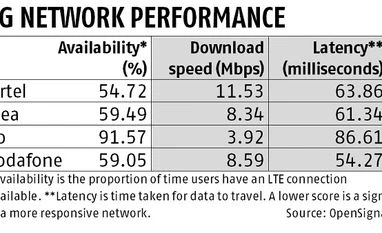
Fixed-line internet is more consistent. If you have, say, a 4 Mbps connection, you would get a speed close to it all the time. “On 4G, users doing a video chat or voice call or playing an online game usually experience a lag. It happens as 4G networks have higher latency (the time taken for data to travel). Users don’t face a lag in broadband as its latency is much lower,” says Mehrotra.

Most homes will need fixed-line internet in the future. “The 4G mobile internet will not suffice as we move towards smart cities and internet of things (IoT), where your washing machine, refrigerator, air conditioning, lights and other devices will all be connected to the internet,” says Tarun.

Determining your data needs: For most individuals, data on mobile is a necessity as they need to check emails, chat and browse. Experts, therefore, suggest that you opt for both – 4G as well as fixed-line. When choosing a broadband, opt for a service provider that has fibre optic connection. But it’s difficult to pin point the minimum speed that you must have or the amount of data you consume in a month. You can be satisfied with a fixed-line plan that offers lower speed provided the latency is low. 

To get a rough estimate of your monthly data requirement, look for a data calculator on the internet. Experts say that for browsing the internet you need around 7-10GB data every month. If you subscribe to Netflix, you may need around 700MB an hour to watch videos in medium resolution and 3GB an hour for viewing in high definition. Each song that you stream is between 4-12MB. If multiple devices within a family are connected at the same time, you can accordingly estimate the usage.


One subscription. Two world-class reads.

Already subscribed? Log in

Subscribe to read the full story →
*Subscribe to Business Standard digital and get complimentary access to The New York Times

Smart Quarterly

₹900

3 Months

₹300/Month

SAVE 25%

Smart Essential

₹2,700

1 Year

₹225/Month

SAVE 46%
*Complimentary New York Times access for the 2nd year will be given after 12 months

Super Saver

₹3,900

2 Years

₹162/Month

Subscribe

Renews automatically, cancel anytime

Here’s what’s included in our digital subscription plans

Exclusive premium stories online

  • Over 30 premium stories daily, handpicked by our editors

Complimentary Access to The New York Times

  • News, Games, Cooking, Audio, Wirecutter & The Athletic

Business Standard Epaper

  • Digital replica of our daily newspaper — with options to read, save, and share

Curated Newsletters

  • Insights on markets, finance, politics, tech, and more delivered to your inbox

Market Analysis & Investment Insights

  • In-depth market analysis & insights with access to The Smart Investor

Archives

  • Repository of articles and publications dating back to 1997

Ad-free Reading

  • Uninterrupted reading experience with no advertisements

Seamless Access Across All Devices

  • Access Business Standard across devices — mobile, tablet, or PC, via web or app

Next Story



