The Pension Fund Regulatory and Development Authority (PFRDA) has floated a concept paper, in which it has proposed raising equity allocation under the active-choice option of the National Pension System (NPS) to 75 per cent from the current limit of 50 per cent.
At present, the PFRDA allows investors to allocate up to 75 per cent in equities in the auto-choice option. Experts say once implemented, this measure will enable younger investors who make an early start in the NPS to gather a larger retirement corpus.
The NPS offers two choices to investors: Active choice and auto choice. They can contribute to four asset classes: Equities (E), corporate debt (C), government securities (G), and alternative assets (A). Under the active-choice option, investors can allocate up to 100 per cent in C and G, up to 5 per cent in A, and up to 50 per cent in E.
Under the auto-choice option, subscribers can invest in one of three life cycle funds. Initially, there was one life-cycle fund, called the moderate life-cycle fund, with an equity cap of 50 per cent.
Later, based on the Bajpai Committee Report’s (2015) recommendations, the PFRDA introduced two life-cycle funds — LC 75 and LC 25 — for private sector subscribers. In the aggressive life-cycle fund (LC 75), the maximum equity investment permitted is up to 75 per cent, while in the conservative life-cycle fund (LC 25), it is restricted to 25 per cent.
The Bajpai Committee Report had recommended introducing LC 75 in the first phase, and increasing the equity cap in the active-choice option to 75 per cent in the second phase. The first recommendation was implemented in November 2016.
The PFRDA’s own data shows that investors want higher equity allocation, as is evident from their preference for LC 75 over LC 25. The number of subscribers in LC 75 stood at 52,454 compared to 10,574 in LC 25. Assets under management in LC 75 stood at Rs 3.31 billion compared to Rs 456 million in LC 25 (the PFRDA data as of December 27, 2017).
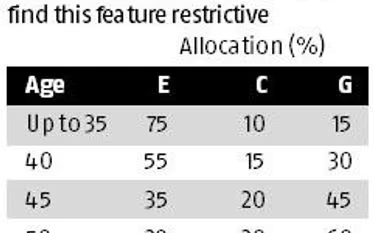
Subscribers also want the PFRDA to allow them to allocate more to equities under the active-choice option. Under the auto-choice option, though equity allocation is allowed up to 75 per cent, it is linked to the subscriber’s age. It begins to reduce once the subscriber’s age crosses 35 and reaches 20 per cent by the time he or she turns 50.
“Many investors want a higher exposure to equities till 45 or 50,” said Mumbai-based financial planner Arnav Pandya.
Subscribers say besides age, their financial profile and risk appetite should determine asset allocation.
In its proposal, the PFRDA has also proposed a gradual reduction in equity allocation in the active-choice option from the age of 50, going down to 50 per cent by the time the subscriber is 60, so that investors are protected from excessive risk at an advanced age.
Financial advisors say this is a welcome move.
Arvind A Rao, financial planner and founder, Arvind Rao and Associates, said: “Since the NPS has restrictions even on partial withdrawals, it is a long-term product. An investor entering the NPS at 25 has a long span of around 25 years, during which he can have a high equity exposure. Allowing a 75 per cent exposure in the active-choice option will allow younger investors to gather a bigger retirement corpus.” Many investors who found the 50 per cent cap on equities under the auto-choice option restrictive will opt for the NPS once this step is implemented, according to him.

 "Raise equity allocation if you have the risk appetite")












 Connect with us on WhatsApp