Oppn parties chalk out strategy for winter session; SP, BSP skip meet

According to sources, the Congress's central leadership is increasingly amenable for an electoral arrangement with the AAP in Delhi
opposition meeting, opposition party meeting, opposition, political parties
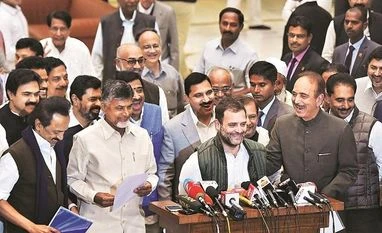
Congress President Rahul Gandhi, Andhra Pradesh Chief Minister N Chandrababu Naidu, Loktantrik Janata Dal (LJD) leader Sharad Yadav, Congress leader Ghulam Nabi Azad,DMK president M K Stalin and other party leaders during a press conference. (PTI)
Archis Mohan New Delhi
Last Updated : Dec 11 2018 | 2:20 AM IST
As many as 21 Opposition parties met in the evening to discuss their future strategy in Parliament and outside in the months to come, and presented their alternative vision for India.

A joint statement said India needed a “truthful government that does not propagate falsehoods and does not make bogus claims”, a government “that respects the autonomy of institutions and conventions in letter and spirit”.

The statement, issued after the meeting, said, “a case in point is the sinister attack on the autonomy of Reserve Bank of India by the Modi government that has led to the unceremonious exit of RBI Governor today.” Opposition parties said they deprecated the “systematic attack by the government on India’s economy through a select band of government nominees arbitrarily dictating the monetary policies and compromising RBI’s institutional integrity”.

The statement said Opposition parties in the next few months will place before the people “a comprehensive programme of work anchored in complete transparency and accountability”.

Rashtriya Lok Samata Party (RLSP) chief Upendra Kushwaha, who had quit the Bharatiya Janata Party (BJP)-led National Democratic Alliance in the afternoon, did not attend the meeting; neither did Samajwadi Party (SP) and Bahujan Samaj Party (BSP). “All in good time,” said a Congress strategist.

The meeting, however, marked the debut of Aam Aadmi Party (AAP) chief and Delhi Chief Minister Arvind Kejriwal to Opposition meetings. It indicated a change in Congress strategy to build the widest possible coalition against the BJP for 2019. Until now, the Congress party, under pressure from its Delhi unit, had opposed Kejriwal attending opposition meetings. However, sources said Congress President Rahul Gandhi, along with party treasurer Ahmed Patel and some other senior party leaders, favour building the widest possible coalition of Opposition parties to defeat Prime Minister Narendra Modi and BJP chief Amit Shah in the 2019 Lok Sabha polls.

According to sources, the Congress’s central leadership is increasingly amenable for an electoral arrangement with the AAP in Delhi.

On SP and BSP not attending the meeting, the Congress chief said the process of building a coalition against Modi and Shah was “a process”. He said the hallmark of this process was open, friendly and respectful space to all opposition voices. “We respect each one of them, however big or small. The role of everybody is to defeat the BJP and protect India’s Constitution and its institutions,” he said.

In the joint statement, Opposition leaders resolved to “defeat the forces that are subverting the Constitution and making a mockery of our democracy”. It said India needs a government that cares for working class, farmers and agriculture labour; a government that makes education accessible and affordable to all and creates decent and secure jobs that provide fair wages to the employed.

At the meeting, Andhra Pradesh Chief Minister N Chandrababu Naidu, who has played the “facilitator” to forge Opposition unity in recent weeks, distributed a power point presentation that detailed the sundry “failures” of the Modi government.

Apart from the Opposition meeting, the parliamentary affairs minister hosted an all-party meeting, while Rajya Sabha Chairman M Venkaiah Naidu also held a meeting of Rajya Sabha floor leaders.

The winter session begins on Tuesday and ends on January 8. The government said it has identified 45 bills to be taken up. Three bills will replace ordinances on triple talaq, Indian Medical Counci and Companies amendment ordinance.

It said new Bills likely to be introduced are National Commission for Indian Systems of Medicine (NCISM) Bill, National Commission for Homoeopathy (NCH) Bill, Aircraft (Amendment) Bill,  Jallianwala Bagh National Memorial  (Amendment) Bill, Information Technology (Amendment) Bill, Allied and Healthcare Professions Bill and Central Universities (Amendment) Bill.

One subscription. Two world-class reads.

Already subscribed? Log in

Subscribe to read the full story →
*Subscribe to Business Standard digital and get complimentary access to The New York Times

Smart Quarterly

₹900

3 Months

₹300/Month

SAVE 25%

Smart Essential

₹2,700

1 Year

₹225/Month

SAVE 46%
*Complimentary New York Times access for the 2nd year will be given after 12 months

Super Saver

₹3,900

2 Years

₹162/Month

Subscribe

Renews automatically, cancel anytime

Here’s what’s included in our digital subscription plans

Exclusive premium stories online

  • Over 30 premium stories daily, handpicked by our editors

Complimentary Access to The New York Times

  • News, Games, Cooking, Audio, Wirecutter & The Athletic

Business Standard Epaper

  • Digital replica of our daily newspaper — with options to read, save, and share

Curated Newsletters

  • Insights on markets, finance, politics, tech, and more delivered to your inbox

Market Analysis & Investment Insights

  • In-depth market analysis & insights with access to The Smart Investor

Archives

  • Repository of articles and publications dating back to 1997

Ad-free Reading

  • Uninterrupted reading experience with no advertisements

Seamless Access Across All Devices

  • Access Business Standard across devices — mobile, tablet, or PC, via web or app

Next Story



