Udta Punjab 2.0: Migrated Sikhs, empty villages a poll dampener

Punjab's declining Sikh population, Khalistani resurgence are issues the parties aren't talking about
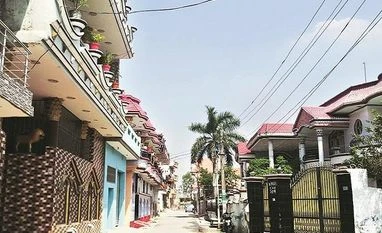
A mansion-lined street in the village of Awam where almost every family has a member settled abroad
A mansion-lined street in the village of Awam where almost every family has a member settled abroad. Photo: Sai Manish
Sai Manish Hoshiarpur/Kapurthala
6 min read Last Updated : May 16 2019 | 2:54 PM IST

Don't want to miss the best from Business Standard?

In the village of Awam in Punjab’s Kapurthala district, the houses are palatial and the streets are well-paved. But most of the mansions are locked and there’s hardly anyone to be seen outside. The name plates on the houses tell you that they belong to Sikh families whose country of residence is elsewhere. The Baz family is in USA, says one name plate. Mr Kartar Singh is in Italy, says another. The only school on the outskirts of the village is called Los Angeles International Public School. Further down the road a health centre is called “NRI health centre”.

After much walking around the deserted streets, a man in orange sun glasses appears on the horizon. He agrees to talk after some persuasion. ‘Mr Happy’ says he is a resident of Spain and runs an Italian restaurant in Madrid in partnership with a local. His wife and family live here and he has a girlfriend in Madrid. He spends only a few months in the village every year.

“I get almost Rs 2 lakh a month from my restaurant in Spain even if I am here,” says Mr Happy, who will speak only Punjabi or Castilian. Ask him why he migrated, and he replies, “Look around — do you see anything worthwhile to do in this village? This is a corrupt place. The people are dishonest. The administrators are corrupt. The politicians are greedy. In Spain if you are honest and hard-working your life is good.” 

For all its beautiful mansions and clean streets, Awam could well be a ghost town. Few politicians come here to campaign since there are hardly any residents. And Awam isn’t the only village of its kind. Punjab’s Doaba region, especially in Hoshiarpur and Kapurthala districts, are dotted with villages where every household has a family member settled abroad. Those left behind are the elderly, and in some cases, family members of the recently migrated. 

Pritam Singh, a member of the Lubana Sikh community is the sarpanch (head) of the village of Sikri in Kapurthala. He has three sons – one of them holds a US green card and two others are Canadian citizens. His two Canadian sons, who work as a cook and a truck driver, lead a hand-to-mouth existence, but they are happier there, says Singh. “Almost a million young people died because of drug use in 10 years of Akali Dal rule. I don’t want my future generations ruined because they stayed on in Punjab.”

The steady migration of people from Punjab to countries around the world has created a peculiar situation in the state, which is the birthplace of Sikhism – one the world’s youngest major religions. In 1991, Sikhs comprised 63 per cent of Punjab’s population. In 2011, when the last census was held, they were down to 58 per cent of the state’s population. The population of all other communities in the state, including Hindus, Christians and Muslims, grew faster than that of Sikhs during this period. 

At the same time, the number of Sikhs in countries like Canada and Australia is ballooning. In Canada, people who identify themselves as Sikhs have grown by 63 per cent from 2001 to 2011. There were almost 1.5 lakh Sikhs in Canada in 2011 — about 1.4 per cent of the country’s population. (In India, Sikhs constitute 1.7 per cent of the population). 

Meanwhile, in Australia, the Sikh population has grown by 325 per cent during the same period. They now comprise 0.7 per cent of Australia’s population. There are an estimated 1.3 lakh Sikhs in Australia. Even in the UK, which has a more rigorous immigration policy than Australia and Canada, the Sikh population has grown by 29 per cent between 2001 and 2011.

In Sanghwal village in Jalandhar district, the mansions are less opulent than those in Awam, but their stories are the same. Every household has a family member abroad and many houses are locked. Saurav, a member of the Ravidassi community (Dalits), is the son of the village sarpanch. His father spent six years working as a farm labourer in Italy before returning home. His mother’s relatives are settled in Italy and the UK.

“Most Scheduled Castes go to the Gulf nations. Most Jats go to US, Canada and UK. My father would have tilled a Jat’s field in this village. He did the same job in Italy and made a lot more money. There was dignity of labour for him in Italy which is missing here,” says Saurav, who has a diploma in hotel management and is without a job. Nor is he actively seeking one.”I want to go to Australia,” he says. “The agent has asked for Rs 20 lakh for a permanent residency with a job in Australia. Once I get there I can make this kind of money in three months.”

With Punjab becoming ‘less Sikh’, the state now faces the prospect of a Khalistani resurgence. From January 2016 to October 2017, there were eight targeted killings of non-Sikhs in Punjab. These include the murder of a member of the Shri Hindu Takht, a Christian pastor and a Rashtriya Swayamsevak Sangh (RSS) leader in Ludhiana. The National Investigation agency (NIA) has found that the Khalistan Liberation Force (KLF) was involved in these murders.

The NIA’s chargesheet has found trans-national money flows funding pro-Khalistan terrorist activities in the state. In a reply to the Rajya Sabha in January this year, Minister of State for Home Affairs, Hansraj Ahir, said 18 Khalistani terror modules had been busted and 95 people with links to organisations like KLF and International Sikh Youth Federation had been arrested in the last two years. 

Countries with a burgeoning Sikh population are also aware of the Khalistani threat. Canada listed “Sikh extremism and demands for an independent homeland of Khalistan” as a security threat in its ‘2018 Public Report on the Terrorism Threat to Canada.’ However after sustained pressure by Sikh groups, the Justin Trudeau government dropped the Khalistani reference in an updated report released in April. 

While none of the political parties in Punjab have made declining Sikhism or Khalistani resurgence an election issue, Sikh religious leaders are perturbed. Says Manjit Singh, secretary of the Shiromani Gurudwara Prabandhak Committee (SGPC), “Some politicians have destroyed Punjab. For years there has been an evil spell on Punjab and the faith. First there was communism, then came terrorism, then came drugs and now we are seeing the consequences of migration.”  

One subscription. Two world-class reads.

Already subscribed? Log in

Subscribe to read the full story →
*Subscribe to Business Standard digital and get complimentary access to The New York Times

Smart Quarterly

₹900

3 Months

₹300/Month

SAVE 25%

Smart Essential

₹2,700

1 Year

₹225/Month

SAVE 46%
*Complimentary New York Times access for the 2nd year will be given after 12 months

Super Saver

₹3,900

2 Years

₹162/Month

Subscribe

Renews automatically, cancel anytime

Here’s what’s included in our digital subscription plans

Exclusive premium stories online

  • Over 30 premium stories daily, handpicked by our editors

Complimentary Access to The New York Times

  • News, Games, Cooking, Audio, Wirecutter & The Athletic

Business Standard Epaper

  • Digital replica of our daily newspaper — with options to read, save, and share

Curated Newsletters

  • Insights on markets, finance, politics, tech, and more delivered to your inbox

Market Analysis & Investment Insights

  • In-depth market analysis & insights with access to The Smart Investor

Archives

  • Repository of articles and publications dating back to 1997

Ad-free Reading

  • Uninterrupted reading experience with no advertisements

Seamless Access Across All Devices

  • Access Business Standard across devices — mobile, tablet, or PC, via web or app

Next Story



