Technology versus troops: Tracing India's defence dilemma

India needs to balance the inexorable logic of force optimisation with making up for the numbers lost
16 min read
Updated On: Dec 10 2025 | 7:15 AM IST
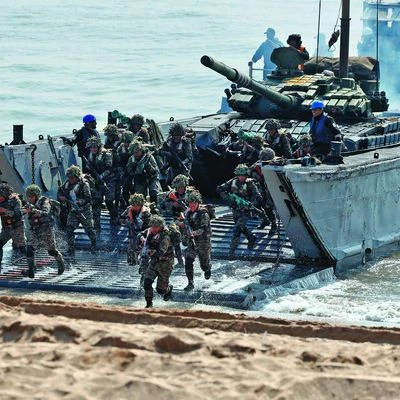
Soldiers disembark from the Indian Navy's landing craft during a tri-services military drill in Porbandar, Gujarat, on November 13, 2025 (Photo: Reuters)

Soldiers disembark from the Indian Navy's landing craft during a tri-services military drill in Porbandar, Gujarat, on November 13, 2025 (Photo: Reuters)

Technology has profoundly changed warfare and transformed the battlefield. It is an evolutionary process, but the pace has been profound in the last few years. Technological advancements have led to a reduction in manpower requirements as automation set in from the industrial to the information age. From industry to the battlefield, technology and automation have reduced the need for hard labour in general, but there are many domains where technology is an enabler and manpower is still required. Warfare is at the top of that pedestal. Advanced weapon systems and automation during the 19th and 20th centuries have enabled the West to optimise their manpower. 
The cost of manpower in the West is high, with small or dwindling populations. So, technology was a welcome substitute. In the global South, it is the other way round, where access to high-end technology was limited and slow to arrive, and the cost enormous  even when accessible. Manpower is cheaper than technology due to economic conditions and large populations. Further, conflicts in the West were limited. For instance, the United States (US) was waging wars far from home. The combination of these factors meant many countries in the global South needed larger armies.
  In the recent past, though, this has significantly changed as the decreasing cost of technology, especially of asymmetric technologies, has enabled their mass proliferation. Thus, their acquisition makes better operational as well as economic sense. So there is a debate around optimising technology and manpower, by having more high technology. As former Chief of Army Staff General Manoj Pande (retired) had emphasised, the “right-sizing” of troops with technology infusion and restructuring was needed as a part of overall efforts to make the Army a lean, agile, and modern fighting force.
  Even then, some of the biggest technological disruptions in the military became enablers and not a substitute. The case of long-endurance unmanned aerial vehicles (UAVs) best illustrates that. The Predator medium-altitude long-endurance UAVs, which revolutionised surveillance and even enabled remote kills from thousands of kilometres away, were originally envisaged as a replacement for high-end fighters and bombers. Instead, it coexisted and became a force multiplier working alongside those manned platforms, significantly lowering operational costs and enabling better management of manned fighter deployments. In some places, technology is an enabler, but it does not affect manpower. One official observed: “Advancements in mobility and counter mobility will save time more than manpower.” 
For example, the per-hour operating cost of a P-8A long-range maritime patrol aircraft exceeds $7,000, and that of an E-2 surveillance aircraft exceeds $10,000. By comparison, the hourly cost for an MQ-9A was just over $550 for the year 2021, according to the US Department of Defense. In addition to reducing operational costs, the long-endurance UAVs also decreased the wear and tear on manned platforms and reduced crew fatigue. This meant the coexistence of both manned and unmanned platforms, meaning more manpower in the form of unmanned crew, not less. It is for similar reasons that the Indian Navy is acquiring MQ-9B SeaGuardian high-altitude long-endurance UAVs. These will complement the P-8Is in service, which have become the workhorse for long-range reconnaissance and anti-submarine warfare.  However, with the vastness of the Indian Ocean and the operational area to be monitored, there is too much stress on the manned P-8I platforms, which have to travel long distances, limiting their on-station time. To maintain continuous surveillance over a remote area means one aircraft would be on station while one would be returning, and another would be on standby or en route. The MQ-9Bs, which have an endurance of up to 40 hours, can remain airborne providing consistent surveillance and, being armed, can be used for quick intervention in case of piracy, smuggling or trafficking incidents, one officer observed. While awaiting the 15 MQ-9Bs, part of a larger deal for 31 MQ-9Bs, the Navy is also currently negotiating six more P-8Is from the 
US-based firm Boeing to add to the 12 in service. The same can be applied to the regular infantry. Drones are an add-on, not a replacement for anything. 
While many countries in the West are struggling to find enough qualified recruits to join the military, China, which has the world’s largest standing army, undertook one of the biggest cuts in recent times. In a major military reorganisation announced by President Xi Jinping in 2015, the strength was reduced by 300,000, bringing it to two million. Such massive cutdowns were also undertaken by China in the 1980s, 1990s, and early 2000s. The last round also saw the reorganisation of the Chinese military into five theatre commands. Also, the reduction was much higher in the People’s Liberation Army, especially 
in non-combat roles, while the naval strength grew in line with its massive expansion. 
The Ukraine moment
  That technology can offset manpower may have been true to an extent till a few years back, but with the changing nature of technology in the 21st century, especially after the conflicts of the last three years, there is an evolved reality. The answer to whether technology can fully replace soldiers is a clear No. Ukraine is a case in point and marks a pivotal moment in global warfare, dispelling many previous assumptions, including that modern wars would be short and swift. As Russia rolled into Kyiv in February 2022, the initial thrust was with air power, missiles, and long lines of armoured columns. While they did make initial ingress, there were no boots on the ground to consolidate the gains. That initial phase of the war reinforced two aspects: The importance of main battle tanks and armour for initial thrusts, and that boots on the ground are indispensable despite technological advancements.  
That modern wars can be protracted, stretching over days, weeks, or months, also changes all operational calculus. It has shown the need for sufficient manpower because the battlefield has become more complicated, contested, and technology-pervasive. For instance, in the modern battlefield, lessons from the Ukraine war prove that the traditional legacy military platforms remain. Tanks, armoured personnel carriers, fighter jets, and helicopters all remain, though it is now precision and long-range. What has changed is the asymmetric threats to them. It means nations need to maintain regular forces but also prepare to counter asymmetric threats that can target them. Nations are hence investing in technologies like drones, counter-drones, loitering munitions, and encrypted communications, among others. In effect, it needs reorientation of manpower, if not 
more. “Ukraine has been a wake-up (call) for all modern armies. Many lessons drawn from that have prepared us for Operation Sindoor,” another official observed. 
The infantry, which has traditionally been more manpower-intensive and relatively less sophisticated in terms of technology than other arms and services, is now finding itself absorbing more technology. An infantry soldier, along with the standard gear of small arms, bulletproof jacket, and night vision, now also carries micro- or mini-drones and counter-drone systems, handheld computers, and other gear. “Long-range firepower is key, but the role of the regular infantry hasn’t diminished in any way, especially in the Indian context,” the official added. 
Another outcome of the war in Ukraine is the threat to Europe, which it perceives as existential. That has forced a major militarisation of the continent. Over the last several decades, many European countries with few major conflicts have downsized their militaries, having the benefit of collective defence under the North Atlantic Treaty Organization umbrella and security guarantees from the US. 
According to an explainer by the Council of the European Union and the European Council, the continent's defence spending touched an estimated €343 billion in 2024 and is projected to reach €381 billion in 2025, a 19 per cent increase from 2023 to 2024 and a 37 per cent rise since 2021. Under the ReArm Europe Plan/Readiness 2030 initiative presented by the European Commission in March this year, a massive defence investment surge of up to €800 billion in additional defence spending has been lined up. 
The major investments and the procurement of a range of frontline military hardware also mean the need for additional manpower to operate them. Finding the desired quality and the numbers is going to be a challenge. Germany, which has announced a decision to expand combat strength, is mulling conscription — compulsory military service — in case the required numbers are not achieved voluntarily. This is going to be felt across Europe. 
Ukranian soldiers launch a Leleka reconnaissance drone to combat Russian troops in the Donetsk region, Ukraine, on February 26, 2025 (Photo: Reuters)
 
India’s unique position
  All the aspects discussed apply to India as well, the added factor being the country’s geography and topography. The Indian subcontinent, as the name implies, has a whole range of geographies, and most of India's contested borders are in harsh 
terrain — high altitude areas and extreme weather. 
In high altitudes, even the best of technology is humbled. So, technology is limited in its employment in the first place. In most cases, imported equipment is not built to function at extreme temperatures, be it 50-plus degrees Celsius in Rajasthan in peak summer or minus-50 degrees Celsius on the Siachen Glacier in peak winter, as they are unique to the region. Maintaining and operating the equipment is a humongous task, in addition to human survival.
  The Siachen Glacier is the world's highest battlefield, where the armies of India and Pakistan are deployed and where the Indian Army is sitting at commanding heights of 21,000 feet. The temperature, rarefied atmosphere, and harshness of weather make existence challenging. Everything freezes in the winter, and the weather can change in the blink of an eye. Technology — be it helicopters, drones, or sensors — can only do so much.
  There has been significant induction of technology in every aspect of life on the glacier, which has reduced casualties and improved personal comfort. There is no way India can fully withdraw troops from the glacier and rely on technology till a permanent resolution is reached. Because if Pakistan were to resort to any misadventure and occupy the glacier, taking it back will be a tall order and will come at a steep price.
  Caution is required in finding the right balance. The Army’s operational commitments have significantly increased in recent years. The western front with Pakistan; insurgency in Northeast India; volatility in the neighbourhood, especially Bangladesh and Myanmar; and the border with China, which has become active since 2020; are among the factors. Despite an unsettled boundary, the border with China was largely quiet with occasional flare-ups. The 2020 standoff was an inflection point, as in that it altered the ground situation, forcing the biggest reorientation of the Indian military since Independence.
  India has one of the largest armed forces in the world, with its Army being the biggest among them at over 1.1 million personnel. The total strength of the Indian armed forces in December 2017 was 1,443,921 personnel, which had dropped slightly to 1,414,823 as of December 2021, as per government data. Of this, the Army’s strength was 1,237,117 personnel in 2017 and 1,189,368 in 2021. These are combined numbers of officers, junior commissioned officers (JCOs), and other ranks (ORs).
  On average, 60,000 vacancies arise in the three services every year. For various reasons, there has always been a deficiency in the numbers of JCOs, ORs, and officers at the junior level, leaving a gap between authorised and actual strength. For instance, as of March 10, 2023, there was a shortage of 8,070 officers and 127,673 JCOs and ORs in the Army. This was exacerbated by a freeze in all recruitment for two years due to the COVID-19 pandemic, followed by the introduction of the Agnipath scheme for recruitment of soldiers, sailors, and airmen. So, effectively, the Army is down by over 150,000 personnel and matches the right-sizing efforts planned, though in an ad-hoc manner. Because of the sudden halt in recruitment, the armed forces were forced to slow down retirements to retain skilled manpower in key locations.
  Technology infusion
  A section that operates a machine gun or a team that fires an artillery gun now has gadgets to improve real-time coordination and provide better battlefield transparency and precise coordinates. As a result, the workload of each individual has gone up, an officer noted, adding they are hard-pressed in having to make do with existing strength in some locations. “There is enough technology even at the lowest unit now. We now need individuals with higher education or more technical qualifications,” the officer said. 
In the infantry, better systems and technology offer enhanced situational awareness and automation enables faster responses, improving overall efficiency and war-fighting potential. Not just infantry, the armoured regiment, artillery, and air defence have all inducted tactical drones. The Army Aviation Corps, which operates the long-endurance Heron and Searcher UAVs, is looking at fleet expansion. In addition, it is set to significantly expand its attack helicopter fleet with six AH-64E Apache heavy attack and 114 advanced light attack helicopters. Similar capability augmentation plans are on the anvil for all arms and services, as well as the Navy and Air Force. 
“It is not that the traditional roles have changed. As seen during Operation Sindoor, every arm and service now has the regular roles and also saw significant technology infusion to tackle new-age threats. The same infantry soldiers are now trained to operate drones and to spot and shoot down enemy drones,” one officer noted. “We cannot add more manpower but there is no room to reduce any. We are already operating with a deficiency.” 
In this backdrop, it is pertinent to recall past efforts at right-sizing the Army. A series of efforts were made over the years in this regard. Several high-level committees had recommended measures to cut down non-essential roles so that the Army could focus on the primary function of war-fighting. One reason for this was ballooning defence pensions. The total allocation to the Defence Ministry in the Union Budget for 2025-26 stood at ₹6.81 trillion, of which revenue allocation was ₹3.11 trillion, capital expenditure ₹1.8 trillion, defence pensions ₹1.6 trillion, and civil expenditure ₹28,682.97 crore. As per information shared by the government in March 2020, there were 2.6 million military pensioners and 6 million defence civilian pensioners.  
The 2016 committee on enhancing the military’s combat potential, rebalancing defence expenditure, and improving the teeth-to-tail ratio, chaired by Lieutenant General D B Shekatkar (retired), made 216 recommendations. These included optimising the defence budget. The need for a chief of defence staff and 65 recommendations pertaining to enhancing the Army’s combat potential. The recommendations led to 57,000 soldiers being redeployed to operational duties from non-essential roles. 
More recently, under the optimisation and transformation initiative, General Pande said in 2024 that the plan was to right-size and rationalise the Army’s strength by 2027 by achieving optimisation of 100,000 troops. Measures towards this include phasing out redundant British-era units like military farms, significantly reducing animal transport by employing drones and all-terrain vehicles, and outsourcing non-essential activities. 
Other measures to improve combat potential, like outsourcing maintenance and logistics, are under development. With massive improvements in infrastructure, expansion of population clusters to far-flung areas and increasing domestic defence manufacturing, the industry has the capability to cater to the Army’s needs.
  The real circuit breakers 
  The pandemic and the Agnipath scheme acted as the actual circuit breakers in the defence recruitment. All recruitment rallies planned by the Army and other services were suspended due to the pandemic. According to the government, 97 Army recruitment rallies were planned in the recruiting year 2020-21, of which only 47 could be held. Out of these 47 rallies, the Common Entrance Exam (CEE) for only four rallies could be conducted before the suspension of recruiting activities, the government said in March 2022. Similarly, 87 recruitment rallies were planned in 2021-22, out of which only four rallies were conducted without any CEE. 
In June 2022, the government announced the Agnipath scheme, replacing the permanent recruitment of soldiers, sailors, and airmen that had been the practice since Independence. Under this, “Agniveers” will be recruited for four years, after which 25 per cent will be taken into permanent recruitment. Agniveers will not be eligible for any pensionary benefit and will get a lump sum at the end of four years. The reasons stated by the government for introducing the scheme were to reduce the age profile of the armed forces and strengthen the security of the country.  There is also a view that the short stint enables the right candidates to be picked after initial observation. 
However, the new recruitment numbers were capped at 46,000 for all three services per batch held twice a year, for the first year, and slightly increased for the next five years. These numbers fall well short of the vacancies created every year. In effect, this means an amplification of the shortage year on year.
  This also brings into question the Army’s sahayak (orderly) system, a colonial practice, which has been debated from time to time. There have been recommendations to rejig or to end it altogether. Based on the last available numbers, there are over 30,000 soldiers employed as sahayaks in peacetime and forward locations. For instance, in 2017 after a series of videos on social media by soldiers, the then Army chief General Bipin Rawat strongly defended the system. The buddy system has an important role in the field locations and especially in wartime. However, a debate to streamline it in tune with modern realities is warranted.
  The conversations around force reduction and optimisation seldom factor in the numerous defence civilian employees. The Defence Ministry has several behemoth defence public sector undertakings (DPSUs) and 41 ordnance factories that have now been converted into seven DPSUs. Their rationalisation and optimisation to improve efficiency and bring them on a par with industry standards are a necessity.  
Broadly, while technology does reduce hard labour and enable manpower optimisation to an extent, that arc of flexibility is now passé as seen in recent conflicts and given the new age technology progression.  
In the backdrop of technological advancements and the churn created in the system due to the Agnipath scheme, India requires a holistic assessment on force optimisation rather than force reduction. Ad-hoc reduction can be counterproductive in the long run. The fix lies in streamlining the process and optimising the non-essential and support roles. Given the new enhanced operational commitments and the gaps left by unplanned cuts since the pandemic, this is a much-needed measure.  
Premium ContentPremium ContentSubscription ExpiredSubscription Expired

Your access to Blueprint has ended. But the story is still unfolding.

No longer a subscriber? There’s a new reason to return.

Introducing Blueprint - A magazine on defence & geopolitics

Introducing Blueprint - A magazine on defence & geopolitics

Like what you read? There’s more in every issue of Blueprint

From military strategy to global diplomacy, Blueprint offers sharp, in-depth reportage on the world’s most consequential issues.

Exclusive pricing for Business Standard digital subscribers

Choose your plan

Exclusive Pricing

Choose your plan

58% off
₹6,000

Blueprint Digital

₹2,500

annual (digital-only)

₹208/Month

70% off
₹12,000

Blueprint Complete

₹3,500

annual (digital & print)

₹291/Month

41% off
₹6,000

Blueprint Digital

₹3,500

annual (digital-only)

₹291/Month

62% off
₹12,000

Blueprint Complete

₹4,500

annual (digital & print)

₹375/Month

Here's what's included:

  • Access to the latest issue of the Blueprint digital magazine

  • Online access to all the upcoming digital magazines along with past digital archives

  • * Delivery of all the upcoming print magazines at your home or office

  • Full access to Blueprint articles online

  • Business Standard digital subscription

  • 1-year unlimited complimentary digital access to The New York Times (News, Games, Cooking, Audio, Wirecutter, The Athletic)

Written By :

Dinakar Peri

Dinakar Peri is fellow, Security Studies Programme at Carnegie Endowment for International Peace India
First Published: Dec 10 2025 | 7:15 AM IST

Next Story