During the Cold War, the great American strategist Andrew Marshall posited the theory that in a world with nuclear weapons that prevented countries from getting into conflict and planning to attack and occupy each other’s territories, grand strategy would be reduced to “winning” the competition and outlasting the enemy’s political system. He was to be proved correct, but the technique he devised to craft a grand strategy was a two-step process. In the first step, a multidisciplinary group of specialists would “define” what the enemy state would evolve into in, say, 20 years. Second, a strategy would be crafted to weaken and overrun the evolved enemy state. The group of specialists so convened came to be the Office of Net Assessment (ONA) situated in the United States (US) Department of Defense, and one of their many achievements was to foresee the collapse of the Soviet Union, roughly
six years before 1991. Another success of the ONA was to predict the contours of future warfare in the era of total transparency and the digital revolution, as witnessed in the attack on Iraq, which duly inspired China to launch its own military revolution.
Net assessment specialists made many attempts to sell the idea in India after the 2008 Indo-US nuclear agreement but met with indifferent success, particularly with the Ministry of External Affairs.
As the world struggles to come to terms with the new global world order, with the US withdrawal from maintaining the international system and the collapse of the idea of liberalised world trade, India must craft a grand strategy of living in a world most likely to be dominated by China. India can never forget that the most evil and vicious act in international affairs was probably the transfer of nuclear weapon technology and material to a technologically backward Pakistan between 1980 and 1989, so that Pakistan was able to field an air deliverable bomb in 1987, 11 years before the Indian nuclear test. So, the die is cast as to which country India has to compete with in the foreseeable future. To get a succinct idea of that world, it is necessary, first of all, to assess what the result of the US-China competition would evolve into. Gross domestic product (GDP) is a coarse indicator of this competition, but even so, the figures are revealing.
The ‘Chinese Dream’
What does China make of all this? Prior to his arrival as the head of state, Xi Jinping articulated a “Chinese Dream” (Zhongguo meng), which along with other white papers and party plenum notes, constitutes a Chinese grand strategy — the only one other than that crafted in the US. The Chinese grand strategy has a number of silos and objectives.
The Chinese speak of a unifying narrative that binds separate silos into a single vision of national rejuvenation through comprehensive power. The nearest that Indian strategic thought comes to a grand strategy is Prime Minister Narendra Modi’s Viksit Bharat, which unfortunately has no silos for geostrategy and military modernisation. This is unfortunate, as armed forces like the Indian Air Force and particularly the Indian Navy are so technologically oriented that it takes more than 30 years to change the force architecture.
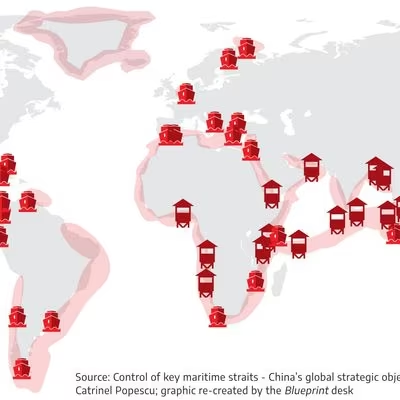
The striking manifestation of China’s geostrategic and military silos are exemplified in an ambitious grand sweep westwards, starting from the Strait of Malacca through the Indian Ocean into Africa, to dominate the littorals of Africa and West Asia, further westwards into and through the Atlantic to South America and Panama, where the Chinese-owned port operator C K Hutchison’s decision earlier this year to sell its ports to a consortium led by the US investment firm BlackRock raised concerns in China. The domination aims to control 129 ports in 65 countries. All this shows that the largest amount of money that India generally spends of its defence budget — on defending our northern border — is unlikely to be the centre of China’s geopolitics in the 21st century. The Indian Army will no doubt give a good account of itself if the border is transgressed, but is that enough to deter China from an aggressive and hegemonic policy towards India? Specifically, does defending our border create anxiety in China? Unlikely, and this is where we need to think of leveraging our sublime maritime geography to deter China from an adventurous foreign policy, symptoms of which India has experienced since the 1980s.
Of course, there are prolific writings on the probable outcome of the US-China competition. Perhaps the most authoritative early work was by the well-known scholar Michael Pillsbury, who warned that China was preparing for a “marathon” to win the competition. A more relevant and authoritative work is by the American political scientist of Indian origin Rush Doshi who, in his book The Long Game: China’s Grand Strategy to Displace American Order, argued that China intends to displace the US sooner than imagined. Doshi has probably the longest of primary sources, including party documents, leaked material, and memoirs of party leaders. But the most talked about source currently is by an American of Chinese origin, Dan Wang, who in his book Breakneck: China’s Quest to Engineer the Future puts out the theory that China is a nation of engineers, while the US is a nation of lawyers. The Chinese engineers will outcompete the benefits conferred on the US by Silicon Valley that could eventually lead to Chinese supremacy in the long game.
Just as India has an unfavourable Himalayan geography against China, with the latter enjoying the advantage of the high ground of the Tibetan plateau where they have built six-lane highways and bullet trains, India has a far superior maritime geography. Although China is the manufacturer to the world, exporting goods at a profit, almost 70 per cent of its trade flows westwards, through the Strait of Malacca. It is hugely dependent on imported crude oil, most of which flows through the Indian Ocean and the strait. China acknowledges its “Malacca Dilemma”, and has a strategic oil reserve capacity of over one billion barrels situated in the vulnerable coastal port of Dongjiakou. To stress the overall objective once again, hostilities with China are not part of the grand plan, but India must possess a conventional geostrategic deterrent to prevent itself being overwhelmed by a rich and hostile China, which has every intention of becoming the world’s hegemon and reordering the global system. India will have to seek peace on honourable terms, though it will be poorer than China by almost $20 trillion in 2050. This can be done by signalling our resolve to retain maritime dominance of the Indian Ocean and information and tactical dominance of the Strait of Malacca, so that China’s giant westward global sweep is dependent on Indian goodwill and conversely, could be wrecked by Indian hostility.
Even as a rising power, China’s unmitigated hostility towards India has been alarming over two decades. So its behaviour, once it is a world power, could be devastating without a calculated Indian response.
Some Indian analysts and practitioners are beginning to think along these lines already and part of a grand plan is emerging, although much more has to be thought through. The first track to retain the initiative in the Indian Ocean were a set of “soft” measures, included in the Indian government’s Sagar (“Security and growth for all in the region”) and Mahasagar (“Mutual and holistic advancement for security and growth across regions”) projects. The two projects aim to knit the Indian and Indo-Pacific communities through maritime diplomacy, joint naval exercises, humanitarian relief, joint maritime domain awareness, freedom of navigation and transfer of hardware, so as to combat China’s aggressive Belt and Road Initiative that has been extractive and ruined the economies of three South Asian countries. The Indian Navy, for instance, runs the Milan exercise in the Bay of Bengal, which includes naval exercises and social, cultural, and sporting events. In 2024, it had over 50 delegations, and 56 countries are expected in 2026. Then there is the Indian Ocean Rim Association, an intergovernmental organisation that promotes cooperation and development among countries bordering the Indian Ocean, of which there are 23 member states. Its priority area remains maritime security. There is also the Indian Ocean Naval Symposium, a conclave of navy chiefs conceived in 2008 as a forum to enhance maritime cooperation of the littoral states; India is scheduled to take over the chair at the end of 2025. Lastly, there is the Colombo Security Conclave, a regional security grouping established in 2020 with India, Bangladesh, Sri Lanka, and Maldives, with Mauritius joining in 2022. Seychelles is an observer.
A new battlespace
Eventually, the diplomatic and quasi-naval initiatives must be backed by a hard power buildup. The Chinese maritime grand strategy in the West Pacific — of establishing an anti-access or area denial strategy — is sought to be replicated off Pakistan’s Makran coast by transferring eight Type 039A attack submarines, the largest ever military transfer by China, in an obvious attempt to limit the reach of the Indian Navy. Equipped with air independent propulsion, four of them will be built in Pakistan, and they will be able to fire a land-attack cruise missile with a range of 450 km. So, the only card that India possesses to compel China to adopt a friendly attitude towards it will be the force structure of the Indian Navy.
At the outset, spending an average of 16 per cent on the Navy, spiking to 19.76 per cent in 2024-25, of the defence budget on its only card is a poor strategic choice. The decisive theatre where this competition will be played out is the Indian Ocean, which is 6,000 nautical miles by 4,700 nautical miles. Through this space passes the major portion of China’s foreign trade amounting to 37 per cent of its GDP, which is vulnerable to Indian naval supremacy. In this vast space, establishing oceanic dominance will only be possible with large aircraft carriers, and a flotilla of nuclear-powered attack submarines (called submersible ship nuclear or SSN).
Lately, an unfortunate debate has arisen in India on one versus the other, but the two are mutually exclusive and complement each other. The large aircraft carrier, with its escorts, has a dominating battlespace shaped like a moving cylinder of national sovereignty, based on a circle of 400 nautical miles and extending from the surface of the ocean to the troposphere, the whole travelling through the ocean at 35 miles per hour. When this cylinder approaches another littoral, it is as though that country has temporarily acquired a new armed neighbour. While India had a lead over China in aircraft carriers, that is now gone with the People’s Liberation Army (PLA) Navy’s Fujian, an 80,000-tonne carrier embarking 40 aircraft with three electromagnetic catapults. We will be dependent on large aircraft carriers in the long years of peace to project Indian power over the Indian Ocean. Equally important will be a fleet of attack submarines, fitted with both land-attack cruise missiles and anti-ship missiles to deny vast stretches of the ocean to a rampaging PLA Navy with clearly stated world power ambitions. The SSN is always part of the carrier’s escort, extending the reach of the “cylinder” to the underwater domain.
There are 38 independent states that form the Indian Ocean littoral. So, the force structure to induce friendly cooperation among them must vary from the high profile and visible aircraft carrier to the deadly threat of the SSN with its arsenal of land-attack missiles, the only platform that can operate in the South China Sea and Philippine Sea despite China’s anti-access strategy, and the burgeoning one in the North Arabian Sea of Pakistan.
Premium ContentPremium ContentSubscription ExpiredSubscription ExpiredYour access to Blueprint has ended. But the story is still unfolding.
No longer a subscriber? There’s a new reason to return.
Introducing Blueprint - A magazine on defence & geopolitics
Like what you read? There’s more in every issue of Blueprint
From military strategy to global diplomacy, Blueprint offers sharp, in-depth reportage on the world’s most consequential issues.
Exclusive pricing for Business Standard digital subscribers
Choose your plan
Exclusive Pricing
Choose your plan
58% off
₹12,000
Blueprint Digital
₹5,000
annual (digital-only)
₹416/Month
72% off
₹24,000
Blueprint Complete
₹6,500
annual (digital & print)
₹541/Month
37% off
₹12,000
Blueprint Digital
₹7,500
annual (digital-only)
₹625/Month
62% off
₹24,000
Blueprint Complete
₹9,000
annual (digital & print)
₹750/Month
Here's what's included:

Access to the latest issue of the Blueprint digital magazine

Online access to all the upcoming digital magazines along with past digital archives

Delivery of all the upcoming print magazines at your home or office

Full access to Blueprint articles online

Business Standard digital subscription

1-year unlimited complimentary digital access to The New York Times (News, Games, Cooking, Audio, Wirecutter, The Athletic)

Access to the latest issue of the Blueprint digital magazine

Online access to all the upcoming digital magazines along with past digital archives

* Delivery of all the upcoming print magazines at your home or office

Full access to Blueprint articles online

Business Standard digital subscription

1-year unlimited complimentary digital access to The New York Times (News, Games, Cooking, Audio, Wirecutter, The Athletic)