AI in the Box: Army's plan to gain an edge

Future battlefields will require on-site processing hardware and capabilities at the frontline, says a senior Army officer
6 min read
Updated On: Dec 10 2025 | 10:30 AM IST
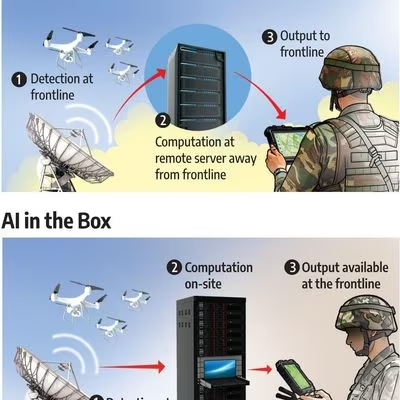
Difference between conventional AI model and AI in the box (Imaging: Ajaya Kumar Mohanty)

Difference between conventional AI model and AI in the box (Imaging: Ajaya Kumar Mohanty)

Between May 7 and 10, as missiles, drones, and artillery shells streaked across the skies dividing India and Pakistan, another front quietly opened: not of steel and fire, but of vast streams of weaponised data. On this newer battlefield, dominated by algorithms and software, the Indian armed forces — air, naval, and ground — turned to artificial intelligence (AI).
  Codenamed Operation Sindoor by India, the conflict began with India’s strikes on terrorist targets across the border in response to the Pahalgam terrorist attack in April, which India claims was carried out by Pakistani nationals, and escalated after Pakistan targeted Indian civilian and military sites. The Army, in particular, described its use of AI tools to build a coherent picture of the battlefield during the operation as “extensive”.
  The Army accelerated decision-making and enhanced battlefield awareness using a suite of around 23 military software applications and AI tools, indigenously developed and trained on datasets provided by the force to reflect its operational and doctrinal needs. These tools, including small language models, generated a unified operational, intelligence, and logistics picture. AI fused multisensor and multisource inputs and analysed vast volumes of real-time data much faster than human operators, compressing threat assessment, intelligence analysis, and battlefield review processes to an unprecedented degree, while also making long-range precision fire more effective.
  Among the more striking deployments was that of the indigenous “Sanjay” battlefield surveillance system along the western borders. It enabled the use of AI directly in the field, processing data and supporting decision-making locally without relying on distant servers — a capability reflecting current advances in computing known as “Edge AI”. This contrasts with the conventional model, in which field devices primarily collect raw data and transmit it to remote servers, where AI systems perform the heavy computation before relaying the processed insights back.
  Now, the Indian Army is preparing to push the envelope further: making AI tools increasingly accessible in forward areas and extending their use to smaller formations. Lieutenant General Rajiv Kumar Sahni, who served as the army’s director-general (DG) of Information Systems during Operation Sindoor before assuming his current role as DG Electronics and Mechanical Engineers, said the force is developing a capability it calls “AI in the Box”, designed to bring data analysis and decision-support functions to commanders at the forward edge of the country’s borders. “This will enable confidential data collation and analysis at a localised, forward level,” said Lt Gen Sahni, adding that potential use cases include deployment by special forces units.
Stating that the Army’s Directorate General of Information Systems is developing this capability in collaboration with industry, Lt Gen Sahni added that the focus is on ensuring that on-premises processing hardware — with secure data — is available at the disposal of field commanders. “It is slated for deployment by the end of 2025,” he said.
  As with Edge AI, the military’s algorithms will run directly on a local device rather than rely on a remote server. By leveraging “on-device” processing, field commanders will gain stronger cyber protection and the ability to operate offline. This makes it ideal for use in highly contested environments where the adversary employs electronic warfare to degrade or deny communications — a situation in which dependence on external processing would be an exploitable weakness. Processing data locally will also enable near-instant decision-making. 
Picture a forward unit detecting a potential drone swarm. The ensuing stages of classification, threat identification, and countermeasure formulation would all occur locally. The system would remain resilient, as AI processing would continue seamlessly even if links to external servers were severed; secure, because interception risks would be lower with sensitive data staying on the local device unless absolutely necessary; and fast, since commanders would no longer have to await the return of off-site analyses. Together, these factors could determine whether the swarm is neutralised in time or not.
  The resulting ability of field commanders to leverage AI independently will also strengthen the Army’s overall command, control, communications, computers, intelligence, surveillance, and reconnaissance (C4ISR) architecture, making it harder to degrade. “With AI independently embedded at multiple levels, the aim is to ensure that even if a proportion of the adversary’s electronic, cyber, or kinetic attacks hit their target, the army’s C4ISR network experiences only graceful degradation. Hitting one server, one node, or jamming communications will not prevent the force from operating effectively in an information-dense battlespace,” said Lt Gen Sahni.
  The army plans to deploy its AI tools across all of India’s borders. This comes at a time when, while Pakistan’s military use of AI remains largely unexamined, China’s progress has been the subject of growing global analysis and attention.
  The United States (US) Department of Defense’s 2024 annual report on military and security developments involving China observed that the country is prioritising the development of AI-enabled capabilities, driven by its belief that such technologies will underpin the next revolution in military affairs. “By 2030, the PLA (People’s Liberation Army) expects to field a range of ‘algorithmic warfare’ and ‘network-centric warfare’ capabilities operating at different levels of human-machine integration,” the report said. 
A September 2025 report by the US-based policy think-tank Centre for Security and Emerging Technology noted that the PLA published more than 2,800 AI-related contract award notices between January 2023 and December 2024. 
However, Lt Gen Sahni emphasised that the Army’s focus was on developing capabilities rather than targeting any specific country, and that its efforts were fully aligned with the Centre’s IndiaAI Mission, approved in March 2024 with a budget outlay of ₹10,372 crore.
  AI adoption in the Army is only slated to grow, driven by the increasing focus on long-range precision fires, over-the-horizon targeting, and the use of drones extending down to individual soldiers. For instance, all 382 infantry battalions (each comprising about 800 soldiers) have raised “Ashni” drone platoons of 20-25 specially trained personnel.
  The recently unveiled Technology Perspective and Capability Roadmap, which outlines the armed forces’ capability requirements for the next 15 years, also lists an Army requirement for up to 800 surveillance drones and loitering munitions with AI-enabled target recognition, as well as up to 2,000 first-person-view drones equipped with AI-driven analytics.  
Employing such systems at scale, integrated through an information-sharing network linking multiple sensor types, 
will itself depend on the immense data-processing power that AI provides. With the Ukraine war having seen the “kill chain” (the process of identifying, targeting, engaging, and destroying a threat) compressed from around 30 minutes to roughly three, and this window continuing to narrow, the speed of analysis has become equally critical. In this context, AI in the Box seems aimed at ensuring that, at the field commander’s level, AI runs where the data is generated rather than data travelling to where the AI runs. “We intend to keep the kill chain operating as close to real time as possible,” said Lt Gen Sahni.
Premium ContentPremium ContentSubscription ExpiredSubscription Expired

Your access to Blueprint has ended. But the story is still unfolding.

No longer a subscriber? There’s a new reason to return.

Introducing Blueprint - A magazine on defence & geopolitics

Introducing Blueprint - A magazine on defence & geopolitics

Like what you read? There’s more in every issue of Blueprint

From military strategy to global diplomacy, Blueprint offers sharp, in-depth reportage on the world’s most consequential issues.

Exclusive pricing for Business Standard digital subscribers

Choose your plan

Exclusive Pricing

Choose your plan

58% off
₹12,000

Blueprint Digital

₹5,000

annual (digital-only)

₹416/Month

72% off
₹24,000

Blueprint Complete

₹6,500

annual (digital & print)

₹541/Month

37% off
₹12,000

Blueprint Digital

₹7,500

annual (digital-only)

₹625/Month

62% off
₹24,000

Blueprint Complete

₹9,000

annual (digital & print)

₹750/Month

Here's what's included:

  • Access to the latest issue of the Blueprint digital magazine

  • Online access to all the upcoming digital magazines along with past digital archives

  • * Delivery of all the upcoming print magazines at your home or office

  • Full access to Blueprint articles online

  • Business Standard digital subscription

  • 1-year unlimited complimentary digital access to The New York Times (News, Games, Cooking, Audio, Wirecutter, The Athletic)

Written By :

Bhaswar Kumar

Bhaswar Kumar has over seven years of experience in journalism. He has written on India Inc, corporate governance, government policy, and economic data. Currently, he covers defence, security and geopolitics, focusing on defence procurement policies, defence and aerospace majors, and developments in India’s neighbourhood.
First Published: Dec 10 2025 | 10:30 AM IST

Next Story