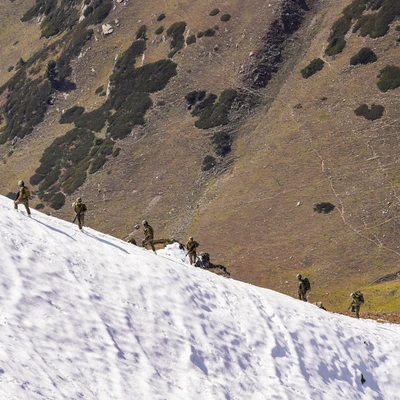
Just a year before Indian and Chinese soldiers engaged in a deadly combat in Galwan in 2020, India completed work on a 255-kilometre (km) stretch of road in the upper reaches of Ladakh. India’s aim was to make durable road links available throughout the year, including during the region’s harsh winter months, to India’s northernmost airstrip, the Daulat Beg Oldie.
The Darbuk-Shyok-Daulat Beg Oldie road serves a crucial strategic purpose for India. The road's proximity to the Line of Actual Control (LAC) and its potential for rapid mobilisation of Indian troops is believed to have triggered activity on the part of the Chinese army and the development of Chinese infrastructure close to Patrol Point 14 in the Galwan Valley.
The tensions culminated in hand-to-hand combat close to Patrol Point 14 along the Galwan river, leaving 20 Indian soldiers and several Chinese troops dead in the worst fighting between both sides since the 1962 war.
In 1962, this site became one of the early flashpoints in a month-long war between India and China. The battle of Galwan in October that year exposed the vulnerability of Indian positions due to poor infrastructure connectivity. The war was a reminder that high in the snowbound western Himalayas, infrastructure is key to gaining a strategic advantage.
The 2020 clash catalysed an infrastructure race along the 3,488 km border, and in the past five years, both India and China have given a hard push to construction along the disputed areas.
“Since then, we have drawn up ambitious plans for developing roads and other infrastructure along the borders, especially along the India-China border,” said Pushpita Das, research fellow and coordinator at Manohar Parrikar Institute for Defence Studies and Analyses (MP-IDSA).
“Several factors, including financial constraints, lack of expertise, and corruption, slowed progress initially, but after the Galwan clash, the urgency became clear,” she added.
BRO takes the lead
The Border Roads Organisation (BRO) has emerged as the central force driving these projects, although it has long been constrained by budgets and bureaucracy. In the Union Budget for 2025, the BRO received ₹7,146 crore, marking a significant increase from the ₹6,500 crore allocated the year before.
“India started late, so it has to cover a large area. But India is catching up. Once you have the political will, financial resources, technical and civil expertise and a cooperative border population, it becomes easier to develop the remote border areas,” Das said.
India shares a vast border with China — approximately, 2,152 km in the western sector (Ladakh), 545 km in the middle sector (Himachal Pradesh and Uttarakhand) and 1,140 km in the eastern sector (Arunachal Pradesh and Sikkim), which makes good, fall-weather roads a strategic necessity. In the western sector, the BRO has constructed the world's highest motorable road across the Mig La Pass in Ladakh at 19,400 feet.
By 2026, an alternative 130-km route to Daulat Beg Oldie in the northernmost tip of Ladakh is expected to be operational. The route will run from Daulat Beg Oldie to Sasoma via Saser La and Gapshan in eastern Ladakh. This construction is under Project Vijayak of the BRO.
The Zoji La Tunnel, running between Sonamarg in Jammu & Kashmir to Kargil in Ladakh, which is aimed at ensuring road access to Ladakh through the year, has had its completion date moved to 2028 from 2026 due to a combination of bad weather and tough terrain. Meanwhile, the Shinku La Tunnel in Himachal Pradesh is still being worked on.
In the eastern sector, the BRO operates under Project Arunank, building roads, bridges, and tunnels across Arunachal Pradesh’s steep, rain-soaked terrain.
Unlike the dry, rocky Western Himalayas of Ladakh and Jammu & Kashmir, the Eastern Himalayas are densely forested, wet, and rise sharply from the plains, posing unique engineering challenges. The climate and terrain make these hills landslide-prone.
However, the Se La Tunnel in Arunachal Pradesh has been completed, enhancing mobility in one of the most challenging terrains in India.
The BRO has also built key bridges over the Subansiri, Sisseri, and Brahmaputra rivers, and upgraded roads leading to border posts. In addition, the BRO is developing routes to remote locations like Kibithu and Walong in Arunachal Pradesh, enhancing troop mobility and civilian access.
Air connectivity is also improving. India's highest airfield, in Nyoma, in eastern Ladakh, is set to become a fully operational advanced landing ground for fighter jets. The defence ministry is also reviving old advanced landing grounds in Chusul and Anini.
The airfields at Daulat Beg Oldie and Fukche are also being modernised, and new helipads have come up in Hanle and Thangu. Telecom connections are slowly but steadily reaching out to more and more areas. Remote villages like Galwan and Demchok have been connected with 4G, but even so, frequent power cuts and harsh winters make connections unstable.
Alongside roads, tunnels and airfields, India has been reinforcing its borders through the Vibrant Village Programme, aimed at improving the lives of remote communities living near the LAC. By developing these settlements, India is improving the quality of life and also fostering a human buffer along strategic frontiers.
“As far as developing infrastructure at the border is concerned, we have always been at the task. The last 15 years have seen a tremendous fillip in our efforts,” Sanjeev Raina, former-additional director-general of the Indo-Tibetan Border Police (ITBP), said.
“We have made tremendous progress, but the availability of resources and steadfast will to complete the tasks on time are key to matching the other side’s decades of work,” he added.
Rail on the rise
Rail connectivity has made significant progress. The Udhampur-Srinagar-Baramulla line, which was opened in June 2025, links the Kashmir valley with the plains. The Chenab Bridge, and the longest rail tunnel of India at 12.775 km, called Tunnel T50, are vital parts of this line. As a result, two new Vande Bharat Express trains run from Katra to Srinagar in only 3 hours.
In northeastern India, the Bairabi-Sairang rail line in Mizoram serves the capital Aizawl. The rail line was inaugurated in 2025, with engineers overcoming the enormity of frequent landslides and the requirement of tunnelling, thus facilitating trade, tourism, and local development.
However, some strategic rail projects are off-track. It took 16 years to approve the Sitamarhi-Jaynagar-Nirmali line in Bihar, a state that shares a border with Nepal, owing to lack of funding and clearances.
Work on the Akhaura-Agartala cross-border link with Bangladesh had to be postponed because of political and logistical issues. “The Indian government didn't have the financial resources to invest in these projects as planned, so some of these plans turned out to be too ambitious,” said Das of MP-IDSA. “The Railways were worried; on top of that, because of the tough terrain in the border areas, these projects would lead to cost increases.”
Indian Railways is now set to expand railway infrastructure along the northeastern frontier by laying down an ambitious 500 km rail line along the borders with Bhutan, Myanmar and China. This project will cost a staggering ₹30,000 crore and will provide
much-needed connectivity to the remote corners of the northeast.
Two cross-border railway projects connecting Bhutan and totalling 89 km have also been announced. This marks the first time the landlocked kingdom will be connected by railway, and it is being pushed on a priority basis as part of India’s Act East policy.
The ongoing construction work in Daulat Beg Oldie, under Project Himank, will help the Indian Army to enhance connectivity (Photo: BRO)
China’s expanding edge
While India has accelerated construction since 2020, China’s build-up in Tibet and Xinjiang remains larger and faster. China treats border infrastructure as an extension of national security and economic policy.
Official data shows that Tibet now has over 120,000 km of roads, with nearly 95 per cent of townships connected by all-weather routes. In the last decade, China has added or upgraded more than 30 airports and helipads in Tibet and Xinjiang, many close to the Indian border.
The Lhasa–Nyingchi section of the Sichuan–Tibet railway, opened in 2021, has cut travel time from Chengdu to the Tibetan capital Lhasa to about 13 hours. China has also built dozens of dual-use “model villages” near the border. Officially designated as civilian settlements, many of these serve as logistical nodes for the People’s Liberation Army. Satellite imagery shows new bridges, roads, and fuel depots across Pangong Tso and in the Doklam region in eastern Ladakh, enabling faster troop mobilisation.
A 2024 report by the US-based Centre for Strategic and International Studies noted that China’s construction network in Tibet allows military convoys to move from inland bases to the border in under 24 hours. India, by contrast, still takes several days for similar redeployment due to terrain and road conditions.
Centralised planning allows China to synchronise road, rail, and air infrastructure under a single command structure. India’s projects, meanwhile, involve multiple clearances, which slow execution.
China’s upcoming 1,980-km Xinjiang-Tibet railway, expected to be operational by 2030, will connect key military garrisons across the plateau. India’s corresponding Ladakh rail is still at the survey stage. The infrastructure race is more than symbolic — it is shaping the tactical balance on the ground. Every new tunnel, bridge, and airstrip reduces supply times to forward bases.
In recent reports, it has been reported that China has been moving military assets like air defences close to the LAC, which has caused alarm in India.
The strategic logic is straightforward: Access equals deterrence. When troops and supplies can move year-round, defensive depth increases. Infrastructure also enhances civilian development in remote areas, improving the local population’s stake in national security. Similarly, diplomacy is also important to ensure stability at the border.
Despite over 30 rounds of talks since 2020, including a holistic border deal in October 2024, India and China lack a clear border agreement. “Infrastructure, logistics, and arming policies are important, but the biggest challenge is the absence of a border agreement with China,” said Raina.
Soldiers patrol along the LoC in Kupwara district, Jammu and Kashmir, on October 19 (Photo: PTI)
Persistent complexities Beyond China, India’s challenges along other frontiers are equally complex. Despite extensive fencing and years of investment in monitoring systems, India’s eastern borders remain difficult to manage. India's geographical position and porous borders with Bangladesh and Myanmar have placed the country on the map as a destination for migrants escaping persecution or looking for economic opportunities.
The Bangladesh frontier is particularly challenging. A large portion of the land is marshy terrain, riverine belts, and jungles.
Electronic fencing and sensor integration in these places fail frequently due to flooding, erosion, and the denial of a power supply. Smugglers take advantage of these weaknesses to shift contraband, livestock, and even humans across the border.
In his Independence Day address in August 2025, Prime Minister Narendra Modi warned that “illegal infiltrators are snatching the bread and butter of our youth”. According to Border Security Force (BSF) officials, the terrain, dense habitation, and local socio-economic networks continue to complicate day-to-day border management.
“At present, many of the high-tech surveillance devices deployed by the BSF are not optimally utilised because the required technical expertise is not uniformly available among the force’s personnel,” wrote Das in a MP-IDSA paper, Comprehensive Integrated Border Management System: Issues and Challenges.
Uneven technical training, however, is only one part of a larger puzzle. “Cross-border smuggling and illegal movement persist not just due to operational gaps but also because of local complicity and corruption,” said former BSF additional director-general S K Sood. “Vested interests, smugglers, corrupt politicians, bureaucrats, and even some BSF personnel, willingly allow such activities to flourish because everyone benefits monetarily.”
“But in areas where local commanders have taken a strict anti-smuggling approach and worked with residents, such incidents have reduced significantly.” Physical fencing is itself incomplete. Close to 569 km of the India–Bangladesh border still requires fencing, and about 100 stretches remain contentious over a 150-yard "no-man's land" guideline and objections from local villagers and Bangladesh's border forces.
“Fences also cut through houses and villages as inhabitants refuse to move, fearing they’ll lose their land,” Sood said.
A similar set of coordination and terrain challenges exists along the Indo–Myanmar frontier, where insurgency and smuggling have surged.
In December 2024, the limit on the free movement regime was reduced the cross-border travel limit from 16 km to 10 km and introduced QR code-based permits with biometric data.
The move aimed to regulate local crossings and curb misuse, but drew protests from tribal groups that depend on traditional transit routes. Meanwhile, the government has sanctioned nearly ₹30,000 crore to fence the 1,643-km India–Myanmar border, though construction has faced resistance from the Naga and Kuki communities.
India’s border challenges are as much social and political as they are logistical. Managing them requires not just surveillance or infrastructure, but consistent inter-agency coordination, local engagement.
“Challenges remain. Drones carrying drugs and weapons are a real threat. We can detect them, but interception is still a weak point. We have caught consignments, but preventing their entry entirely is very difficult,” said Sood. On the western and northern fronts, infrastructure is largely in place, though the Pakistan border remains the most sensitive because of infiltration and terrorism risks. Most stretches are fenced and connected by roads, allowing for better troop mobility and control.
In Jammu and Kashmir, infiltration across the Line of Control has fallen sharply in recent years due to stronger fencing, surveillance, and coordination. “Zero infiltration may not be possible given the terrain,” Sood said, “but the situation is far more stable than it was a decade ago”.
In contrast, India’s borders with Nepal and Bhutan are peaceful but highly porous and economically active, demanding smarter regulation of movement rather than militarisation.
Despite terrain, weather, and bureaucratic challenges, India’s frontier development is moving faster than ever before. Yet, officials and experts agree that roads and tunnels alone cannot guarantee border stability. True deterrence will come from seamless integration of infrastructure with technology, where surveillance, logistics, and communication networks function as one.
Das said, “Technological integration is not so simple, more so when India has different borders with diverse terrain and climatic conditions. India has to keep on researching, investing, and evolving its strategies.”