Indian Railways to set up plant to convert plastic into diesel: Dr Harsh Vardhan
The plant will use the technology developed by CSIR-Indian Institute of Petroleum (CSIR-IIP) for producing diesel (conforming to Euro-5 specifications) from plastic waste
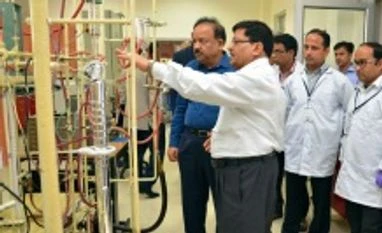
Dr Harsh Vardhan visiting the Indian Institute of Petroleum (IIP) campus in Dehradun
Last Updated : Apr 20 2015 | 12:50 PM IST
Indian Railways will soon run on diesel (conforming to Euro-5 specifications) produced from plastic waste, according to Dr Harsh Vardhan, minister for science and technology and vice president, Council of Scientific and Industrial Research (CSIR). For this, Railways is expected to set up a plant to convert plastic waste into diesel using the technology developed by CSIR-Indian Institute of Petroleum (CSIR-IIP). “I have myself campaigned on the streets of Delhi against pollution and plastic proliferation. Today, I am glad to announce that diesel conforming to Euro-5 specifications in sulphur content has become a reality thanks to the CSIR-IIP & GAIL’s diligence and ingenuity,” said Dr Harsh Vardhan during his visit to Indian Institute of Petroleum campus in Dehradun on April 17, 2015.
The rapid decision to embrace the technology by the world’s largest railway network, Indian Railways, is aimed at the government’s resolve to apply out-of-the-box ideas to reduce India’s carbon footprint. “We are the first to have the capability to convert 1 tonne of broken buckets, mugs, toothpaste tubes, bottle caps and other polyolefins products into 850 litres of the cleanest grade of diesel. This is the best news yet for the planet this year because henceforth plastic waste will be viewed more as a resource than a nuisance,” said Dr Harsh Vardhan.
The minister laid out the roadmap for further exploitation of opportunities in alternative fuel sources. Reducing India’s high dependence on imports and sparing the fossil fuels for the future generations constitute the major focus of CSIR-IIP’s present R&D thrust.
CSIR-IIP has also been success in producing low-carbon jet fuel from the inedible, drought-resistant Jatropha plant. This has already captured the imagination of several governments worldwide. Dr Harsh Vardhan said, “We have gone several steps ahead in developing alternative sources of jet fuel. Jatropha apart, CSIR-IIP has the knowledge to make jet fuel out of any non-edible oil - even the waste cooking oil from our kitchens is soon to become prized material in the market.”
While moving fast with alternative fuels, CSIR-IIP has developed a sweetening catalyst which helps to remove excessive foul smelling mercaptans from LPG. After capturing the Indian market, recently 600 kg of this new material hit the international market, said Dr Harsh Vardhan.

 "Indian Railways to set up plant to convert plastic into diesel: Dr Harsh Vardhan")

