In the streets and alleys outside Deoband’s Darul Uloom, the buzzword is “vikas” or development. Inside the imposing Islamic seminary, the only such institution in the world besides Jam’a-e-Azhar in Cairo, Egypt, the unstated code is “No politics please, we are here to imbibe theology”.
Mehboob Alam, an employee of the Deoband town municipality, invoked Prime Minister Narendra Modi’s slogan “Sab ka saath, sab ka vikas (everyone with us, development for everyone)" — but located it in another political context. “The Akhilesh Yadav government (of Uttar Pradesh) has implemented this slogan in a real way, because it is a government that helps the poor in every community. For the BSP (Bahujan Samaj Party), only the Dalits count; for the BJP, Muslims don’t matter,” said Alam.
The sitting legislator, Samajwadi Party’s Maviya Ali, quite obviously has a strong following in his constituency. He had won a by-election on a Congress ticket, but switched to Samajwadi Party (SP).
Deoband goes to election on 15 February. The first of the seven phases of the Uttar Pradesh Assembly election was on Saturday, with 63 per cent votes being cast till 5 pm.
In the Deoband town, nearly 600 km north of state capital Lucknow, expectations are pretty low. The national and state highways have been dug up to make a flyover and sweage management is almost non-existent. Ali’s wife Zaher Fatima, who heads the municipal board, has become a ministering angel.
“She widened the road leading to the railway station and built a divider to smoothen traffic flow. She gave electricity connections to Hindus and Muslims; we get 20 hours of power supply,” said Khaleel Ahmed Qureishi, a fruit wholesaler.
He added that in the state Assembly elections, Deoband’s Muslims have decided not to raise community-specific issues nor react to the discourse on “triple talaq” or the Ayodhya temple that the Bharatiya Janata Party (BJP) have flagged. “Our effort is to see that there is no communal trouble,” he said.
Of Deoband’s population of 274,307 (2011 census), Muslims make up 50.5 per cent and Hindus 48.5 per cent, with Sikhs, Jains and Christians constituting the rest. “We are in a majority and, therefore, we have to conduct ourselves responsibly,” said Qureishi.
In Darul Uloom, uncharacteristically quiet for a campus because the students speak in hushed tones, the word “siyasat” (politics) was taboo.
Maulana Mohammad Madani, the younger brother of Mahmood Madani, Jamiat-Ulama-i-Hind general secretary and a member of the Uloom’s trust, explained why. “Our students are free to discuss politics among themselves, they can also vote but we don’t encourage debates. This is not JNU (Jawaharlal Nehru University).”
A faculty member, who did not want to be named, conceded that because the seminary “depends heavily” on foreign funding, it cannot allow itself to get enmeshed in political conflicts. Madani senior, who was a Rajya Sabha member from the Samajwadi Party and the Rashtriya Lok Dal, has refused to utter a word on the elections.
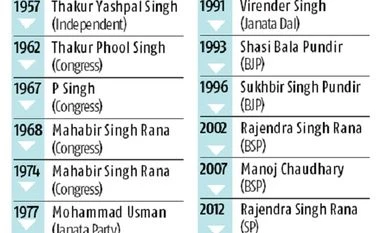
However, since 1952, Deoband has never sent a Muslim to the legislature except in 1977 and in the February 2016 by-election. “The votes get polarised on Hindu-Muslim lines,” said local businessman Pradeep Garg, who is associated with the Rashtriya Swayamsevak Sangh. “An election is an opportunity for the Hindus to collectively assert their political clout,” he added. In these elections too, BJP’s Kunwar Brijesh Singh, a Rajput, would pip the SP’s and the BSP’s Muslim candidates to the post after a possible vote division.
But in Moradabad, 162 km south of Deoband, another facet of the Muslim political narrative was at play. BJP’s pitch to end triple “talaq” by constitutional and legal means and raise the Ram temple has shaken the city’s Muslims.
Urdu scholar Murtaza Iqbal refused to be persuaded by the contention that there was a case for ending triple “talaq” and restoring to women their rights. He said he perceived the BJP’s statements as a “direct interference” in Muslim Personal Law. “Our personal law exists for reasons of faith. If our Shariat is tampered with, our identity goes,” said Iqbal.
The incipient restiveness among the community’s thinkers and opinion-moulders gave the BSP an opening to reach out to the clergy who have been out of work in the past few elections and put them back in business, hoping that they could shift at least a section of the Muslim votes towards Mayawati.
Abdul Manan Kalim, Moradabad’s chief “mufti” (religious jurist), frankly conceded that Mayawati’s Dalit base vote was “far stronger” than the SP’s core Yadav vote. “If we add our votes, her candidates are better placed to defeat the BJP,” said Kalim.
Outside the “mufti’s” office, young Nigamul Khan, who has a small shop, was clear. “We will not take dictation from the ‘qazis’ and ‘maulvis’. We know who we are voting for,” said Khan, raising cheers for Chief Minister Akhilesh Yadav, with the other boys.
While Muslims will vote tactically for the party best poised to defeat the BJP, the SP remained their first choice. Their support can potentially determine fortunes because they constitute 38 per cent of the electorate in western Uttar Pradesh’s 125 Assembly seats, whereas the state average is 18 per cent.

 "Deoband's Muslims back <i>vikas </i>over politics")











