5 min read Last Updated : Apr 05 2019 | 11:25 PM IST
The thing that is immediately striking is the absence during campaigning of real issues affecting the electorate. The single most important political subject in the United Kingdom is the National Health Service. It is funded and operated by the state and provides primary and emergency healthcare to all people in the country (not just all citizens) for free. A couple of years ago, I was in London and broke my leg and was cared for in a way that was superior to the best healthcare in India. The UK is proud of this service and rightly so. Similarly, in the US, the two policies of Medicare (the service run by their Union government that insures people mostly over 65) and Medicaid (which helps pay for health costs for those who cannot afford it) are right on top of the political agenda, whether one is Democrat or Republican.
In India, stunting from malnourishment affects a third of our children. This is not a political issue and not spoken about by Modi, Gandhi or whoever else. The quality of education provided by the state is dreadful and has resulted in half of our children being unable to read or calculate. This is not a campaign issue either.
Why is this not important? Most politicians are very aware about what works as a campaign subject and what elicits a good response. Most voters are aware of what they want the government to do and do not shy away from expressing it. But if this is so, then what explains the fact that our politics does not regard fundamental issues concerning the bulk of the population as important? It is a mystery.
The second thing that is noticeable is that there is emphasis, at least from the ruling party, on the army and militarism, though this is not an issue that concerns 28 out of the 29 Indian states. The actions of cross border terrorists affect one state only — Jammu & Kashmir. Even if we are to assume that 100 per cent of the violence there originates from Pakistan, it is still something that touches the lives of other Indians only peripherally. Given this, why is there such a focus on a couple of actions this government took in Pakistan? Does it mean that even things that do not concern us become voting issues because we have a strong emotional investment in them? Again, it is not easy to say and certainly I do not know.
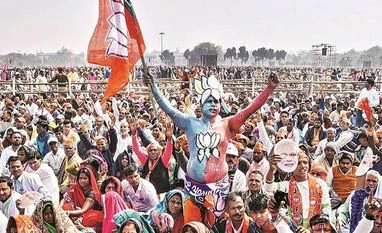
The third thing that the outsider will notice is that we are going through probably the last election where the public rally is more important than other activity. The United States got there during the first Obama election, in 2008. I think that was the first time that more individuals were reached and more minds were made up through communication over the internet than in person, or through mainstream media, such as television and newspapers. In India, the giant rally has been the means of choice for political parties to show the extent of their mobilisation. These rallies also provide the spectacle necessary for media coverage. However, they are not as efficient as communication in modern ways. The rising rate of literacy and the increasing universality of smartphones and other means of accessing the world wide web lead one to believe that 2024 will be quite different from 2019.
Photo: Reuters
That brings me to a related point. If we assume that two things, the mass rally and the reliance on mainstream media, are in decline in politics, this opens up room for non-traditional parties. One of the reasons for the reluctance of individuals to contest in India is that politics is an activity that is isolated from ordinary life and seems akin to joining a company and then working one’s way up in it. Only career politicians, often those who were landed or had other means of income, could consider doing this. It seems that this has changed and it is possible to make a name for oneself without relying on the traditional political ways.
Think of it as setting up a social media account and being able to draw large numbers of people to it because of the quality of the message. There are of course many, many such people that we know and, perhaps, even follow on the internet. I see no reason why this phenomenon cannot be extended to politics and elections, and I suspect that this will happen before 2024. Another thing that will likely happen is that there will be lobby groups that will be united on the internet and will pressure their local parties and candidates to either do or promise some things to them before they can commit their vote. I mean groups like residents’ associations and teachers’ unions and such things. The last thing that someone would find strange and unusual is how in India the losers still hang around. Politics is something that people do here for life. Obama was a senator and then president and then he finished his term and walked off, even though a relatively young man by the standards of our politics. It’s similar for Tony Blair and Gordon Brown and David Cameron and even John Major. These are all individuals who, having once lost the confidence of either the electorate or their party, left politics never to return.
In our country, you could lose election after election and still be a candidate. There is always a next time in India.