Pradip Krishen is a man of many parts. In the 1980s and 1990s, he gave us films such as
Massey Sahib, Electric Moon and
In Which Annie Gives It Those Ones, starring a then-unknown woman by the name of Arundhati Roy, who would later on become a celebrated novelist and activist (and his wife).
Later, he taught himself botany. The beautiful 70-hectare Rao Jodha Desert Rock Park surrounding Jodhpur's Mehrangarh Fort is a result of his efforts. In 2006, his
Trees of Delhi became a best-seller and a household name.
Whether as a filmmaker, a landscape architect or a botanist and environmentalist, Krishen has always striven to expand the boundaries of his own learning curve.
This year, Krishen is back with another labour of love.
Jungle Trees of Central India: A Field Guide for Tree Spotters is a product of four years of painstaking research, which as Krishen reveals, was often done in the face of stiff opposition from the forest department.
If
Trees of Delhi chronicled exotic and native tree species in the national capital territory of Delhi,
Jungle Trees… is about 165 species of native trees growing in the forests of Central India.
But 'Central India' is a rather vague term, denoting territory spread across several states of India. In his book, Krishen says: "As it panned out, my version of Central India encompasses most but not all of the state of Madhya Pradesh. It also accommodates a sliver of (northern) Maharashtra, a slice of Chhattisgarh, tiny outliers of (southern) Uttar Pradesh and a longitudinal wedge of (eastern) Rajasthan…"
The region that is the focus of Krishen's study is mostly highland, dotted with hill ranges (Vindhyas, Satpuras, Panna, Mahadeo and Kaimur), plateaus (Malwa and Gwalior) and ravines (Chambal). This topography, coupled with the geology of the region, as well as the rain it receives, has shaped the forests of Central India and the tress growing in these forests.
Krishen documents the soils of the region for us, enumerating six different types, most of them made up of rock: Deccan trap, Vindhyan, igneous or sedimentary, Gondwana, alluvium and laterite.
The geography, topography, geology and rainfall in the 480,000 sq km region that is Krishen's Central India is summed up thus: "…This is a striking aspect of Central India and its jungles: they are predominantly hill forests, adapted for the most part to growing in thin, stony soils with rapid drainage. Dry, deciduous forests. Or, to use a term I prefer, 'monsoon forests'. Exquisitely adapted and finely tuned to one big pulse of summer rain…"
Krishen documents nine different forest types in Central India: sal, teak, anjan, dhok, mixed deciduous, savannah woodland, riverine, subtropical hill and thorn.
Krishen uses a four-fold scheme for categorising trees: the texture of the bark, the colour of the flower, the form of the fruit and the shape of the leaf.
The most important cataloguing is by leaf, according to Krishen. A mammoth part of the book, some 267 pages, are under the section called the 'Tree Catalogue' (pg 86-363), which lists the trees on the basis of leaf shapes and their arrangement; first as 'simple' or 'compound' and further subdivided into 'toothed', 'untoothed' and 'lobed' or 'digitate', 'pinnate' and 'twice pinnate'.
The tree catalogue is the most important section of the book, not just for the information it gives, but also since it enhances the book's aesthetic value.
That is where the design factor comes in.
Jungle Trees… has been blessed with one of the best design layouts in any book I have seen till date. Chief designer Kadambari Mishra pulls off a coup of sorts with her team of artists.
The front and the back cover are coloured bottle green, the distinctive colour of plants. The inside flaps are parrot green in shade and have miniature silhouettes of various trees by Golak Khandual, a friend of the author. There are also maps of the region inside the book, by Anisha Heble. The book is lavishly illustrated, with a total of 2,000 photographs of trees, flowers, bark, leaves and fruit.
The forests of Central India, notes Krishen, have suffered a lot, both in colonial British India and in post-independence India. Wrong policies towards forestry adopted by colonial authorities, were continued by their successors in independent India. For instance, the British cut down large areas of forests to use their timber for sleepers in railroad tracks. Worse, they developed plantations of lucrative species like teak in the space cleared, but reduced biodiversity in the forests in the process.
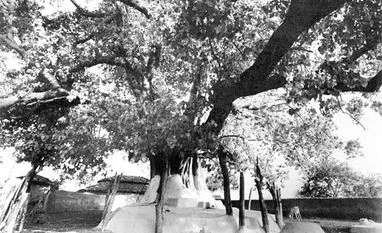
But Krishen still has hope for Central India's forests. "…If there is any hope of saving our forests, I like to believe it lies in the simple faith that make tree-shrines. When you stop finding tree-shrines, you will know that there is little hope left…"
Krishen's book is a treasure of sorts. In an age when India, especially urban India has become so apathetic towards the environment, books like
Junge Trees… remind us that there is still an India shaped by the hand of nature and not man. And that we still have time to save it from obliteration.
THE JUNGLE TREES OF CENTRAL INDIA A Field Guide for Tree Spotters Author: Pradip Krishen
Publisher: Penguin India
Pages: 400
Price: Rs 1,499

 "Green tales from the heart of India")


