Kabbadi comes to the fore again
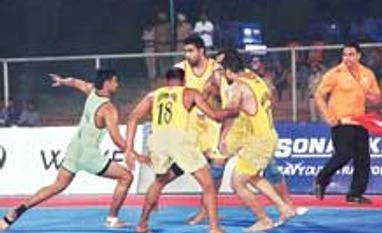
Television coverage and a bit of Bollywood has given India's ancient contact sport of kabaddi a touch of glamour, sending youngsters to parks on raiding missions
Dhruv Munjal Till about a month ago, 15-year-old Naeem Ahmed had never played kabaddi in his life. He had heard about the ancient pastime from his grandfather, but never felt enthused to try out the indigenous sport. For the last three weeks, however, Ahmed and his friends have been playing kabaddi every day at Lodhi Road's central park. As the sun sets, and the scanty floodlights take their full effect, the young boys returning from tuition classes nearby hurry to make it in time for their daily round of kabaddi. In the middle of the playing area, a string of rubber
chappals are laid out in a straight line, clearly demarcating the halfway mark of the playing court. As the game begins, Ahmed springs to the other side of the court, ready to take on four opposition defenders. He grabs a piece of an opposition player's shirt and scampers to cross the halfway line without being caught - the objective of the game. In spite of his valiant efforts, the lanky boy is out-muscled and thudded back into opposition territory.
"I love playing kabaddi," he says afterwards. Twenty minutes and three attempts later, he is successful in his first raid, wriggling his way through a slew of defenders, and earning his team an impressive two points. Ask him if he prefers kabaddi to cricket, and Ahmed replies with a coy smile. " I've been playing cricket all my life. Kabaddi is new and refreshing. It's fun to watch and even more enjoyable to play."
After the overwhelming success of the Pro Kabaddi League and, to an extent, the World Kabaddi League in the last few months, young people like Ahmed have started taking an interest in the sport. The two leagues, with daily coverages on television, along with the razzmatazz of team owners, have definitely struck a chord with people. "We felt that the sport of kabaddi had tremendous potential. Kabaddi has always been known, but it wasn't popular among the masses," says Charu Sharma, director of Pro Kabaddi League.
In its first week, Pro Kabaddi League managed to garner three times the television ratings that the FIFA World Cup got in its opening week. Pro Kabaddi League was sampled by 435 million viewers in India over its five-week run, making it the second-most viewed sporting tournament in the country after the 2014 edition of the Indian Premier League cricket, which was viewed by 552 million people. In comparison, the Hockey India League final had a viewership of 10.4 million and Wimbledon men's final, 6.1 million. "In today's age, television is the most powerful medium of entertainment," says Sharma. "Aggressive promotion, along with the quality of performances during the tournament made it such a hit." Such was the enormity of league's success that unknown players like Rakesh Kumar, Maninder Singh and Sandeep Narwal, all an integral part of the Indian national team, have now become household names.
But it's not just the viewership that has soared - youngsters are increasingly wanting to take up the sport, to the delight of the more than 5,000 kabaddi clubs in India, over 50 of them in Delhi alone. One of the most popular kabaddi clubs in the city is the Palam Sports Club. Founded in 1995, the club provides kabaddi training exclusively to girls. Several of the academy's graduates have gone on to represent India in international tournaments. Ever since the emergence of kabaddi as a mainstream sport, the club has been swamped with calls from kids seeking admission. "We get almost 50 calls every day," says Ajay Sahu, one of the coaches at the club. "Kabaddi has finally found a fan following. Everyone wants to play it." Seeing the massive upswing in the popularity of the sport, the club has decided to start a boys team at the club. Enrollment for the capital's next generation of kabaddi players is already under way.
Ludhiana-based Dashmesh Kabaddi Club has formed two new men's teams, in order to accommodate the rising number of kabaddi enthusiasts. "We generally organise two local tournaments a month. Now we plan to increase that to four," says Balwinder Singh, an organiser with the club. In Bangalore, in an effort to prolong this interest, the Jai Hanuman Kabaddi Club has decided to teach kabaddi to kids free of cost.
So what makes kabaddi so special? According to Raman Raheja, CEO of World Kabaddi league, the Indian game has the right mix of action and entertainment to make it big. "In our league, for example, the style is called circle kabaddi, which is a combination of kabaddi, wrestling and rugby. That makes for wholesome entertainment," he says. Kabaddi involves skill, speed and strategy, components that have helped it amass such an ardent fan following. Moreover, the influx of sponsors and celebrity team owners has helped the sport cement a strong foothold in the booming league-style sporting events segment. Pro Kabaddi League is owned by Anand Mahindra-led Mashal Sports and has Star Sports as title sponsors, while World Kabaddi League is sponsored by the Wave group. A whole host of Bollywood celebrities and industrialists has invested heavily in the two leagues. "We have to acknowledge the fact that glamour has played its part," says Sharma. "Celebrity team owners was one of the reasons for such massive turnouts during the tournament."
Comparing the sport's popularity with cricket may sound fatuous, but kabaddi is catching up. Cricket has always been the dominant sport in the country, simply because of the relatively big successes on the world stage and the heaps of media coverage it has received. Kabaddi cannot boast of the worldwide appeal that cricket enjoys, but don't forget, India is a five-time world champion in the sport. The 2012 kabaddi World Cup featured 16 nations, compared to the 14 that took part in the 2011 cricket World Cup, enough proof that winning a world title in kabaddi is no mean feat.
However, sustaining this high level of interest will be the biggest challenge for the sport. While World Kabaddi League is reaching its fag end, the next edition of Pro Kabaddi League is scheduled only for March-April next year. "We plan to increase the duration of the league from next year, and also start a women's league," says Sharma. A quick search on Google for the names of players who represent the Indian national kabaddi team, and you may still end up drawing a blank. But, the Rakesh Kumars and Sandeep Narwals of this world have made their mark. For now, Indians can revel in the new-found popularity of an indigenous sport.

 "Kabbadi comes to the fore again")


 Connect with us on WhatsApp