5 min read Last Updated : Feb 03 2021 | 7:19 AM IST
Gruyere, Gouda, Parmesan, Cheddar. Pronouncing the names is a tongue twister so now they have their own "pet names" for each one. Each has a distinctly odd smell and all the four women scrunch up their noses as they try to describe these somehow. And to say, the final product they are creating and packaging tastes "peculiar" is putting it mildly: they've never tasted anything even remotely similar or as "ajeeb" before.
For Hira, Deepa, Hansi and Neema, four young local hill women who have learnt the art of cheese making and are employed for the first time in their lives, the Old Hills Cheese Company is almost like an alien coming and settling down in their midst at 7000 feet in Mukteshwar, one that they are still trying to come to terms with. But for all their suspicion and wariness, two of the four have developed a taste and now love the end product.
Nitin Dayalu was one of the numerous, unhappy bankers eking out a living, based out of Gurugram and growing increasingly disenchanted with city living. Dayalu had studied hotel management and always wanted to do something in the food space but life had taken him in another direction.
In 2012, at age 32, he decided to call it a day, quit his job and travelled in East Africa, Nepal and India, back-packing for two years before he reached Auroville where he stayed a few months and learnt how to make cheese. He enjoyed the experience thoroughly and decided to take a deeper dive. To up his game and to learn the Dutch way of cheese making, he went to the Netherlands – known for its Gouda and Edam - and spent a few months honing his skills, learning to make cheese the traditional way without mechanization.
After his return to India, Dayalu started looking for places where he could set up a similar production unit to the one where he'd learnt the skill. He knew he needed high quality milk and some basic infrastructure. He decided to keep it simple, go traditional, avoiding mechanization as far as possible.
Nitin Dayalu
After some exploring, he decided that the Kumaon hills could work for his new enterprise. The inputs required – high quality milk in large quantities – could be found here. Moreover, he could offer a new livelihood opportunity to the women in the region while escaping the chaos of city life.
In 2014, Dayalu took over a small space from the local NGO Chirag in the region and started his venture. In the initial days, curious villagers would come to ask what he was attempting to make. When he'd answer "cheese", they would look at him quizzically and say "of course, we know that but kaun si cheez".
Within a few months of starting the venture, he faced a host of seemingly insurmountable and unforeseen problems. For a variety of reasons, his venture failed to take off and by December 2014, he shut shop, losing his entire investment
Dayalu was disheartened but a friend who also relocated to the area decided to join hands (both invested) and they restarted in 2018 by leasing a new space. The unit now produces 350 kilograms of cheese a month – currently on a go-slow due to the pandemic. There is a special range of exotic spring cheese that uses all kinds of local flowers and herbs available in the area during season. Demand for the product is high and Dayalu estimates that even with his existing unit, he could produce almost six times the quantity. But after his first experience, he's treading carefully.
Before a hard push on the marketing end, he's trying to ensure he has sufficient high quality milk and other inputs. Old Hills is currently supplying cheese mainly to outlets in Delhi and Dehradun through a complex distribution chain. Dayalu says he will get into discussions to supply to big chains and hotels once he is certain he can deliver the large quantities they need although he's likely to keep the operation small and sustainable. One of his big drivers for growth is the fact that he can employ women in the area and provide them with livelihoods, otherwise non-existent.
He's also looking to sort out the financial challenges since investments precede returns typically as cheese is "aged" for many months before being ready to be sold in the market. "Operating from the mountains has all kinds of other challenges" explains Dayalu, who once bitten, twice shy and prefers to tread slowly but surely.
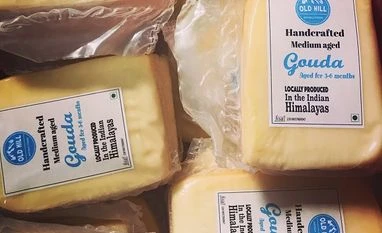
For many in India's cities who are familiar with and love cheese – including this writer who first came across the Old Hills cheese at the Sundar nursery organic market in Delhi and then tracked them down - the fact that Old Hills cheese is actually produced in the Kumaon hills and comparable with the best is hard to swallow.
Finding this little gem has been also a delight for those for whom cheese has been part and parcel of their daily cuisine. "What Old Hills is managing to produce from an Indian mountaintop is comparable with what is available internationally but at a fraction of the cost", says Asha Vreeswijk D'Souza, a Goan born Kumaon resident with a Dutch husband, who lived a better part of her life in Switzerland and knows her cheese.