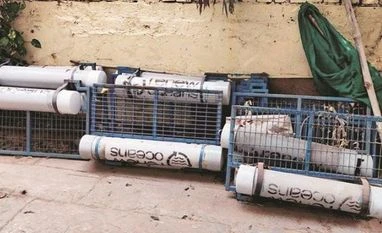
A wheelbarrow and a handful of metal grids for capturing litter, emblazoned with the words “Renew Oceans,” sit rusting outside an empty, padlocked office in the Indian city of Varanasi, a short walk from the Ganges.
It is all that is left of a programme, funded by some of the world’s biggest oil and chemical companies, that they said could solve a runaway ocean plastic waste crisis which is killing marine life — from plankton to whales — and clogging tropical beaches and coral reefs.
The closure of Renew Oceans, which has not previously been reported, is a sign that an industry whose financial future is tied to the growth of plastic production is falling short of its targets to curb the resulting increase in waste, according to two environmental groups.
The Alliance to End Plastic Waste, a Singapore-based non-profit group set up two years ago by big oil and chemical firms, said on its website in November 2019 that its partnership with Renew Oceans would be expanded to the world’s most-polluted rivers and “ultimately could stop the flow of plastic into the planet’s ocean.”
Exxon Mobil, Royal Dutch Shell, Dow, Chevron Phillips Chemical, and about 50 other firms committed to spend $1.5 billion over five years on the Alliance and its projects. The Alliance has not said publicly how much money it has raised or what it has spent overall.
The Alliance confirmed to Reuters that Renew Oceans had stopped operating, partly due to the new coronavirus, which had halted some work. “Without any foreseeable time frame for restarting, combined with other implementation challenges, the Alliance and Renew Oceans jointly decided to a mutual termination agreement in October 2020,” Alliance spokeswoman Jessica Lee said.
Anne Rosenthal, counsel at US law firm Hurwit & Associates, representing Renew Oceans, said it expects the project to fold. “While it has made progress in tackling the problem of plastic waste, the organisation has come to the conclusion that it simply does not have the capacity to work at the scale this problem deserves,” she said.
The Alliance, with a staff of about 50, mostly based in Singapore, has other projects in the pipeline, but they are small, community-based endeavours or have not yet come to fruition. “It is important to note that the full impact of projects will be realised when their operations are at full scale,” said Lee.
Renew Oceans published targets on its website to collect 45 tonnes of plastic trash from the Ganges in 2019 and 450 tonnes in 2020. Neither the Alliance nor Renew Oceans has published any information on their progress in reaching those targets.
Four people involved in the project said it collected less than one tonne of waste from the Ganges before it closed in March last year after less than six months in operation. The Alliance and Renew Oceans declined comment on the amount of waste the project collected. Scientists estimate over half a million tonnes of trash enters the Ganges every year. There is no government data on how much of that is collected.
Read this article for free
Register to continue reading premium journalism and analysis from Business Standard.

 "Big oil's flagship plastic waste project sinks in the Ganges: Report")












 Connect with us on WhatsApp