India lags in fight against trans fats in packaged food
Consumer activists say a few years ago, the food regulator had prescribed norms for trans fats in vegetable oils, but these weren't notified
Viveat Susan Pinto Mumbai A proposal by the US Food and Drug Administration to ban trans fats in processed food has put the spotlight on this food category.
A number of countries in Europe such as Switzerland and Denmark have similar strictures in place. However, India is far behind in the fight against trans fats in packaged food, considered bad for the heart.
Chandra Bhushan, deputy director general, Centre for Science and Environment (CSE), said India had no regulation related to trans fats in packaged food. “Instead, there are mere labelling requirements,” he says. “In packaged food products where the amount of trans fat is less than 0.2 gm per serving, manufacturers are allowed to label it as trans fat-free. For products in which trans fat exceeds 0.2 gm a serving, the manufacturer has to disclose it contains trans fats. This is hardly enough.”
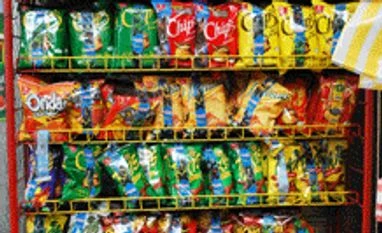
Worse, he says, most manufacturers take advantage of the lax labelling rules to reduce the serving size, ensuring the amount of trans fats is less than the permissible limit. “We have seen packs of Haldiram’s Aloo Bhujia that say these weigh only 10 gm. Who consumes 10 gm of Aloo Bhujia? Obviously, a consumer eats more. Some Lays packs (from PepsiCo) say these weigh 14 gm, which is equivalent to five chips. Do you eat five chips? I don’t think so,” Bhushan says.
Dillip Kumar Samantaray, chief executive of Food Safety and Standards Authority of India (FSSAI), wasn’t immediately available for comment.
Consumer activists say a few years ago, the food safety regulator had prescribed norms for trans fats in vegetable oils, but these weren’t notified.
The World Health Organization recommends in a balanced diet, trans fats account for one per cent of total energy. An adult male can have 2.6 gm of trans fats a day, an adult female 2.1 gm and a child of 10-12 years 2.3 gm. Daily consumption of salt by an individual should be limited to five-six gm.
Last year, CSE had released a study analysing specific fast-food and snack brands. It said these contained dangerous levels of trans fats and salt.
The study showed a Happy Meal at McDonald’s could provide 90 per cent of a child’s trans fat requirement for a day, implying the level of trans fat in these products was high. This was also true for KFC’s Fried Chicken and other such snacks analysed by CSE. McDonald’s, Yum (which controls KFC) and other packaged food manufacturers whose products were analysed by CSE denied there were high levels of trans fats in their products. They said their products were compliant with FSSAI regulations.

 "India lags in fight against trans fats in packaged food")


