Mangroves as carbon sink: India joins five-nation alliance at COP27

India is among the first five countries to join the MAC, at the 27th session of the Conference of the Parties (COP27) at Sharm el-Sheikh in Egypt
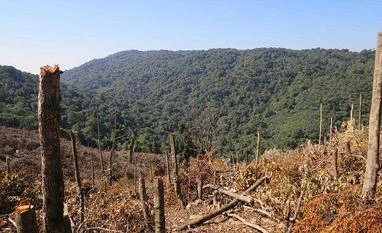
Nokrek deforestation
Due to the large amount of carbon stored in mangroves, it is crucial to conserve the current areas in order to prevent future potential CO2 emissions | Representative Image
Nitin Kumar New Delhi
3 min read Last Updated : Nov 08 2022 | 10:27 PM IST
Calling for integration of mangroves conservation with the Reducing Emissions from Deforestation and Forest Degradation (REDD+) programmes for carbon sequestering, India on Tuesday joined the Mangrove Alliance for Climate (MAC). 

India is among the first five countries to join the MAC, at the 27th session of the Conference of the Parties (COP27) at Sharm el-Sheikh in Egypt. The others are Australia, Japan, Spain, and Sri Lanka.

The move is in line with India's Nationally Determined Contributions (NDCs) to create an additional carbon sink of 2.5- 3 billion tonnes of carbon dioxide (CO2) equivalent, through additional forest and tree cover by 2030.

Dubbing mangrove forests the most productive ecosystems of the world at the launch of the MAC, Union Minister for Environment Forest and Climate Change Bhupender Yadav said: “This tidal forest serves as a nursery ground for several organisms, protects coastal erosion, sequesters carbon, and provides the livelihood for millions of people, besides it harbours an array of faunal elements in its habitat.”  

Highlighting that mangrove forests can absorb four-five times more carbon emissions than landed tropical forests, the minister said that creating new carbon sinks from mangrove afforestation and reducing emissions from mangrove deforestation are two feasible ways for countries to meet their NDC targets and achieve carbon neutrality.

Mangroves can also act as a buffer for ocean acidification and act as a sink for microplastics.

Giving a clarion call for joining hands to protect “one of the most precious assets of tropical coasts”, Yadav said: “India can contribute to the global knowledge base due to its extensive experience in mangrove restoration, studies on ecosystem valuation, and carbon sequestration.”

He further said the partnership would also benefit from associating with other nations regarding cutting-edge solutions and generating appropriate financial instruments for mangroves conservation and restoration.

“To sustain the blue economy, it is imperative to ensure the sustainability of coastal habitats, particularly mangroves for tropical nations, at the local, regional, and international levels,” Yadav said.

Mangroves are distributed in tropical and subtropical regions and are found in 123 countries.

According to the State of the World's Mangroves report 2022, from 2010 to 2020, the human-driven loss represents 62 per cent of total losses of over 600 square kilometres or 60,000 hectares.  

Global mangrove extent in 2020 was 147,359 km2. South Asia comprises 6.4 per cent of the global mangroves cover. India accounts for over 50 per cent of total mangrove cover in South Asia.

The most extensive area of mangroves is found in Southeast Asia, with Indonesia alone comprising a fifth of global total. Together, Indonesia, Brazil, Australia, Mexico, and Nigeria host almost half the world’s mangroves, according to the State of the World's Mangroves report.

At a planetary scale, mangroves are ahead of the curve. Some 42 per cent (61,287 km2) of all the world’s remaining mangroves fall within protected areas recognised by the IUCN.

Due to a large amount of carbon stored in mangroves, it is crucial to conserve the current areas in order to prevent potential CO2 emissions.

According to the Forest Survey report 2021 released in January, mangroves cover in the country is 4,992 km2, which is 0.15 per cent of the country’s total geographical area. An increase of 17 km2 in mangroves cover has been observed as compared to the previous assessment of 2019.

The top three states showing an increase in mangroves cover are Odisha (8 km2), Maharashtra (4 km2), and Karnataka (3 km2).


One subscription. Two world-class reads.

Already subscribed? Log in

Subscribe to read the full story →
*Subscribe to Business Standard digital and get complimentary access to The New York Times

Smart Quarterly

₹900

3 Months

₹300/Month

SAVE 25%

Smart Essential

₹2,700

1 Year

₹225/Month

SAVE 46%
*Complimentary New York Times access for the 2nd year will be given after 12 months

Super Saver

₹3,900

2 Years

₹162/Month

Subscribe

Renews automatically, cancel anytime

Here’s what’s included in our digital subscription plans

Exclusive premium stories online

  • Over 30 premium stories daily, handpicked by our editors

Complimentary Access to The New York Times

  • News, Games, Cooking, Audio, Wirecutter & The Athletic

Business Standard Epaper

  • Digital replica of our daily newspaper — with options to read, save, and share

Curated Newsletters

  • Insights on markets, finance, politics, tech, and more delivered to your inbox

Market Analysis & Investment Insights

  • In-depth market analysis & insights with access to The Smart Investor

Archives

  • Repository of articles and publications dating back to 1997

Ad-free Reading

  • Uninterrupted reading experience with no advertisements

Seamless Access Across All Devices

  • Access Business Standard across devices — mobile, tablet, or PC, via web or app

Topics :Climate ChangeCOP27EgyptUN climate summitDeforestationCarbon emissionsclimate planclimateclimate summitCarbon dioxideEmissions

Next Story



