The ruling BJP’s defeat in Madhya Pradesh, Rajasthan, and Chhattisgarh has revived the question of rural distress.
Though the jury is out as to how far and by how much farmers’ discontent contributed to the below par performance of the party in the three states, most experts and economists warn attempting any short-term, hasty solution to problems of India’s agriculture sector could do more harm than good.
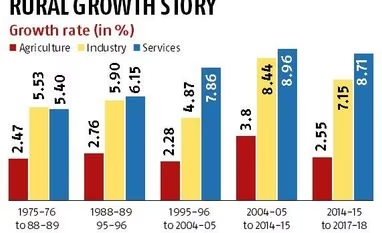
India’s farm sector growth between 2014-15 and 2017-18 averaged just 2.55 per cent, much lower than the average 3.8 per cent growth in the 10 years of the UPA government between 2004-05 and 2014-15.
The first two years of the NDA government, 2014 and 2015, were drought years, which pulled down output.
Though farm growth recovered subsequently due to good monsoons, it wasn’t enough to pull the sector out of the mess as strong output growth wasn’t matched by rise in domestic and export demand on account of slowing overall economic growth and demonetisation.
As a result, India, after a few years of shortages, faced a situation of surplus in the short term, which pulled down crop prices and subsequently impacted rural incomes.
Between 2008-09 and 2012-13, real agriculture wages of ploughing, weeding and harvesting grew 6.90 per cent, while during the subsequent period of 2013-14 to 2016-17, they rose by just 1 per cent.
Farm gate prices of most commodities, be it oilseeds, pulses or milk, have been 5-10 per cent lower than the minimum support prices (MSP).
The Centre’s response to shoring up procurement and announcing high MSPs, which was 50 per cent more than A2+FL cost of production, found little traction among growers as it was grossly inadequate and also not timely.
In 2018-19, report show that against the target of procuring 3.3 million tonnes of pulses and oilseeds under the much-talked about PM-ASHAA scheme, just around 0.4 million tonnes have been purchased. And, even if there is procurement, it isn’t done timely.
“To me there are lot of reasons for farmers’ unhappiness with the current government and a big one is that the MSP announcements haven’t been backed up by strong procurement mechanisms which coupled with relentless falling farm prices has made the entire concept of doubling income unfeasible,” Sukhpal Singh, Professor at the Centre for Management in Agriculture (CMA), IIM, Ahmedabad said.
He said distress in rural areas looks very real and the MSP-based procurement system and government efforts doesn’t seem to be making a big impact.
“It is implementation on ground of the schemes which is lacking though programmes like PM-ASHAA in itself is good,” said Mahendra Dev, Director of Indira Gandhi Institute of Development Research.
Äshok Dalwai, additional secretary in the ministry of agriculture, said the speed at which states should make the intervention isn’t always there for which infrastructure of storage, procurement and transportation needs to improved.
One big solution which is being increasingly talked about is farm loan waiver which the Congress has promised in three states of MP, Rajasthan and Chhattisgarh, but here too most experts feel that it isn’t a long-term solution to problem.
Also, experience shows most waivers unless implemented properly does not percolate down to small and marginal farmers who have sizeable indebtedness.
“One-time loan waivers should be confined to small and marginal farmers as then they become eligible for fresh loan from banks,” Singh said.
Experts said a way out could be a uniform basic income sort of solution in the short-term something which Telengana tried with its ‘Ryuthu Bandhu’s scheme and which many are attributing as one big reason for its re-election in the state polls.
However, unless state finances are sound enough and the interest of tenant farmers are protected, attempting anything on the lines of ‘Ryuthu Bandhu’ could be counter-productive.
“This is the least market distorting scheme as the benefit is transferred directly into the bank account of farmers, but the fact remains that tenant farmers aren’t benefitting from the scheme, but the problem is identifying tenant farmers in itself is difficult,” said Shiraz Hussain, former agriculture secretary.
He said current problems to agriculture don’t have any quick fix solution and any attempt at adopting a short-term way could further push the sector into a greater mess.